
Mr and Mrs Quiz
How the Scales are Structured
Who Usually Takes This Test?
See How You Compare
Below is a preview of how scores are typically distributed across each scale.
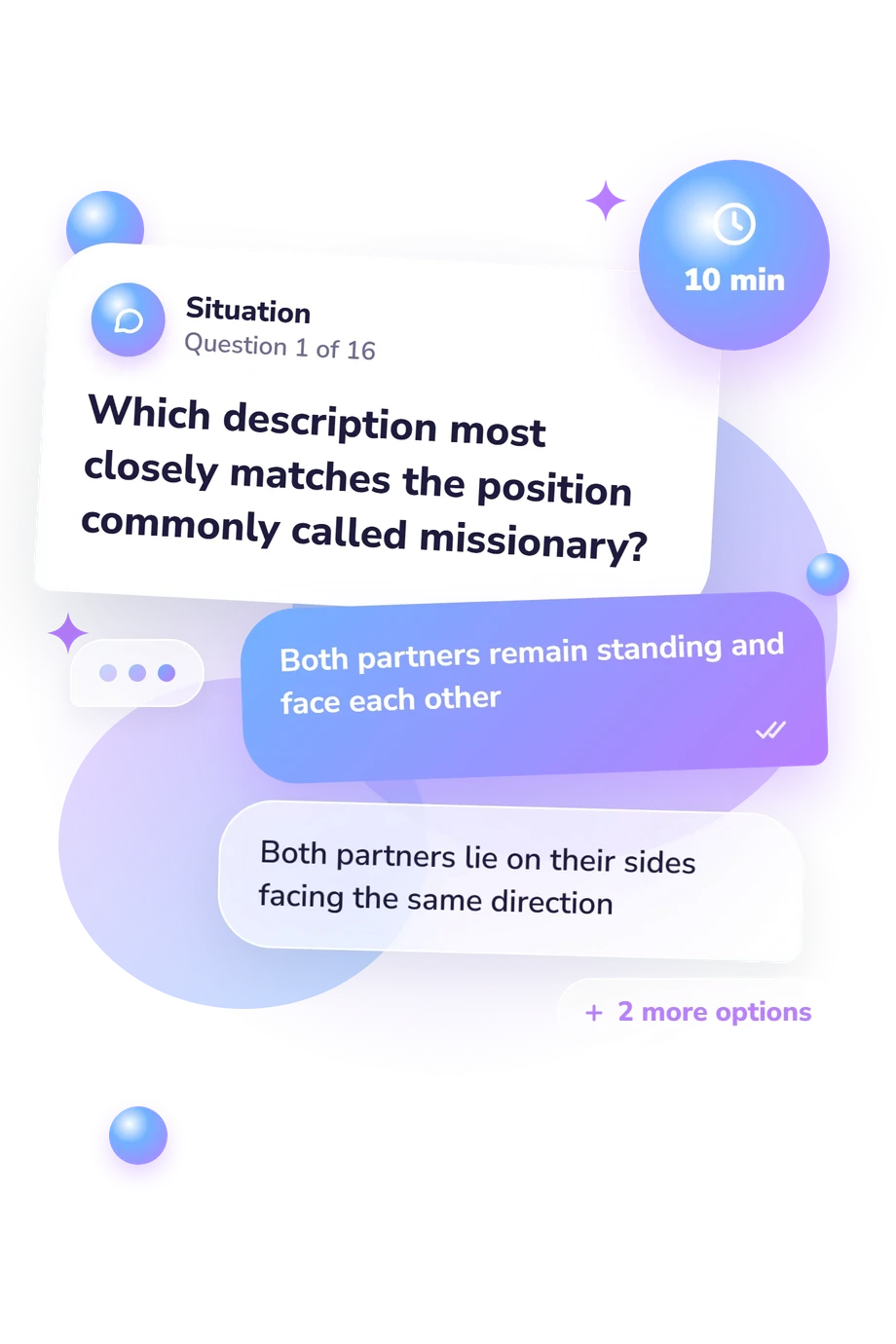
Example Questions From the Test
- Both partners remain standing and face each other
- Both partners lie on their sides facing the same direction
- The receiving partner sits or kneels on top while facing away
- One partner lies on their back while the other partner is above them, usually face-to-face
- Both partners stand face-to-face with one leg raised
- One partner lies face-down while the other kneels behind
- Partners sit face-to-face, usually with one seated in the other's lap
- Both partners lie on their sides facing opposite directions
- Being on top and setting the movement themselves
- Lying underneath with both legs held up
- Standing while being supported by the other partner
- Lying face-down while the other partner controls movement
Mr and Mrs Quiz - Description and methodology of the test
For readers deciding whether this mr and mrs quiz fits their goals, the assessment checks sexual-position knowledge and the judgment that supports comfortable, safer activity. It is designed around recognition and practical choices rather than personal disclosure. People taking the quiz online for Mr and Mrs can refresh terminology, consider consent and adaptations, and identify topics to discuss with a partner. The result highlights knowledge areas, not experience or performance.
What This Assessment Explores
The questionnaire checks recognition of sexual-position terms and judgment about consent, comfort, support, and safer choices. Examples include missionary, lotus, spooning, cowgirl, reverse cowgirl, coital alignment, side-lying positions, lubrication, barriers, balance, and control. They ask what positions mean, how they can be adapted, and how to respond when willingness or comfort changes.
A playful setting can suit a hen-party quiz for Mr and Mrs, but the result concerns knowledge rather than experience. The result areas are:
- Position terminology shows whether named arrangements and orientations are recognized.
- Consent and comfort show whether changes in willingness, pain, pace, and control are noticed.
- Safer practices show whether lubrication, barriers, STI risk, and positional limits are understood.
Sexual Position Knowledge (0-16) counts correct answers: Foundations (0-6), Developing knowledge (7-12), and Strong knowledge (13-16) mark progressively broader understanding.
Methodology and Scientific Basis
Each item offers one best answer from four options. Some of its questions about Mr and Mrs identify a position’s usual arrangement, while others ask about consent, comfort, support, lubrication, barriers, or safer choices. This combines factual recognition with applied judgment.
The displayed total is the number of correct answers, with no weighting or clinical cutoff stated. A playful Mr & Mrs quiz format therefore tests knowledge of the topics, not experience. The result is educational rather than medical advice or a measure of sexual skill.
Conceptually, the content is consistent with Sex Knowledge and Attitude Test (Miller & Lief, 1979), a precedent for sexuality-related knowledge assessment. It also overlaps with the knowledge-measurement approach described by Sanz-Martos et al. (2019), while the consent scenarios align with themes examined by Humphreys and Brousseau (2010). This questionnaire is not an adaptation, validation, or standardized administration of those instruments.
As a self-report tool, performance can reflect attention, honesty, prior learning, self-awareness, and current context. Results can identify topics for reflection or partner discussion, but they cannot predict communication or choices in every situation.
- William R. Miller and Harold I. Lief. 1979. The Sex Knowledge and Attitude Test (SKAT). Journal of Sex & Marital Therapy, 5(3), 282-287. 10.1080/00926237908403733
- Sebastian Sanz-Martos, Isabel M. Lopez-Medina, Cristina Alvarez-Garcia, and Carmen Alvarez-Nieto. 2019. Sexuality and contraceptive knowledge in university students: instrument development and psychometric analysis using item response theory. Reproductive Health, 16, 127. 10.1186/s12978-019-0791-9
- Terry P. Humphreys and Melanie M. Brousseau. 2010. The Sexual Consent Scale-Revised: Development, Reliability, and Preliminary Validity. Journal of Sex Research, 47(5), 420-428. 10.1080/00224490903151358
Updated: