
Mitosis Quiz
How the Scales are Structured
Who Usually Takes This Test?
See How You Compare
Below is a preview of how scores are typically distributed across each scale.
Example Questions From the Test
- The cell is prevented from progressing normally into anaphase
- DNA replication begins again during metaphase
- The cell completes anaphase without moving its chromosomes
- A cell plate forms before the chromosomes align
- Prophase, metaphase, anaphase, telophase
- Metaphase, prophase, telophase, anaphase
- Prophase, anaphase, metaphase, telophase
- Anaphase, telophase, prophase, metaphase
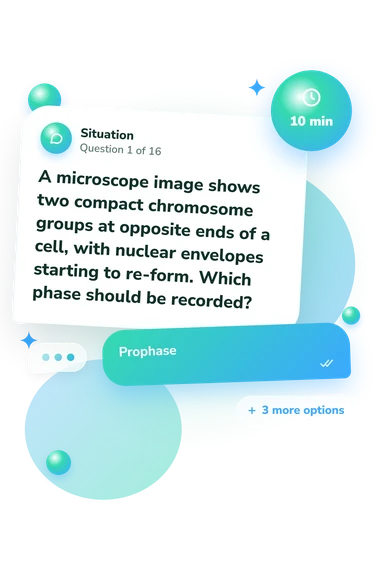
- Interphase
- Prophase
- Metaphase
- Telophase
Mitosis Quiz - Description and methodology of the test
Students reviewing cell division, and readers who want to check whether the sequence of events is clear, can use this mitosis quiz as a focused knowledge check. It connects chromosome behavior with cell-cycle control and cytokinesis, helping a learner decide which concepts deserve another look before a lesson, laboratory exercise, or exam. The format also works as a mitosis practice quiz because each answer requires selecting the best biological explanation.
What This Assessment Measures
Rather than measuring general biology achievement, the assessment concentrates on how mitosis proceeds and what its outcomes mean in typical body cells. It examines four connected areas:
- Phase recognition shows whether observations can be matched to prophase, metaphase, anaphase, telophase, or related cell-cycle stages.
- Chromosome behavior captures understanding of alignment, spindle attachment, condensation, and sister-chromatid movement.
- Division outcomes indicate whether the respondent understands chromosome-number continuity and the production of daughter nuclei.
- Cytokinesis links nuclear division with cleavage furrows in animal cells and cell plates in plant cells.
For a learner using a mitosis phases quiz to revise, the Mitosis Knowledge scale runs from 0-16: Foundations to build (0-6), Developing knowledge (7-12), and Strong knowledge (13-16). The result points to conceptual strengths and gaps, not personality, motivation, or laboratory skill.
Methodology and Evidence Base
Each item presents a direct biology question or a short cell scenario with four answer choices. The respondent identifies a phase, mechanism, consequence, or comparison, so the format tests recognition and application. Themes include phase order, microscope observations, spindle and cohesin function, chromosome-number outcomes, and cytokinesis. A quiz on the cell cycle and mitosis rewards careful reading because distractors may describe another stage.
The questionnaire reports one overall result and does not state a separate weighting scheme; readers should interpret the supplied bands rather than infer point values. McIntosh (2016) is the closest conceptual reference for mitotic stages and chromosome behavior. Barr and Gruneberg (2007) addresses cytokinesis, while Uhlmann, Lottspeich, and Nasmyth (1999) explains cohesin cleavage at anaphase onset. These questions are conceptually consistent with those works, not a standardized adaptation of any one.
Phase-order items also work as a quiz about the stages of mitosis. No published norms or reliability estimates accompany this online questionnaire, and self-selected answers can reflect current study context. Use the result as a targeted learning signal.
- McIntosh, J. Richard. (2016). Mitosis. Cold Spring Harbor Perspectives in Biology, 8(9), a023218. 10.1101/cshperspect.a023218
- Barr, Francis A., and Ulrike Gruneberg. (2007). Cytokinesis: Placing and Making the Final Cut. Cell, 131(5), 847-860. 10.1016/j.cell.2007.11.011
- Uhlmann, Frank, Friedrich Lottspeich, and Kim Nasmyth. (1999). Sister-chromatid separation at anaphase onset is promoted by cleavage of the cohesin subunit Scc1. Nature, 400(6739), 37-42. 10.1038/21831