
Men's Cologne Quiz
How the Scales are Structured
Who Usually Takes This Test?
See How You Compare
Below is a preview of how scores are typically distributed across each scale.
Example Questions From the Test
- Use the same amount but choose a sweeter fragrance
- Apply fewer sprays and reassess in the work setting
- Apply it only to clothing so it projects farther
- Add another fragrance to soften the original scent
- Apply an unscented moisturizer before the fragrance
- Rub the application area vigorously until it feels warm
- Store the bottle in a steamy bathroom before applying it
- Dilute the fragrance with water inside its bottle
- Smell all four blotters together after spraying them
- Fold the blotters so the wet areas touch each other
- Choose whichever fragrance produces the strongest first spray
- Label each blotter and revisit it at intervals
Men's Cologne Quiz - Description and methodology of the test
People who want to understand fragrance labels, scent development, and everyday wearing choices can use this assessment to check practical knowledge rather than personal taste. The Mens Cologne Quiz is suited to curious beginners and enthusiasts who want a clearer picture of what they already recognize. Readers approaching it as a men's fragrance quiz can use the result to decide which fragrance concepts to revisit.
What This Assessment Explores
Practical knowledge is the focus: the questions connect scent structure with choosing, testing, wearing, and storing cologne. This men's cologne test examines fragrance reasoning, not personal taste.
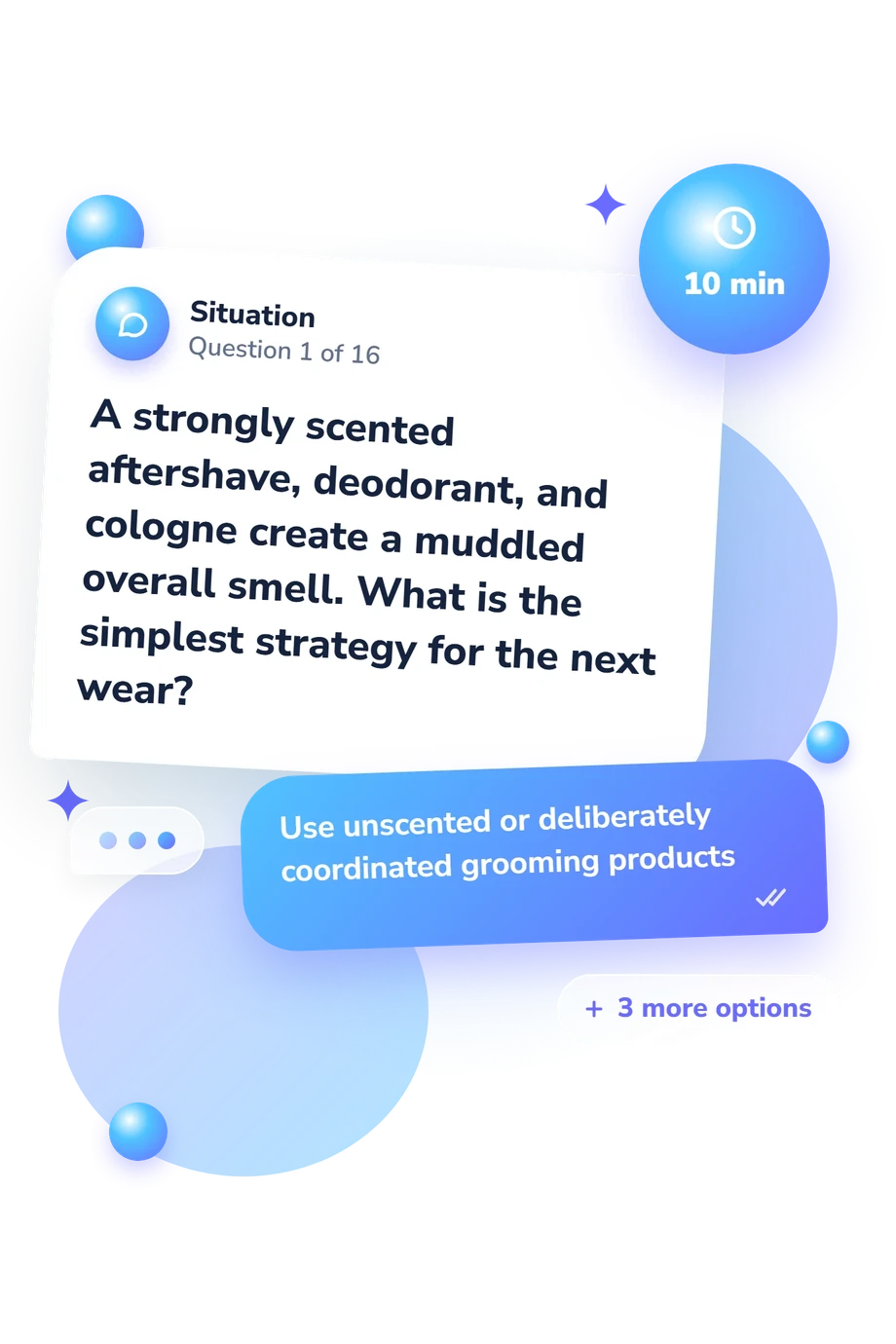
The items cover note development, projection, longevity, olfactory adaptation, skin effects, storage, concentration labels, flankers, blotter testing, grooming-product coordination, and considerate application. Together, these situations show whether a respondent can apply basic fragrance concepts to everyday decisions.
The displayed result uses the Men's Cologne Knowledge scale (0-16) and three bands:
- Fragrance Foundations (0-6) shows emerging basics and points to notes, testing, and storage for further study.
- Developing Nose (7-12) indicates useful working knowledge with terminology and evaluation habits to refine.
- Cologne Connoisseur (13-16) reflects strong practical understanding of structure, performance, selection, and use.
Brand formulas, surroundings, skin, and perception can change experience, so the result describes knowledge, not taste.
Methodology and Scientific Basis
Each item presents a fragrance situation or concept with several answer choices. The respondent selects the most accurate explanation or practical response, covering evaporation, concentration labels, skin and blotter testing, sensory breaks, storage, and application. This format tests recognition and judgment rather than liking.
The questionnaire is a cologne knowledge test that uses a straightforward knowledge-check method: the score is the number of correct answers, while the displayed band describes practical understanding. The result is a snapshot of current fragrance knowledge.
Its conceptual basis is consistent with Behan's study of skin-related changes in perfume and Teixeira's work on diffusion and odor performance. Sell's edited chemistry text supports composition and consumer terminology, while Dalton's work on olfactory adaptation supports the account of sensory adjustment. The questions are conceptually consistent with these sources, while the online questionnaire remains a separate knowledge check.
The bands summarize current fragrance knowledge; they do not measure personal taste or predict performance on every wearer. Skin chemistry, formula, and environment affect wearing experience, but they are not measured by the score.
- Behan, John M., A. P. Macmaster, Keith D. Perring, and K. M. Tuck. "Insight into how skin changes perfume." International Journal of Cosmetic Science, 18(5), 237-246, 1996. 10.1111/j.1467-2494.1996.tb00154.x
- Teixeira, Miguel A., Oscar Rodríguez, Vera G. Mata, and Alírio E. Rodrigues. "The diffusion of perfume mixtures and the odor performance." Chemical Engineering Science, 64(11), 2570-2589, 2009. 10.1016/j.ces.2009.01.064
- Sell, Charles, ed. The Chemistry of Fragrances: From Perfumer to Consumer. 2nd ed. Cambridge, UK: Royal Society of Chemistry, 2006. ISBN 9780854048243
- Dalton, Pamela. "Psychophysical and behavioral characteristics of olfactory adaptation." Chemical Senses, 25(4), 487-492, 2000. 10.1093/chemse/25.4.487
Updated: