
Main Idea Quiz
How the Scales are Structured
Who Usually Takes This Test?
See How You Compare
Below is a preview of how scores are typically distributed across each scale.
Example Questions From the Test
- Walking is the fastest way to travel through every community.
- Choosing to walk can benefit personal health and the environment.
- People should walk only when they are unable to drive.
- Fuel use is the main cause of all personal health problems.
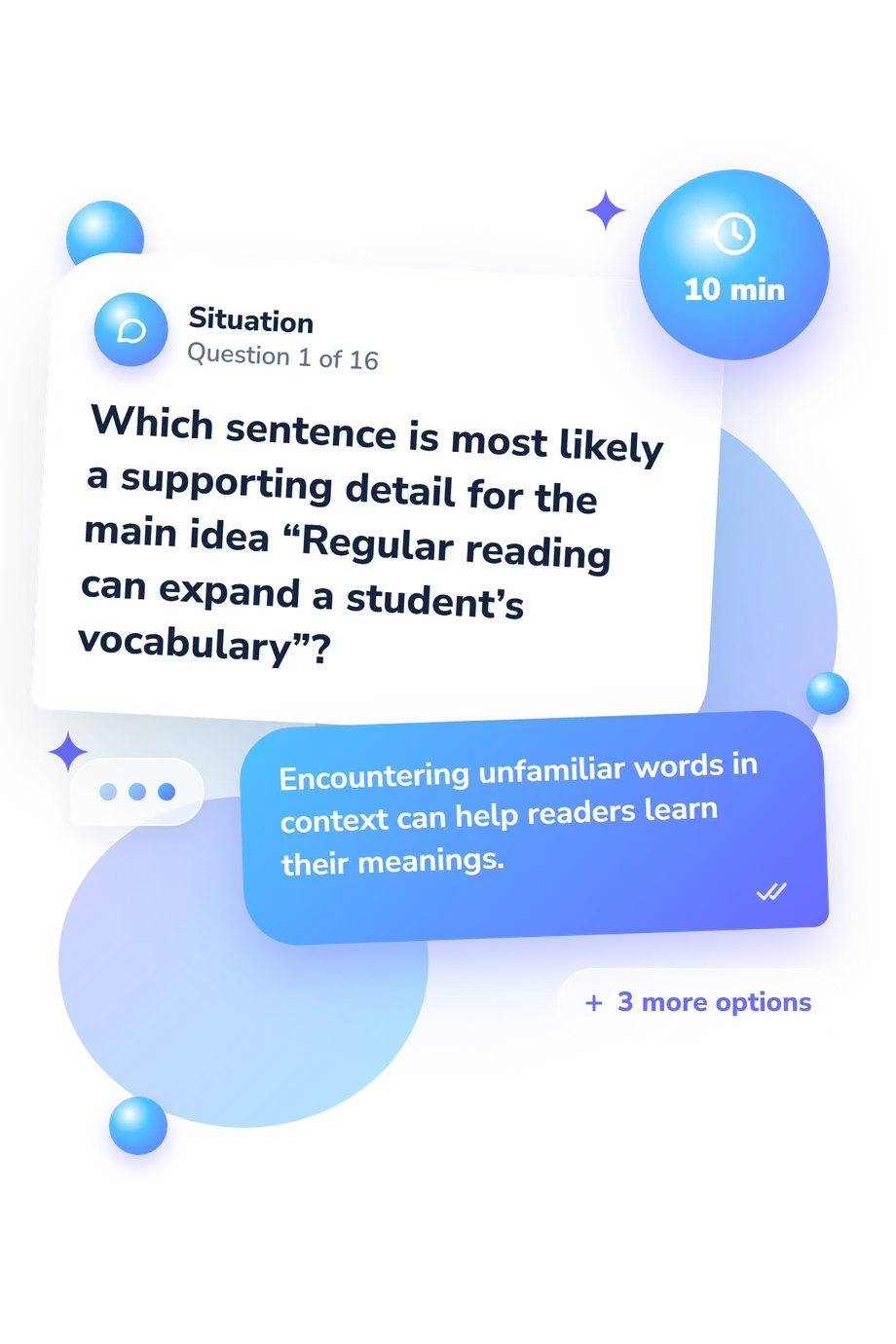
- Encountering unfamiliar words in context can help readers learn their meanings.
- Reading has been part of human culture for centuries.
- Vocabulary consists of the words a person knows and uses.
- Some students prefer mysteries, while others choose biographies.
- The most surprising fact included by the author
- The general subject named in one or two words
- The central point that the passage develops or communicates
- The final sentence, regardless of its role
Main Idea Quiz - Description and methodology of the test
For readers who want to strengthen reading comprehension, the main idea quiz provides a focused way to examine how they identify a passage’s central message. An online quiz on main ideas can help learners, parents, and educators see whether difficulty comes from choosing a topic, overlooking evidence, or missing an implied point. The result offers a practical starting point for targeted reading practice.
What This Assessment Explores
Short passages and notices ask the respondent to choose the statement that best represents the information as a whole. The items distinguish a topic from a developed main idea, test scope, and require attention to relationships among claims, examples, and explanations.
Taken together, these tasks form a quiz on main ideas and details: they test whether the reader combines evidence rather than choosing one noticeable sentence.
The result covers three skills:
- Central-point selection shows how accurately you identify a passage’s developed message.
- Scope control indicates whether you avoid treating one detail as the whole point or accepting an unsupported claim.
- Inference reflects how well you combine explicit information into a concise understanding.
Main Idea Knowledge ranges from 0 to 16: Foundation (0-6) reflects difficulty separating central ideas from details; Developing (7-12) shows general success with implied ideas; Strong (13-16) indicates accurate separation across passages.
Methodology and Scientific Basis
Each item presents a short passage, notice, paragraph, or definition followed by four answer choices. The respondent selects the option that best captures the central meaning. Distractors may represent a supporting detail, an overly narrow claim, an unsupported generalization, or confusion between topic and main idea. The displayed total is the number of correct answers, and no separate weighting rule is stated.
The questionnaire is conceptually consistent with Wijekumar et al. (2020), which connects gist construction with reading comprehension and emphasizes identifying what matters most in a text. The 2009 NAEP reading framework and Snow’s 2002 account of comprehension also support attention to central meaning, text evidence, reader processes, and inference.
Used as a quiz with answers about main ideas, it offers a focused skills snapshot rather than a broad reading profile. The bands are descriptive categories, not national norms or a reported standardization sample. As a quiz for high school students on main ideas, it supports practice, but honest responses and current context affect performance; the score cannot capture vocabulary, fluency, or comprehension in longer texts.
- Wijekumar, Kausalai, Andrea Beerwinkle, Debra McKeown, Shuai Zhang, and R. Malatesha Joshi. “The ‘GIST’ of the reading comprehension problem in grades 4 and 5.” Dyslexia 26, no. 3 (2020): 323-340. 10.1002/dys.1647
- National Assessment Governing Board. Reading Framework for the 2009 National Assessment of Educational Progress. Washington, DC: National Assessment Governing Board, 2008.
- Snow, Catherine E. Reading for Understanding: Toward an R&D Program in Reading Comprehension. Santa Monica, CA: RAND Corporation, 2002.
Updated: