
Macbeth Quiz
How the Scales are Structured
Who Usually Takes This Test?
See How You Compare
Below is a preview of how scores are typically distributed across each scale.
Example Questions From the Test
- Thane of Glamis
- Thane of Cawdor
- Prince of Cumberland
- King of Scotland
- He is too inexperienced in battle to defend a crown.
- He is too full of kindness to seize power ruthlessly.
- He is too loyal to Banquo to act independently.
- He is too superstitious to believe the witches.
- Macbeth alone
- Macbeth and Lady Macbeth
- Macbeth and the assembled thanes
- Lady Macbeth alone
Macbeth Quiz - Description and methodology of the test
Readers who have studied or encountered Shakespeare’s tragedy may use the Macbeth Quiz when they want to examine how their interpretation of the play holds together. It is useful for questioning familiar assumptions about motives and dramatic choices, while a Macbeth knowledge test can indicate whether a return to particular scenes would be worthwhile.
What This Assessment Explores
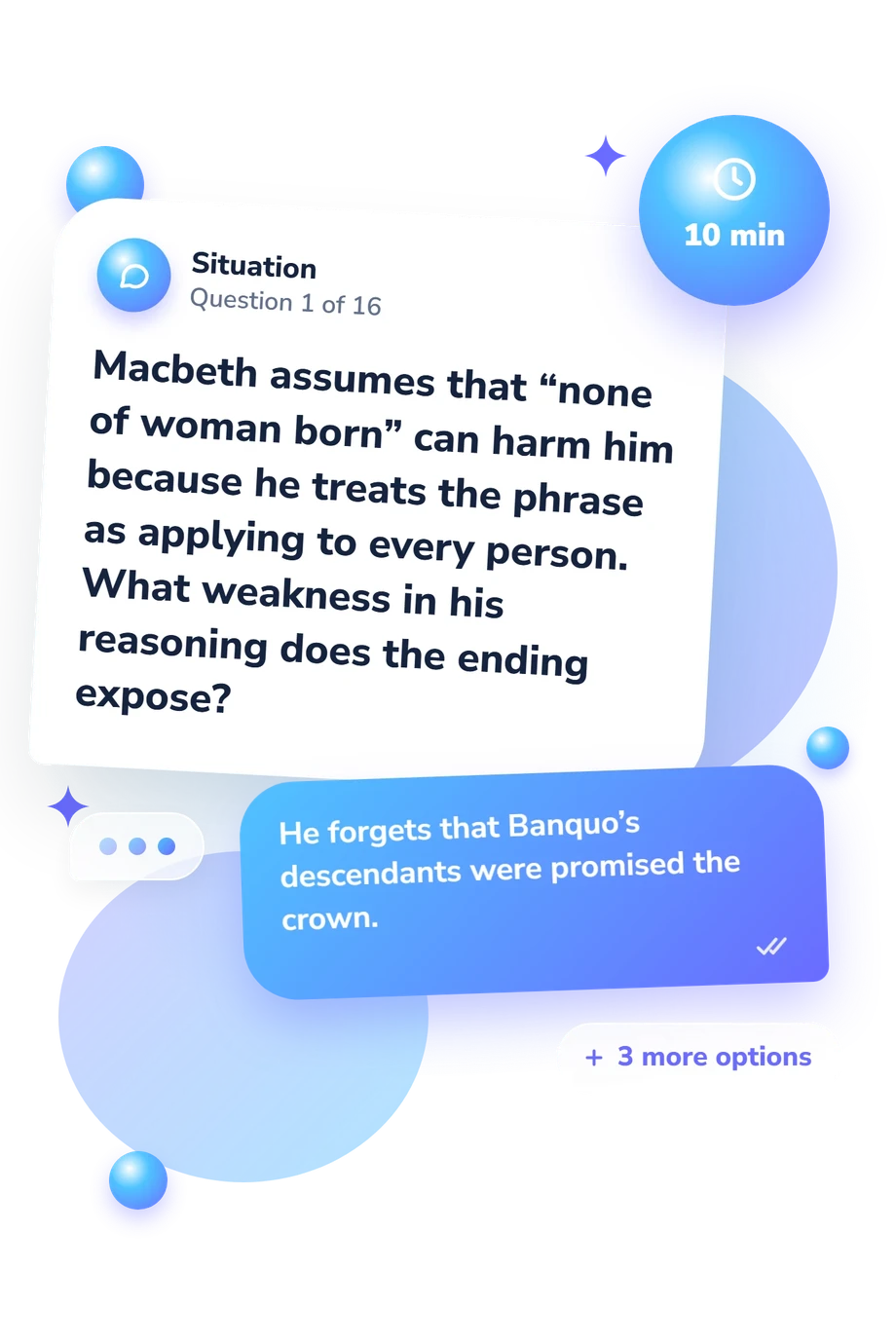
Questions identify events, motives, prophecy wording, and dramatic techniques such as irony. The sample asks readers to connect Macbeth’s reasoning, Lady Macbeth’s guilt, Malcolm’s test of Macduff, and the consequences of tyranny. Thus, this Macbeth plot quiz measures connected understanding of the tragedy rather than isolated quotation memory.
The result uses one scale, Macbeth Knowledge, scored from 0-16, with three catalogue bands:
- Foundation to Build (0-6) indicates that some elements are recognized, while sequence, relationships, and major prophecies need review.
- Developing Command (7-12) shows a solid grasp with room to strengthen details, motives, and dramatic choices.
- Strong Command (13-16) reflects detailed knowledge and confident connections among events, language, motives, and dramatic effects.
Taken together, these bands show whether the reader needs a refresher, has workable command, or can interpret the play in detail.
Methodology and Evidence Base
Each item presents a question with four answer choices, asking the reader to select the interpretation or event that best fits the play. The displayed score is converted into a band describing knowledge; no extra weighting or penalty should be assumed from the range alone.
The literary reference point is Macbeth (Shakespeare and Middleton). The questionnaire is conceptually consistent with the play’s wording, scenes, and tragic form, but it is not an adaptation of a published standardized instrument.
Viewed as an online quiz about Macbeth, the result is best read as performance on this particular set of questions. Results may reflect memory, prior study, recent rereading, and familiarity with theatrical terminology. A high band shows command of the tested material; a lower band identifies topics to revisit, not a fixed limit on literary ability. Because no population norms or reliability estimates are reported, the score is most useful for self-directed review and discussion.
- Shakespeare, William, and Thomas Middleton. Macbeth: The New Oxford Shakespeare. Edited by Emma Smith and John Jowett. Oxford University Press, 2024. ISBN 9780192862426.
- Shakespeare, William. Macbeth. Edited by Sandra Clark and Pamela Mason. The Arden Shakespeare, Third Series. Bloomsbury Publishing, 2015. ISBN 9781408153734.
- Wells, Stanley. Shakespeare's Tragedies: A Very Short Introduction. Oxford University Press, 2017. 10.1093/actrade/9780198785293.003.0008
Updated: