
Loyalty Quiz
How the Scales are Structured
Who Usually Takes This Test?
See How You Compare
Below is a preview of how scores are typically distributed across each scale.
Example Questions From the Test
- The conflict between customer satisfaction and repeat behavior
- The difference between confidentiality and privacy
- The conflict between in-group loyalty and fairness to others
- The difference between a promise and a preference
- Loyalty requires agreement when an issue matters to the group
- Respectful disagreement can coexist with loyalty
- Disagreement demonstrates loyalty only when it happens privately
- Loyal people avoid expressing views that could create tension
- Strong emotional attachment to the café
- A mutual commitment between Maya and the café
- Active advocacy for the café
- Repeat behavior without strong attitudinal loyalty
Loyalty Quiz - Description and methodology of the test
Readers who want to understand loyalty in friendship, groups, and customer relationships can use this loyalty quiz to examine the reasoning behind common dilemmas. In the loyalty test quiz, short scenarios ask how trust, fairness, and responsibility should guide a response when interests or expectations conflict. The result indicates how well you distinguish key loyalty concepts, rather than issuing a character verdict.
What This Assessment Explores
The items in this loyal quiz treat loyalty as a relationship judgment rather than automatic agreement or constant availability. They ask how trust, fairness, disagreement, commitment, and personal limits interact. The knowledge measure focuses on conceptual understanding: a higher result means the distinctions are recognized more accurately, not that the respondent always behaves loyally.
The question themes show what the result covers:
- Trust and repair show whether the respondent recognizes honesty, accountability, listening, and concrete follow-through after a breach.
- Fairness, boundaries, and disagreement show whether loyalty can coexist with integrity, respectful dissent, privacy, and stepping back from harm.
- Commitment, reciprocity, and repeat behavior separate durable preference and mutual support from convenience, obligation, discounts, or habit.
Loyalty Knowledge runs from 0-16: Foundations (0-6), Developing (7-12), and Strong (13-16). The scale measures knowledge, not personal loyalty.
Methodology and Scientific Basis
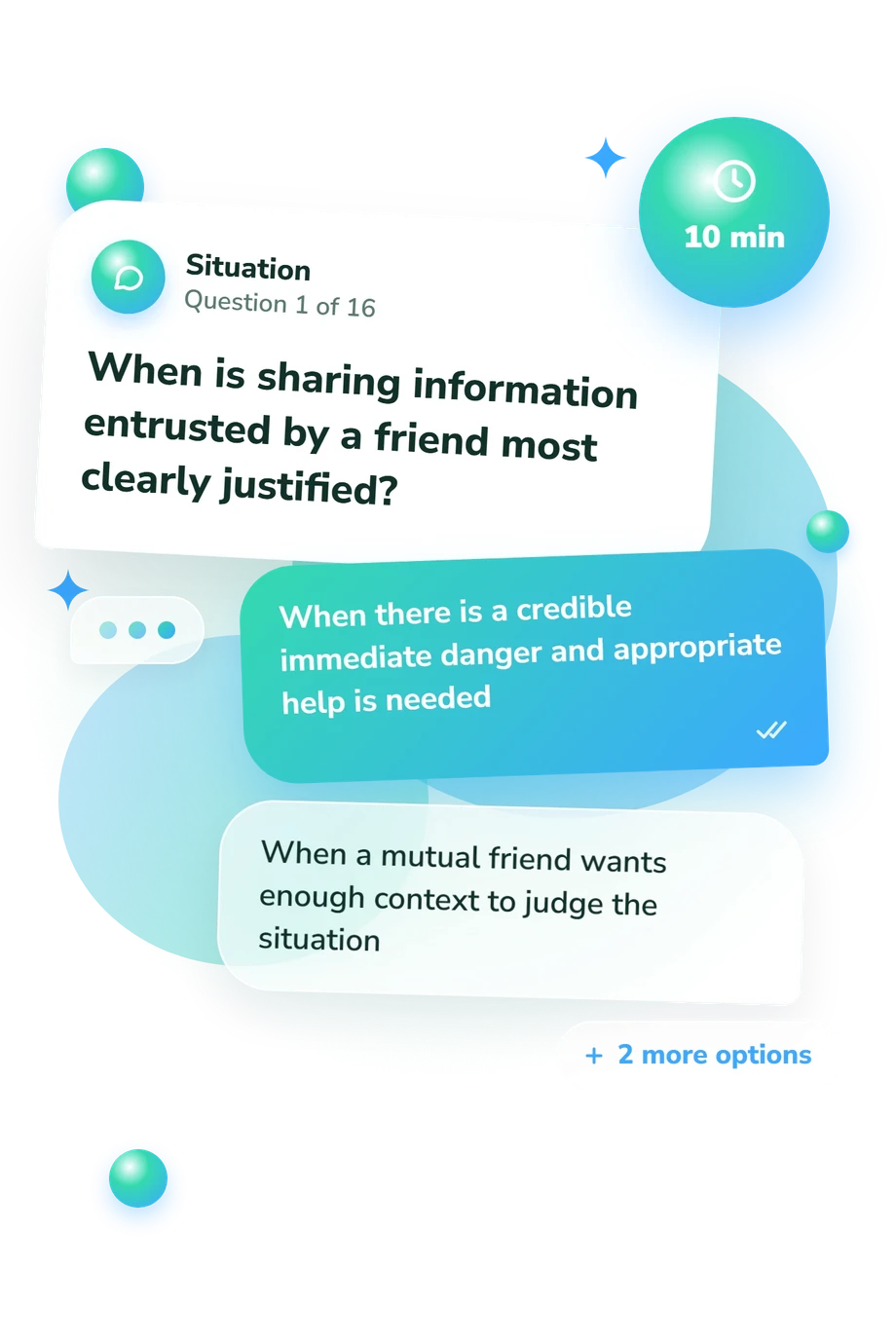
Each item presents an interpersonal or consumer situation with four answer choices and asks for the best response. The choices contrast principled loyalty with secrecy, blind agreement, pressure, convenience, or obligation. The questionnaire presents one overall score, interpreted through the displayed result bands rather than as a report of actual conduct. No separate subscale profile is established.
Personal questions are conceptually consistent with Baxter and colleagues’ 1997 study of loyalty and betrayal, but this questionnaire is not an adaptation. That perspective supports trust, obligation, fairness, boundaries, and repair. Dick and Basu (1994) supports the distinction between repeat behavior and attitudinal commitment in customer examples. Lewicki and Brinsfield (2017) supports acknowledgment, responsibility, and concrete repair after trust violations.
In practice, this relationship loyalty questionnaire is a structured knowledge exercise. Its scenarios require respondents to distinguish a motive from an outward action, such as repeated purchasing, continued availability, or a promise to repair. Readers who approach this as an are you loyal quiz should read the displayed band as an indication of understanding, not proof of character or an account of relationship behavior.
- Baxter, Leslie A., Michael J. Mazanec, John Nicholson, Garth Pittman, Kathy Smith, and Lee West. (1997). Everyday Loyalties and Betrayals in Personal Relationships. Journal of Social and Personal Relationships, 14(5), 655-678. 10.1177/0265407597145005
- Dick, Alan S., and Kunal Basu. (1994). Customer Loyalty: Toward an Integrated Conceptual Framework. Journal of the Academy of Marketing Science, 22(2), 99-113. 10.1177/0092070394222001
- Lewicki, Roy J., and Chad Brinsfield. (2017). Trust Repair. Annual Review of Organizational Psychology and Organizational Behavior, 4, 287-313. 10.1146/annurev-orgpsych-032516-113147
Updated: