
Legal Terminology Quiz
How the Scales are Structured
Who Usually Takes This Test?
See How You Compare
Below is a preview of how scores are typically distributed across each scale.
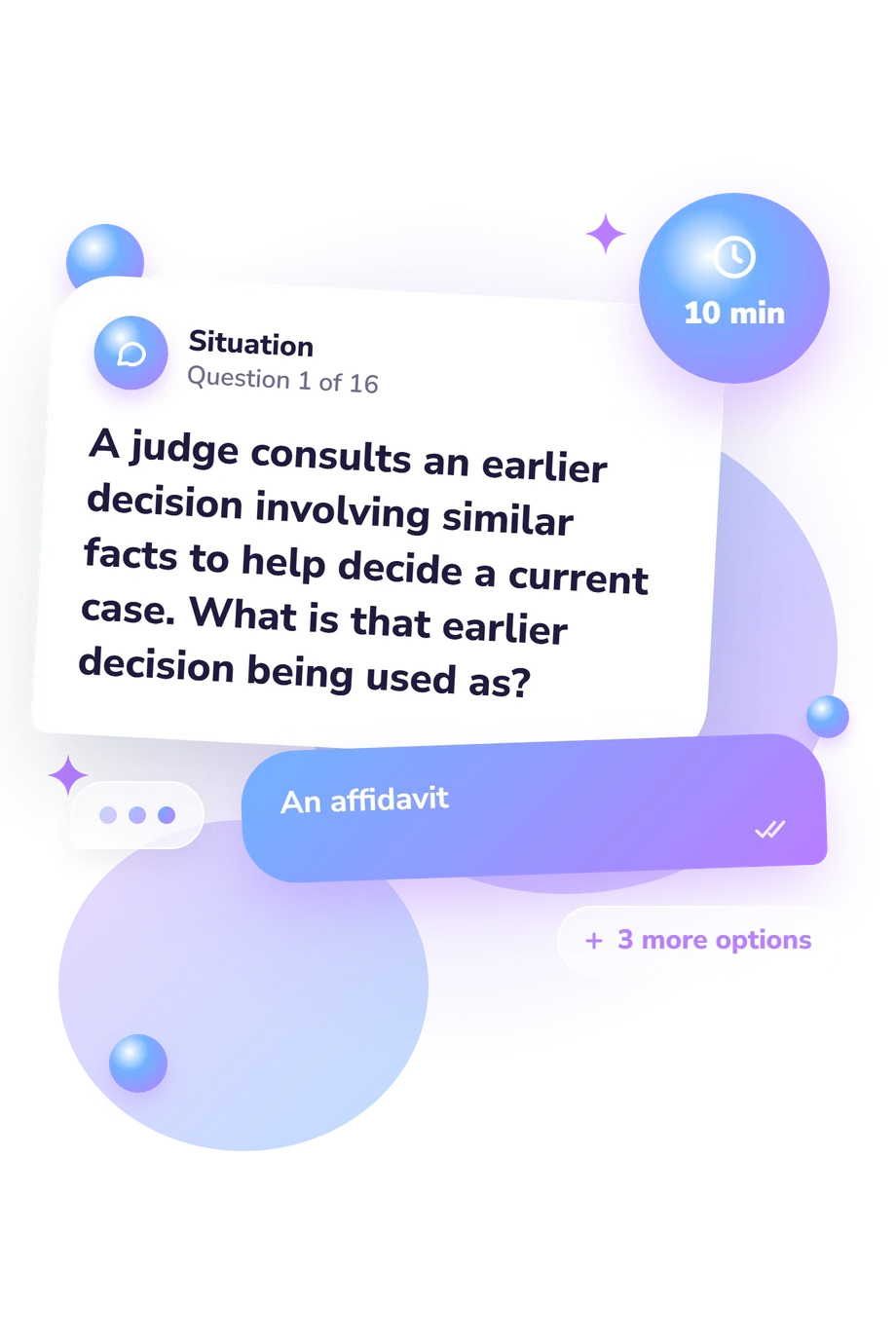
Example Questions From the Test
- A precedent
- A conviction
- A subpoena
- A settlement
- An informal summary of arguments prepared by a lawyer
- A judge's final instructions to a jury
- A written statement confirmed by oath or affirmation
- A request for a higher court to review a decision
- Judicial review
- The burden of proof
- Rules of evidence
- Legal standing
Legal Terminology Quiz - Description and methodology of the test
For learners and anyone reviewing common courtroom language, this legal terminology quiz tests recognition of common legal concepts. It can show which terms you distinguish confidently and which areas deserve review. This assessment is a legal vocabulary quiz that serves as a focused learning checkpoint: its score counts correct terminology recognition, while meanings and procedures can vary by jurisdiction, so the result is educational and does not provide legal advice.
What This Assessment Measures
The questions focus on terms used across civil and criminal procedure, courtroom practice, legal authority, obligations, and remedies. Each item places a term in a short situation, asking the respondent to distinguish related concepts such as settlement and appeal, or jurisdiction and liability.
The main thematic groups are procedural and courtroom terms, which cover documents and actions such as depositions, subpoenas, affidavits, and appeals; legal duties, which show how liability, negligence, breach of contract, and burden of proof describe responsibility or required proof; authority and dispute resolution, which clarify statutes, precedents, settlements, and jurisdiction; and outcomes and remedies, which identify acquittals, damages, and injunctions.
The result reflects the number of legal terms and distinctions recognized correctly. The legal terminology test suits self-directed study and broad orientation, especially before reviewing terms that remain easy to confuse.
Methodology and Evidence Base
Each question presents a scenario and four answer choices; one term best matches it. This tests recognition rather than written recall or full legal analysis.
The displayed scale is Legal Terminology Knowledge: 0-16, based on the number of correct responses. Its bands are:
- Foundational (0-6) means you recognize some vocabulary but may need to review core terms and their roles.
- Developing (7-12) indicates understanding of many common terms, with room to strengthen distinctions among procedures, authority, and remedies.
- Strong (13-16) indicates solid working knowledge of broadly used legal terminology.
The New York Court Interpreter Legal Terminology Test (2008) offers a comparison: this questionnaire's scenario format is conceptually consistent with its terminology-recognition focus, but is not an adaptation of it. Bancroft-Billings (2020) addresses spoken technical legal vocabulary in instruction, while Kauffman and Brown (2018) provide a textbook reference for common terms.
The displayed bands are educational and based on correct answers rather than norms. Memory, scenario interpretation, prior study, and jurisdiction can affect performance. This legal terms quiz produces a score that can guide review by showing which distinctions need more study.
- New York State Unified Court System, Office of Court Administration. Written Test of English Language Proficiency and Legal Terminology for Per Diem (Freelance) Court Interpreters (Languages Other than Spanish). 2008.
- Bancroft-Billings, Sandra. Identifying spoken technical legal vocabulary in a law school classroom. English for Specific Purposes, 60 (2020), 9-25. 10.1016/j.esp.2020.04.003.
- Kauffman, Kent D., and Gordon W. Brown. Legal Terminology, 7th ed. Pearson, 2018.
Updated: