
Languages of the World Quiz
How the Scales are Structured
Who Usually Takes This Test?
See How You Compare
Below is a preview of how scores are typically distributed across each scale.
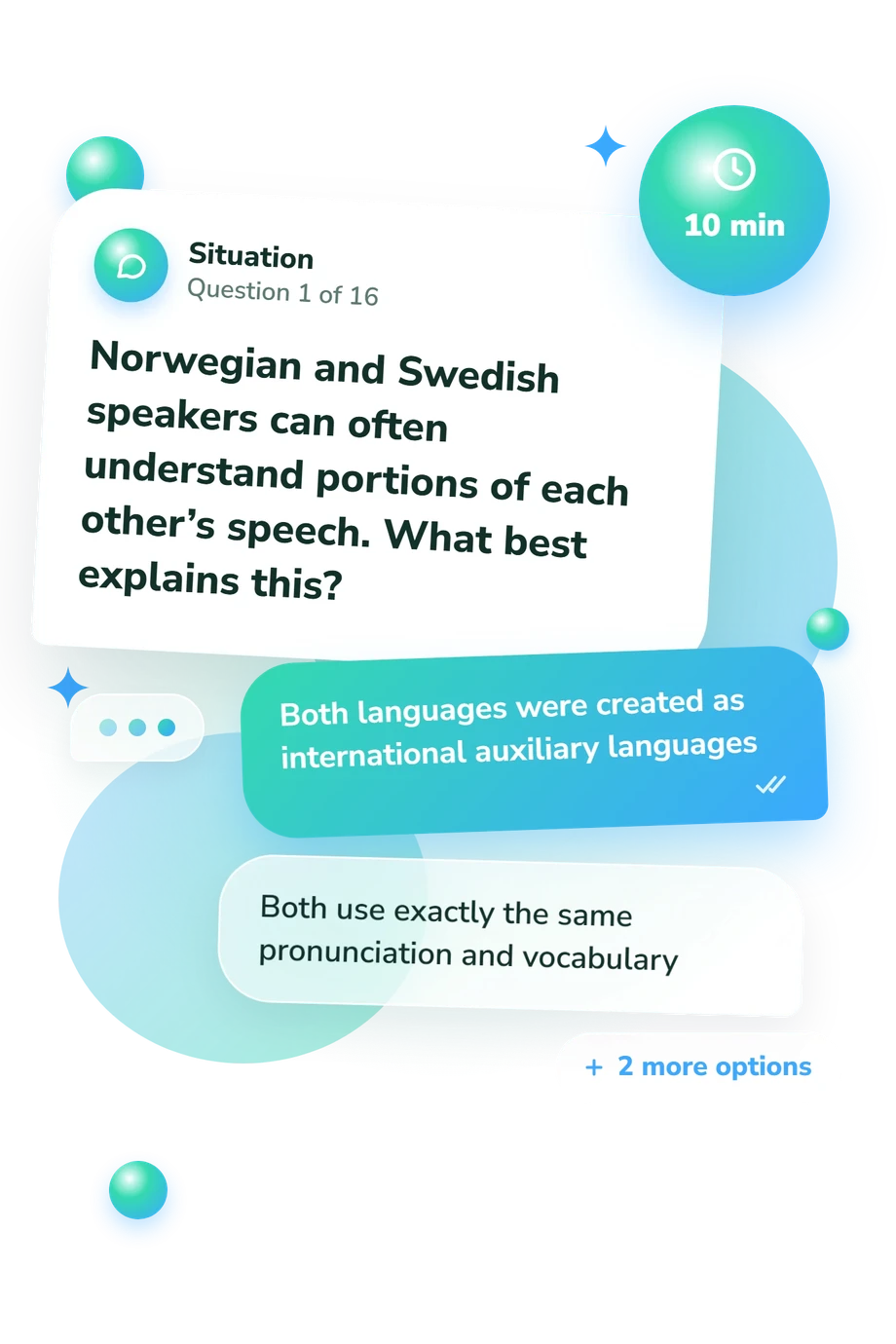
Example Questions From the Test
- Both languages were created as international auxiliary languages
- Both use exactly the same pronunciation and vocabulary
- They are closely related North Germanic languages
- One is a regional dialect of the other
- Romanian
- Greek
- Dutch
- Welsh
- Afroasiatic
- Uralic
- Indo-Aryan
- Turkic
Languages of the World Quiz - Description and methodology of the test
Readers who want a structured introduction to global linguistic diversity can use the Languages of the World Quiz to check what they already recognize and where curiosity may lead next. Rather than testing fluency, it samples knowledge of language classification, writing systems, geography, historical change, and social use. This coverage suits learners, travelers, teachers, and anyone exploring cultures, who can use the world language quiz to connect them.
What This Assessment Explores
The questionnaire measures knowledge of how languages are related, written, distributed, and used. Items ask the reader to connect Norwegian and Swedish with North Germanic relatedness, identify Devanagari, recognize code-switching, and interpret declining transmission as a sign of endangerment. The questions also cover language isolates, lingua francas, lexical tone, revival, and contact across regions, giving this world languages quiz a wider scope than a vocabulary check.
The result is reported on one knowledge scale: Languages of the World Knowledge (0-16) counts correct answers. Foundational (0-6) reflects recognition of major languages and concepts; Developing (7-12) shows a useful base with some missed connections; Strong (13-16) indicates broad, accurate knowledge across language geography, classification, writing, and use.
This profile helps the reader judge their overall language-knowledge level and decide whether to explore the subject further, rather than judging fluency or conversational ability.
Methodology and Evidence Base
Each item offers a factual or scenario-based prompt with four answer choices. It checks recognition and application: classify a family, match a script, identify code-switching, or interpret language vitality. The score counts correct responses; it does not measure speaking fluency.
The question themes fall into four groups:
- Families and classification show whether languages can be connected through descent or grouping.
- Scripts and sound systems cover writing direction, scripts, and features such as tone.
- Geography and change connect languages with regions, migration, revival, and contact.
- Social use and vitality examine code-switching, lingua francas, and weakening transmission.
An atlas by Asher and Moseley supplies geographic and classificatory context. WALS Online supports comparison of linguistic features, while UNESCO’s framework distinguishes continuing transmission from endangerment. This questionnaire has no documented standardization, norms, reliability, or validation evidence; these sources provide subject-matter context only.
For interpretation, this language knowledge quiz remains sensitive to guessing, memory, education, and current context. Read the profile as a learning guide rather than a fixed measure of ability.
- Asher, R. E., and Christopher Moseley (eds.). 2007. Atlas of the World's Languages. 2nd ed. London and New York: Routledge. ISBN 9780415310741.
- Dryer, Matthew S., and Martin Haspelmath (eds.). 2013. WALS Online (v2020.4) [Data set]. Zenodo. 10.5281/zenodo.13950591.
- UNESCO Ad Hoc Expert Group on Endangered Languages. 2003. Language Vitality and Endangerment. Paris: UNESCO.
Updated: