
Language Quiz
How the Scales are Structured
Who Usually Takes This Test?
See How You Compare
Below is a preview of how scores are typically distributed across each scale.
Example Questions From the Test
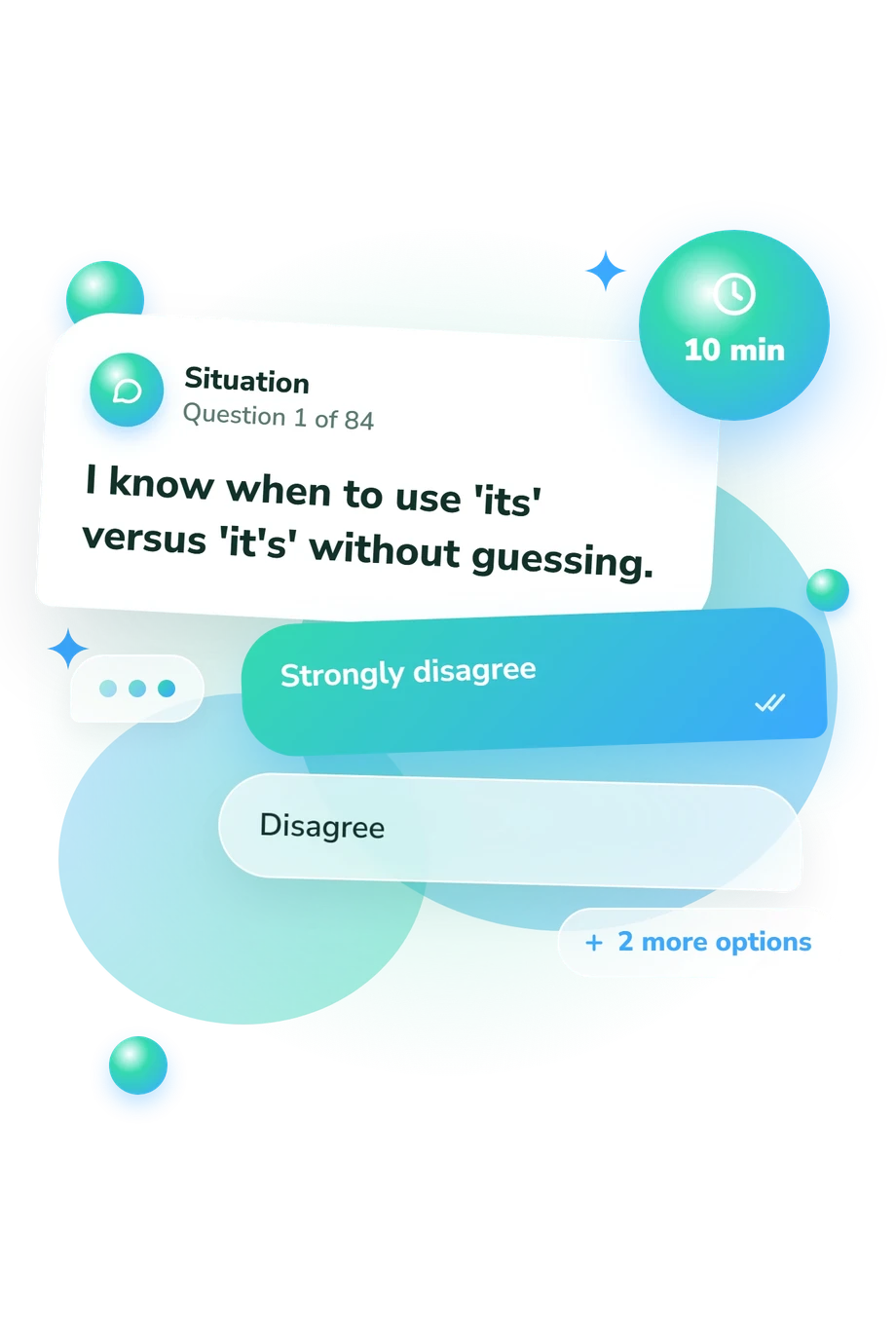
- Strongly disagree
- Disagree
- Not sure
- Agree
- Strongly disagree
- Disagree
- Not sure
- Agree
- Strongly disagree
- Disagree
- Not sure
- Agree
Language Quiz - Description and methodology of the test
Readers who want a clearer picture of their written-English strengths can use this language quiz to examine grammar, word choice, and understanding of short passages. It suits learners, writers, and curious adults who want a language assessment with separate profile areas. The result distinguishes grammar, comprehension, and vocabulary rather than reducing language ability to one overall impression.
What This Assessment Explores
The questions focus on practical written-English situations, not specialist linguistic terminology. They cover standard forms, nuanced word choice, idioms, and meaning inferred from context. In this language knowledge questionnaire, the result forms a practice profile.
The three dimensions describe the result:
- Grammar & Usage Accuracy (0-30) measures grammar rules and common usage traps; higher scores indicate consistent sentence structure. Its bands are Developing 0-14, Proficient 15-23, and Strong 24-30.
- Reading & Idioms Comprehension (0-20) measures short-passage inference, figurative language, and idioms. Its bands are Developing 0-8, Competent 9-15, and Strong 16-20.
- Vocabulary Mastery (0-30) measures word meanings, nuance, synonyms, antonyms, and word choice. Its bands are Developing 0-14, Proficient 15-23, and Advanced 24-30.
The vocabulary profile can point toward work on precision, context clues, or formal usage.
Methodology and Evidence Base
The representative items use first-person statements and four-choice response formats, with options ranging from Strongly disagree to Agree or Strongly agree and Not sure on some items. They ask respondents to rate confidence in abilities, so the result reflects perceived competence rather than a performance score.
Scores are grouped into the displayed dimensions, with higher values indicating stronger grammar, contextual understanding, or word knowledge. The questionnaire does not state a per-answer weighting, so the displayed ranges cannot be used to infer how many points any single response contributes.
When interpreting the reading-related profile, bands are strongest when considered alongside tasks that felt easy or uncertain. A lower band marks a practice priority, not a fixed limit on learning.
Methodologically, the questionnaire is conceptually consistent with language self-assessment work by Blanche and Merino and by Ross, but it is not an adaptation of those studies. Those studies do not standardize, validate, or norm this online version, and the CEFR is only a general descriptive framework; it does not establish the displayed bands. Recent practice, mood, and self-awareness may also influence responses.
- Blanche, Patrick, and Barbara J. Merino. "Self-Assessment of Foreign-Language Skills: Implications for Teachers and Researchers." Language Learning, 39(3), 313-338, 1989. 10.1111/j.1467-1770.1989.tb00595.x
- Ross, Steven. "Self-Assessment in Second Language Testing: A Meta-Analysis and Analysis of Experiential Factors." Language Testing, 15(1), 1-20, 1998. 10.1177/026553229801500101
- Council of Europe. Common European Framework of Reference for Languages: Learning, Teaching, Assessment - Companion Volume. Council of Europe Publishing, Strasbourg, 2020. ISBN 978-92-871-8621-8
Updated: