
Is She Cheating on Me Quiz
How the Scales are Structured
Who Usually Takes This Test?
See How You Compare
Below is a preview of how scores are typically distributed across each scale.
Example Questions From the Test
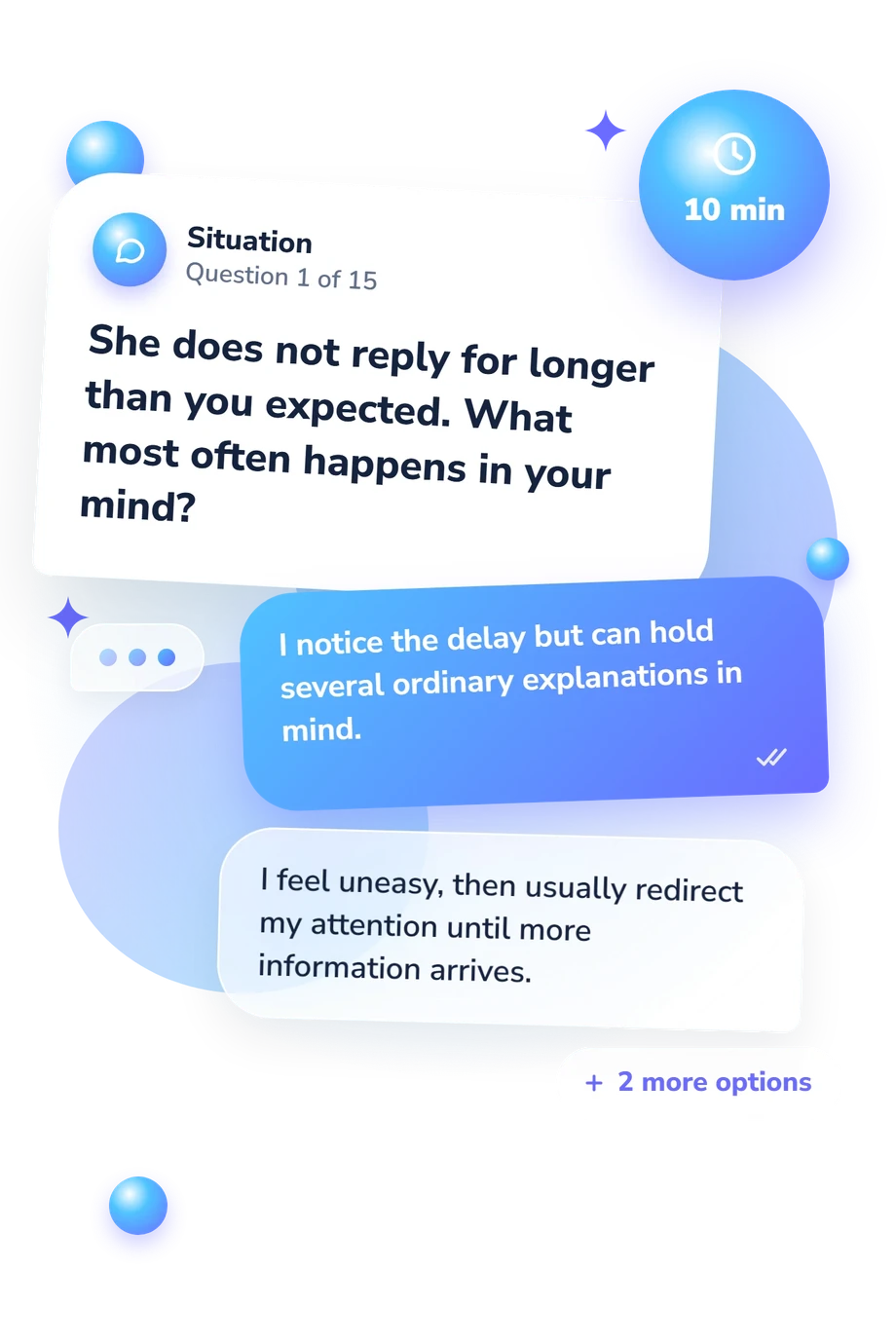
- I notice the delay but can hold several ordinary explanations in mind.
- I feel uneasy, then usually redirect my attention until more information arrives.
- I repeatedly imagine betrayal even though I know the delay is ambiguous.
- I quickly become convinced something is being hidden and struggle to consider alternatives.
- Her privacy habits are generally stable and consistent with the boundaries we each expect.
- She has become somewhat more private, with a plausible work, family, or personal context.
- There is marked new secrecy, and attempts to discuss the change produce little clarity.
- Repeated concealment is combined with explanations that noticeably contradict what I observe.
- It feels broadly familiar, including normal fluctuations in closeness.
- Closeness has dipped somewhat during an identifiable stressful period.
- There has been a noticeable withdrawal that has not been clearly discussed.
- Affection and engagement changed abruptly across several parts of the relationship without a coherent explanation.
Is She Cheating on Me Quiz - Description and methodology of the test
People unsettled by changes in closeness, privacy, availability, or communication can use the Is She Cheating on Me Quiz to slow interpretation and sort observations from assumptions. This Is My Girlfriend Cheating Quiz addresses the concern, but the result also shows how trust and worry shape that concern. It helps distinguish communication and trust strain, observable changes, and uncertainty-related worry when you wonder whether your girlfriend is cheating.
What This Assessment Explores
The questions connect difficult conversations, observable changes in recent behavior, and uncertainty’s effects on attention, routines, and interpretations. This Is She Cheating Quiz shows trust strain, observable relationship changes, and uncertainty-related worry, helping readers compare observations with the worry and trust shaping them.
Four ordered choices cover privacy, closeness, schedules, inclusion, explanations, boundaries, checking urges, and separating facts from inferences. Three scales organize the result:
- Communication and Trust Strain (0-15) reads dialogue and confidence as Workable dialogue (0-5), Strained trust (6-10), or Significant rupture (11-15), from discussable concerns to blocked communication.
- Observable Relationship Changes (0-15) summarizes shifts as Limited change (0-5), Mixed signals (6-10), or Persistent pattern (11-15), helping compare reported changes with their context.
- Uncertainty and Worry (0-15) shows Contained concern (0-5), Recurring preoccupation (6-10), or Worry taking over (11-15), according to daily impact.
Methodology and Scientific Basis
This Is My Girlfriend Cheating on Me Quiz uses concrete situations. Each item offers four ordered descriptions, letting the respondent choose the option closest to recent experience or to the respondent’s likely response in the situation described rather than rate an abstract trait. Results are reported separately; the displayed bands are unvalidated reflective summaries, and the questionnaire does not state how individual answers are converted into the scale totals.
Weigel and Shrout (2025) is the closest conceptual comparison because it examines suspicion-confirmation and avoidance around possible partner infidelity. Hanson Sobraske, Gaulin, and Boster (2014) adds work on sensitivity to cues of a partner’s involvement with a rival. Knobloch and Solomon (1999) supports the focus on relational uncertainty. It is consistent with these studies, not an adaptation or validated reproduction of any one.
High worry can make suspicion of infidelity feel conclusive, but a score cannot establish whether infidelity occurred. Current stress, earlier betrayal, selective attention, and limited self-awareness shape answers. Use the result to identify questions for proportionate conversation, not surveillance; if discussion could be unsafe, choose support and a safer setting. Broader context still matters.
- Daniel J. Weigel and M. Rosie Shrout (2025). Are You Cheating on Me? Identifying Factors Contributing to the Use of Suspicion Confirmation and Avoidance Strategies. Western Journal of Communication, 89(1), 108-131. 10.1080/10570314.2024.2324382
- Katherine N. Hanson Sobraske, Steven J. C. Gaulin, and James S. Boster (2014). Functional Variation in Sensitivity to Cues That a Partner Is Cheating with a Rival. Archives of Sexual Behavior, 43(7), 1267-1279. 10.1007/s10508-014-0283-5
- Leanne K. Knobloch and Denise Haunani Solomon (1999). Measuring the Sources and Content of Relational Uncertainty. Communication Studies, 50(4), 261-278. 10.1080/10510979909388499
Updated: