
Is My Third Eye Open Quiz
How the Scales are Structured
Who Usually Takes This Test?
See How You Compare
Below is a preview of how scores are typically distributed across each scale.
Example Questions From the Test
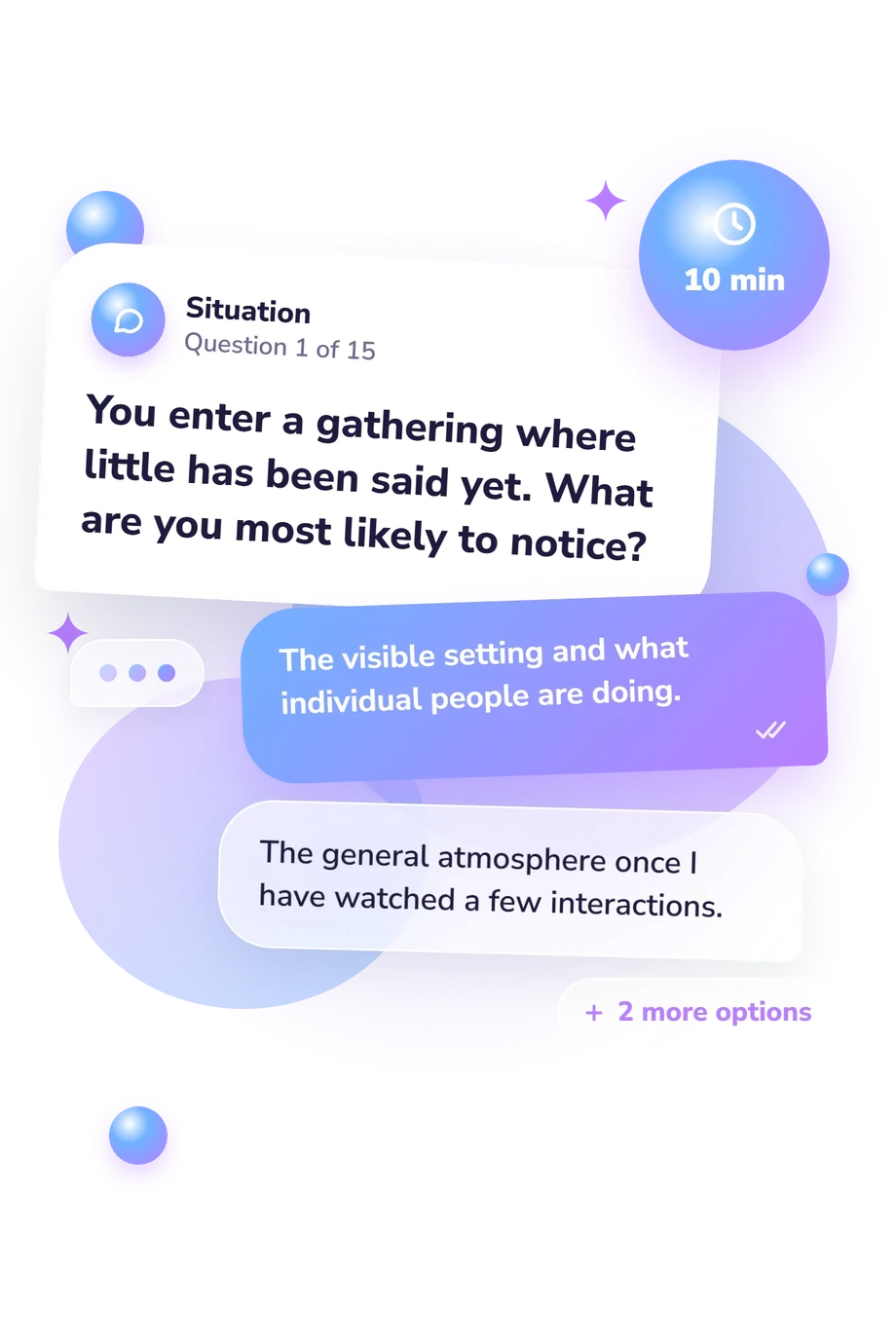
- The visible setting and what individual people are doing.
- The general atmosphere once I have watched a few interactions.
- A noticeable mood in the room before many conversations unfold.
- An immediate and strong felt impression of the room's atmosphere.
- Little beyond the fact that I dreamed.
- A general mood or a few disconnected fragments.
- Several scenes, people, or details from the dream.
- A vivid sequence with strong images or symbols that stay with me.
- I understand the idea without forming much of a mental picture.
- I catch brief or fuzzy impressions of the scene.
- I can maintain a recognizable image when I concentrate.
- Detailed imagery tends to develop and unfold on its own.
Is My Third Eye Open Quiz - Description and methodology of the test
For people reflecting on vivid dreams, hunches, meditation sensations, or meaningful coincidences, the Is My Third Eye Open Quiz offers a structured way to examine those experiences. It can help a curious reader notice whether imagery, spiritual interpretation, or subtle impressions are especially prominent in their personal perspective. It turns broad spiritual curiosity into specific areas for reflection, making this third eye quiz a structured exploration of personal experiences.
What This Assessment Explores
Responses examine how a person notices inner images, intuitive impressions, bodily sensations, dreams, symbols, and spiritual meaning. The items also ask how these experiences influence choices, creativity, reflection, and practice. For someone wondering about these experiences, this assessment is a how to know if your third eye is open quiz that organizes self-reported patterns into three dimensions.
The three displayed dimensions are:
- Inner Imagery and Symbolism (0-15) describes vividness and recurrence of images, dreams, colors, and symbols: Concrete Inner Style 0-5; Occasional Symbolism 6-10; Vivid Symbolic Life 11-15.
- Spiritual Meaning and Integration (0-15) describes how strongly reflective or unusual experiences shape personal meaning-making and practice: Light Spiritual Emphasis 0-5; Active Meaning-Making 6-10; Deep Spiritual Integration 11-15.
- Subtle Inner Awareness (0-15) describes prominence of hunches and felt shifts alongside observable information: Externally Anchored 0-5; Emerging Sensitivity 6-10; Strong Inner Salience 11-15.
Methodology and Evidence Base
Each item offers four ordered response choices, moving from concrete or externally anchored descriptions toward more vivid, spontaneous, or integrated experiences. The result is a profile of separate scale scores, with bands that describe tendencies rather than population-standardized cutoffs.
The framework is conceptually consistent with the Hood Mysticism Scale, a reference point for reported mystical experience, but this questionnaire is not that published instrument. Further parallels come from Underwood and Teresi's Daily Spiritual Experience Scale, Tellegen and Atkinson's absorption framework, and Marks's research on visual imagery. Population norms or validation evidence are not supplied for this online version.
This self-report third eye test relies on personal reports, so results may shift with mood, memory, cultural language, and attention to inner events. A high score describes prominence in the respondent's report; it does not verify supernatural ability or identify the source of a sensation. Compare the profile with the situations and experiences that led you here, noting where its bands fit everyday observations and where they do not.
- Hood, Ralph W. (1975). The Construction and Preliminary Validation of a Measure of Reported Mystical Experience. Journal for the Scientific Study of Religion, 14(1), 29-41. 10.2307/1384454
- Underwood, Lynn G., & Teresi, Jeanne A. (2002). The Daily Spiritual Experience Scale: Development, Theoretical Description, Reliability, Exploratory Factor Analysis, and Preliminary Construct Validity Using Health-Related Data. Annals of Behavioral Medicine, 24(1), 22-33. 10.1207/S15324796ABM2401_04
- Tellegen, Auke, & Atkinson, Gilbert. (1974). Openness to Absorbing and Self-Altering Experiences ("Absorption"), a Trait Related to Hypnotic Susceptibility. Journal of Abnormal Psychology, 83(3), 268-277. 10.1037/h0036681
- Marks, David F. (1973). Visual Imagery Differences in the Recall of Pictures. British Journal of Psychology, 64(1), 17-24. 10.1111/j.2044-8295.1973.tb01322.x
Updated: