
Is It True Love Quiz
How the Scales are Structured
Who Usually Takes This Test?
See How You Compare
Below is a preview of how scores are typically distributed across each scale.
Example Questions From the Test
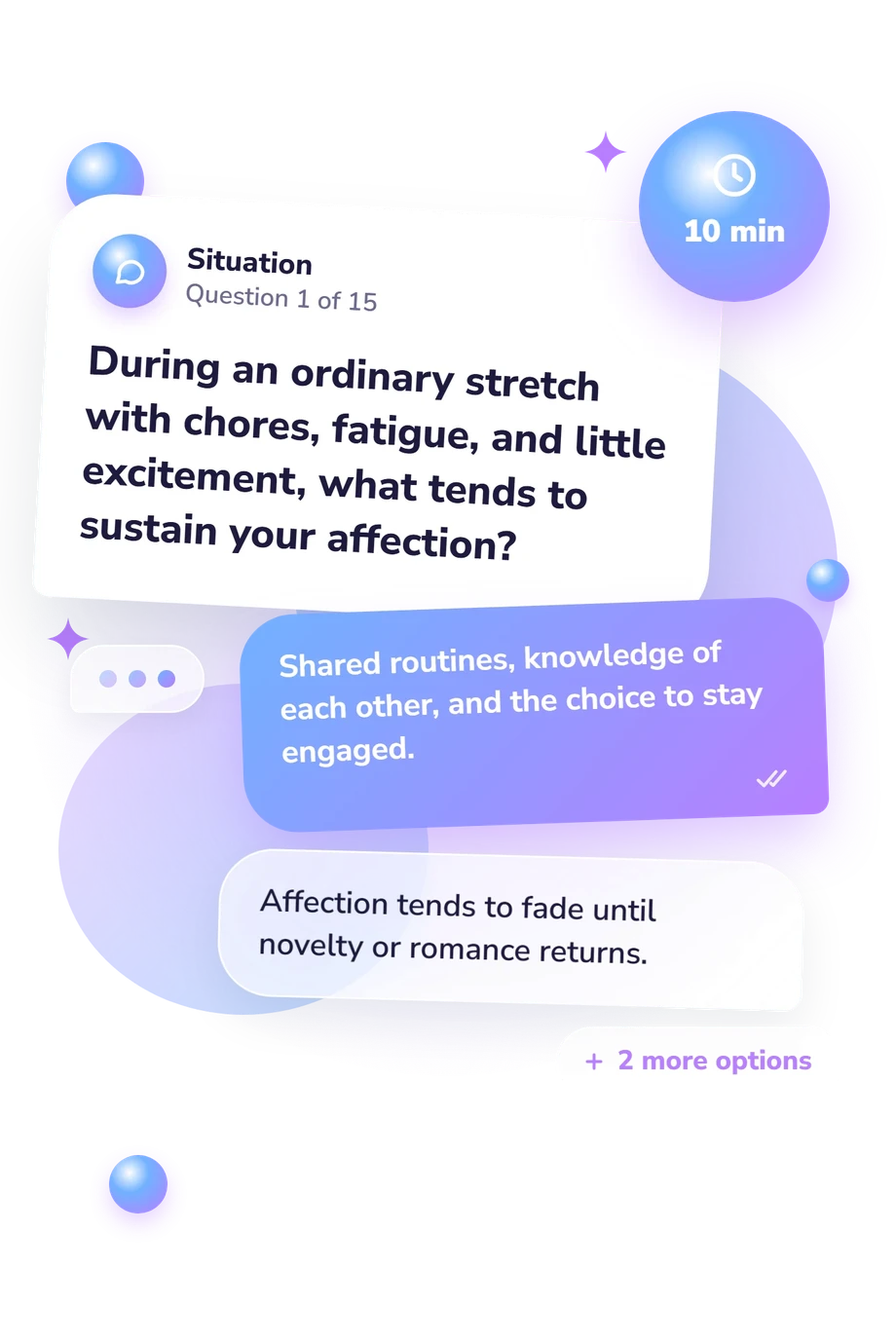
- Shared routines, knowledge of each other, and the choice to stay engaged.
- Affection tends to fade until novelty or romance returns.
- Small enjoyable moments help, though I question the bond when excitement drops.
- Companionship and shared effort usually keep the connection meaningful.
- Explain both the feeling and what was happening beneath it.
- Correct the main misunderstanding without discussing much emotion.
- Ask for space and work through the mood on my own.
- Name how I feel, while keeping some of the deeper details to myself.
- I respect it, though I may seek some reassurance about us.
- I accept the request but tend to interpret it personally.
- I treat the need for space as compatible with our connection.
- I feel unsettled and am likely to keep seeking contact.
Is It True Love Quiz - Description and methodology of the test
For readers reflecting on a current romantic relationship, this true love assessment offers a focused way to consider what they are experiencing and what they may want to discuss. The Is It True Love Quiz can support a clearer conversation or a thoughtful decision about how to approach the relationship next.
What This Assessment Explores
For someone reflecting on a current romantic bond, the questionnaire examines whether affection is supported by openness, practical realism, and mutual care. It describes relationship patterns rather than deciding whether love is present.
The emotional intimacy assessment considers vulnerable disclosure, compatibility, boundaries, shared decisions, and responses to success or strain.
The three result dimensions are:
- Emotional Closeness (0-15) reflects openness and felt understanding; it does not prove or disprove love. Results are Guarded connection (0-5), Growing connection (6-10), or Deep connection (11-15).
- Grounded Commitment (0-15) reflects realistic knowledge, compatibility, and chosen investment; it cannot predict a relationship’s future. Results are Present-focused bond (0-5), Emerging foundation (6-10), or Well-grounded bond (11-15).
- Mutual Respect and Care (0-15) reflects consideration for needs, boundaries, and successes; it is not a judgment of either person’s worth. Results are Uneven regard (0-5), Developing reciprocity (6-10), or Strong reciprocity (11-15).
Methodology and Scientific Basis
Each item presents an ordinary relationship situation, such as vulnerable disclosure, different preferences, a practical decision, or a canceled plan. Four response options represent differing degrees of openness, realism, support, and joint responsibility. Select the response that best matches the relationship as it usually operates.
The questionnaire is conceptually consistent with the Triangular Love Scale, or TLS-15, and Sternberg’s model of intimacy, passion, and commitment. It is not the TLS-15 or its digital administration; it is a separate online self-reflection format organizing related ideas into three parts. These frameworks help read its dimensions as distinct features of a current relationship, not a direct measure of that scale or a judgment about either partner.
Scoring produces descriptive bands for each dimension rather than a forecast; displayed bands show how the questionnaire organizes responses about disclosure, practical choices, boundaries, and reciprocity. As a relationship self-reflection quiz, the profile can guide what to explore in conversation.
Self-report can shift with current stress, recent conflict, memory, self-awareness, and the wish to present the relationship favorably. The result therefore describes this perspective at this moment.
- Kowal, Marta, Piotr Sorokowski, Bojana M. Dinic, et al. (2024). Validation of the Short Version (TLS-15) of the Triangular Love Scale (TLS-45) across 37 Languages. Archives of Sexual Behavior, 53(2), 839-857. 10.1007/s10508-023-02702-7
- Sternberg, Robert J. (1986). A triangular theory of love. Psychological Review, 93(2), 119-135. 10.1037/0033-295X.93.2.119
- Acker, Michele, and Mark H. Davis. (1992). Intimacy, Passion and Commitment in Adult Romantic Relationships: A Test of the Triangular Theory of Love. Journal of Social and Personal Relationships, 9(1), 21-50. 10.1177/0265407592091002
Updated: