
Is He Serious About Me Quiz
How the Scales are Structured
Who Usually Takes This Test?
See How You Compare
Below is a preview of how scores are typically distributed across each scale.
Example Questions From the Test
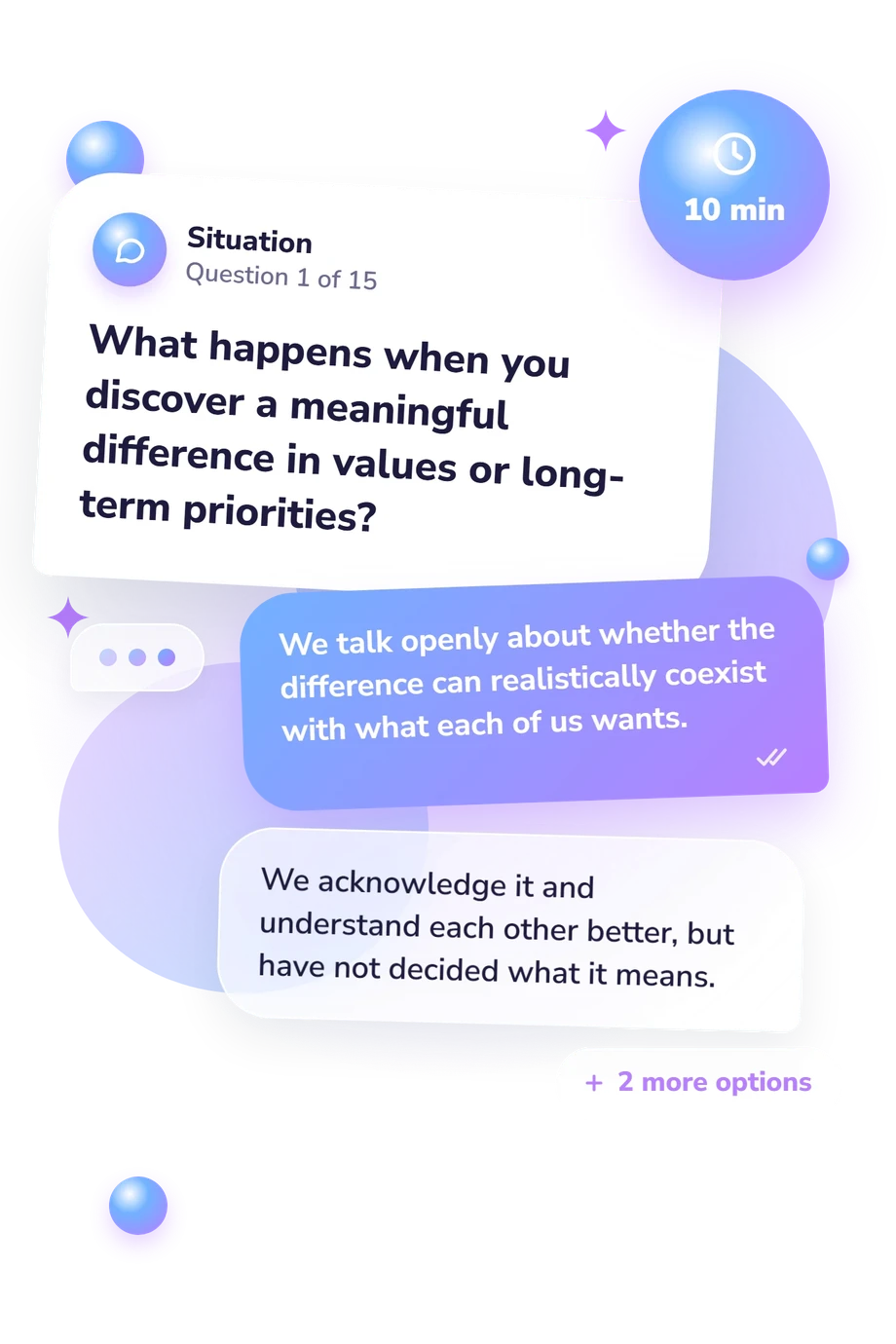
- We talk openly about whether the difference can realistically coexist with what each of us wants.
- We acknowledge it and understand each other better, but have not decided what it means.
- We usually focus on enjoying the present rather than examining the difference.
- He reassures me that it will be fine, though the practical implications remain vague.
- He engages with the idea and, when practical, helps turn it into a real plan.
- He responds positively but prefers not to discuss plans that far ahead.
- He considers it seriously while being honest about anything that could affect the plan.
- He treats future plans as separate from what the two of you are doing now.
- He knows the major ones and consistently plans with them in mind.
- He remembers some priorities but usually fits the relationship around his existing routine.
- He is learning what matters to me and makes room when we discuss it clearly.
- Our time together is generally based on immediate availability rather than each other’s wider lives.
Is He Serious About Me Quiz - Description and methodology of the test
People who feel uncertain about a partner’s intentions can use this questionnaire to examine recurring patterns instead of guessing from isolated moments. The Is He Serious About Me Quiz considers whether communication, plans, boundaries, and everyday effort point in a compatible direction. Framed as a quiz about whether he will commit, this questionnaire turns uncertainty into specific behaviors and a clearer conversation.
What This Assessment Explores
Seriousness here is assessed through observable inclusion, dependable effort, and mutual fit. Scenarios address priorities, social visibility, planning, support, disagreement, boundaries, and shared decisions. This relationship commitment quiz suits anyone reflecting on a romantic connection.
The result groups those situations into three dimensions:
- Clarity and Life Integration (0-15) measures inclusion in his life and plans: Separate/Undefined (0-5), Emerging Inclusion (6-10), or Clear Inclusion (11-15).
- Consistency and Follow-Through (0-15) measures whether actions reinforce words: Unreliable pattern (0-5), Mixed follow-through (6-10), or Consistent investment (11-15).
- Mutuality and Relationship Fit (0-15) measures space for both people’s needs and direction: Limited alignment (0-5), Partial alignment (6-10), or Strong mutual fit (11-15).
Together, the bands organize the current patterns for discussion.
Methodology and Scientific Basis
Each item presents a relationship situation with four response choices covering future planning, rescheduling, conflict repair, limits, support, public acknowledgment, and shared goals. Choose the option that best matches repeated experience, not one unusually good or difficult day.
Responses become one score for each displayed dimension. The weighting of the response choices is not stated, so interpret the numerical result through its displayed band rather than reverse-engineering it. Memory, current emotion, expectations, and self-protective interpretations can influence this structured self-report.
The themes are consistent with Weigel and Ballard-Reisch (2002), who examined behavioral indicators associated with relational commitment. Stanley and Markman’s framework and Rusbult, Martz, and Agnew’s Investment Model Scale offer related concepts involving dedication, constraints, satisfaction, alternatives, and investment. Those instruments provide conceptual context for the themes, not validation or scoring for this questionnaire.
As a serious relationship quiz, it works best as a conversation map: compare scores with specific examples and discuss needs, boundaries, and direction. Scores reflect current observed patterns, so memory, present circumstances, expectations, and how each response is interpreted can shape the self-report result.
- Weigel, D. J., & Ballard-Reisch, D. S. (2002). Investigating the Behavioral Indicators of Relational Commitment. Journal of Social and Personal Relationships, 19(3), 403-423. 10.1177/0265407502193006
- Stanley, S. M., & Markman, H. J. (1992). Assessing Commitment in Personal Relationships. Journal of Marriage and the Family, 54(3), 595-608. 10.2307/353245
- Rusbult, C. E., Martz, J. M., & Agnew, C. R. (1998). The Investment Model Scale: Measuring Commitment Level, Satisfaction Level, Quality of Alternatives, and Investment Size. Personal Relationships, 5(4), 357-387. 10.1111/j.1475-6811.1998.tb00177.x
Updated: