
Imperfect Subjunctive Practice Quiz
How the Scales are Structured
Who Usually Takes This Test?
See How You Compare
Below is a preview of how scores are typically distributed across each scale.
Example Questions From the Test
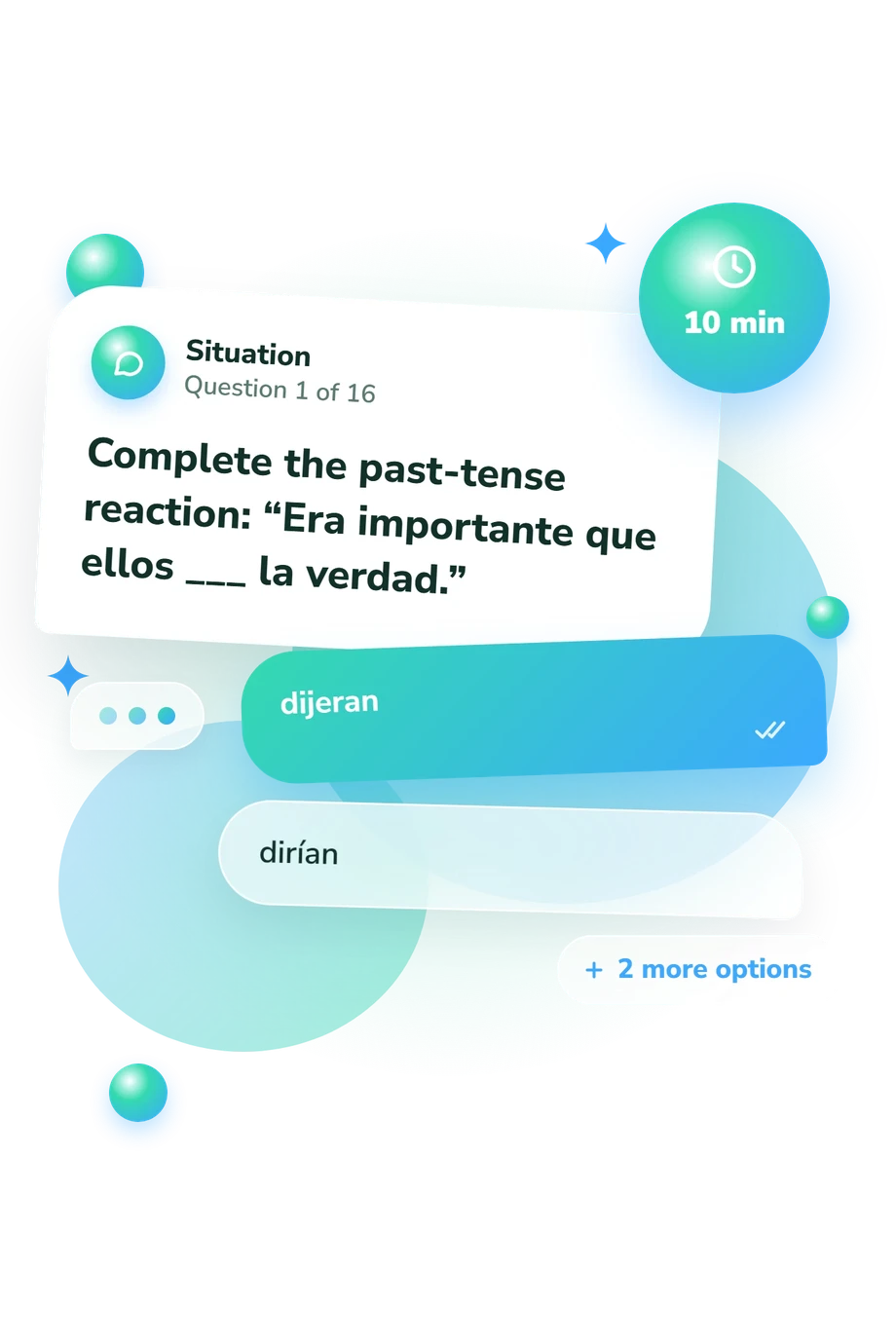
- dijeran
- dirían
- dijeron
- dicen
- dormieramos
- durmiéramos
- dormiríamos
- duermamos
- empezó
- empezaría
- empieza
- empezara
Imperfect Subjunctive Practice Quiz - Description and methodology of the test
For learners who want to check their command of a Spanish tense, this assessment offers focused practice with form, meaning, and sentence context. The imperfect subjunctive practice quiz suits students, independent learners, and anyone revising before a lesson. An imperfect subjunctive Spanish quiz can guide the next study step by showing which parts of the tense deserve attention, without judging broad Spanish ability.
What This Assessment Measures
The items assess how you build and select the imperfect subjunctive when a clause expresses a request, doubt, wish, purpose, comparison, or hypothetical situation. They distinguish it from indicative, conditional, infinitive, and present-subjunctive forms.
As a past subjunctive quiz, it focuses on four abilities:
- Forming stems from the third-person plural preterite helps you handle irregular verbs.
- Applying endings and accents shows whether the written form is accurate.
- Reading clause context measures whether you select the tense for the intended meaning.
- Recognizing equivalent forms shows that tuviera and tuviese express the same tense.
The displayed scale is Imperfect Subjunctive Knowledge (0-16): Foundations to Review (0-6) signals review of formation and triggers; Developing Control (7-12) reflects patterns with difficulty in irregular stems, accents, or clause selection; Strong Command (13-16) reflects accurate use across standard contexts. It describes quiz performance, not Spanish proficiency.
Methodology and Evidence Base
Methodologically, the questionnaire uses four-option multiple-choice items. Prompts ask you to complete sentences, choose a correctly spelled form, or identify an appropriate use. Distractors represent errors in tense, stem formation, accent placement, or clause selection, so the items sample form recognition and contextual judgment.
In this Spanish subjunctive practice quiz, each response is compared with a keyed answer, and the resulting performance is reported on the displayed scale. Because point weighting is not specified, the result reflects this question set rather than a normed measurement. The questionnaire is a focused learning check, not a standardized administration of a published instrument.
The grammatical reference point is Butt et al. (2019), with compatible treatment in Batchelor (2006) and RAE and ASALE (2011). The questionnaire is conceptually consistent with these accounts, but is not presented as an adaptation of them.
Interpret the result narrowly. Guessing, vocabulary familiarity, attention to context, and current study can affect answers. Higher performance supports confidence with these patterns, while a lower band identifies topics for practice; neither establishes Spanish proficiency nor mastery of every subjunctive use.
- Butt, John, Carmen Benjamin, and Antonia Moreira Rodríguez. A New Reference Grammar of Modern Spanish. 6th ed. Routledge, 2019. ISBN 9781138124011.
- Batchelor, Ronald E. “Subjunctive (El subjuntivo).” In A Student Grammar of Spanish, pp. 129-153. Cambridge University Press, 2006. 10.1017/CBO9781139168502.020.
- Real Academia Española and Asociación de Academias de la Lengua Española. Nueva gramática básica de la lengua española. Espasa, 2011. ISBN 9788467034714.
Updated: