
How Many Calories Should I Eat a Day Quiz
How the Scales are Structured
Who Usually Takes This Test?
See How You Compare
Below is a preview of how scores are typically distributed across each scale.
Example Questions From the Test
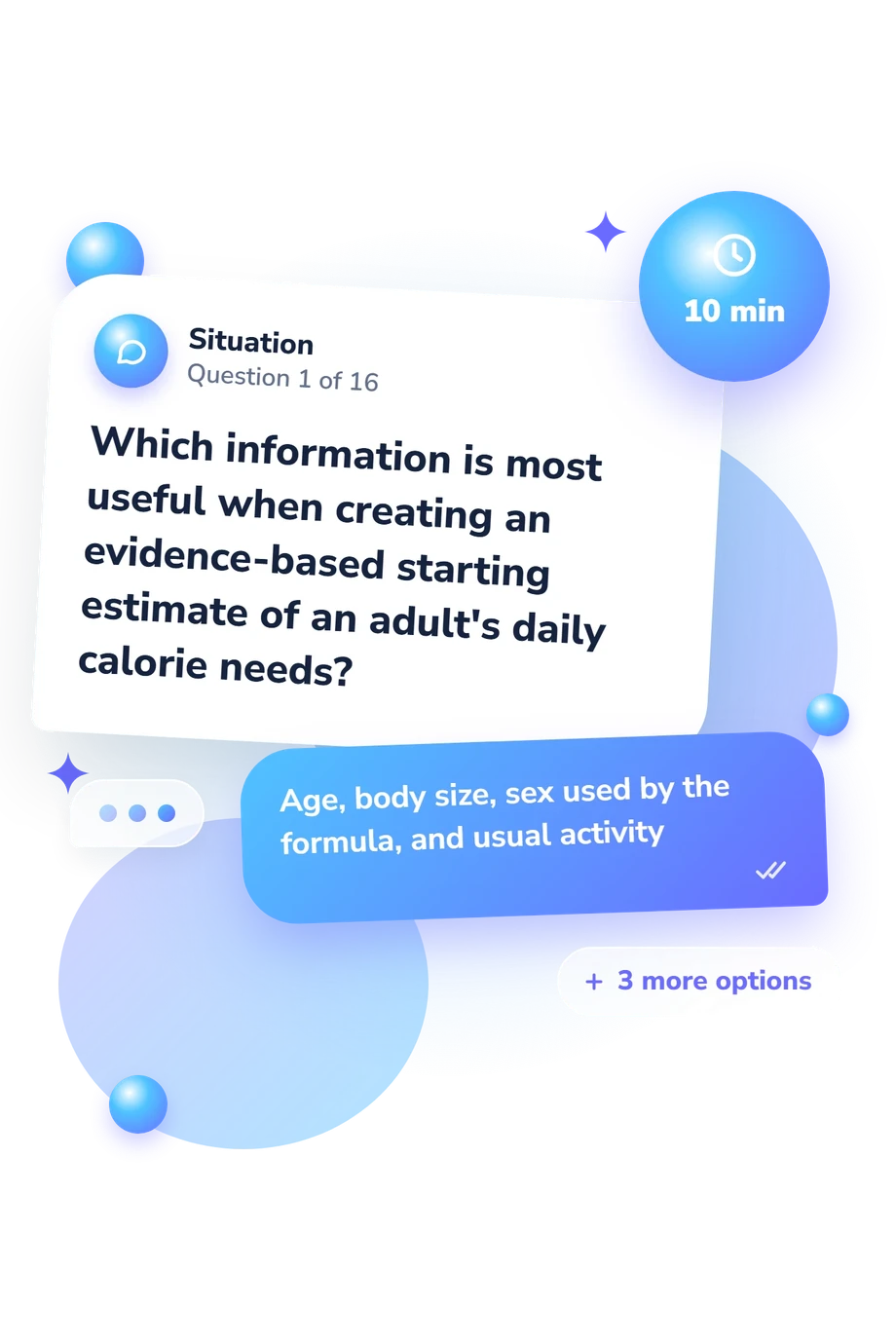
- Age, body size, sex used by the formula, and usual activity
- Meal timing, favorite foods, and water intake
- Body weight alone
- The calorie intake of another person with a similar goal
- Their current maintenance intake is probably near 2,300 calories
- They must increase their intake because weight should change every week
- Their basal metabolic rate is exactly 2,300 calories
- Their activity level cannot affect their calorie needs
- The physical weight of a serving
- The amount of energy food can provide
- The amount of protein in food
- How quickly food is digested
How Many Calories Should I Eat a Day Quiz - Description and methodology of the test
Readers who want to judge calorie information more carefully can use this assessment to examine the reasoning behind everyday estimates. The How Many Calories Should I Eat a Day Quiz helps distinguish a useful starting point from a personal decision that depends on context. People can use this How Many Calories Should I Eat Quiz to frame questions about weight, activity, nutrition, or changing circumstances.
What This Assessment Explores
Questions test whether respondents can interpret calorie needs as estimates shaped by age, body size, sex used by an equation, activity, goals, and longer-term weight trends. They also cover maintenance intake, basal metabolic rate, total daily energy expenditure, serving labels, and short-term scale changes.
The result reflects calorie-estimation knowledge rather than a personal prescription. It helps readers see why activity, body-weight changes, growth, pregnancy, or fluid shifts can affect interpretation. Before considering their own circumstances, people can use this How Many Calories Should I Eat in a Day Quiz to review general nutrition concepts.
The Daily Calorie Needs Knowledge scale reports these bands:
- Foundations to build (0-6) shows that core concepts need review.
- Developing understanding (7-12) shows that context needs attention.
- Strong understanding (13-16) shows thoughtful interpretation of estimates and their uncertainty.
Methodology and Scientific Basis
Each item presents a scenario or knowledge question with answer choices. They test whether respondents distinguish a starting estimate from a fixed prescription, relate maintenance intake to weight stability, and interpret exercise readings, labels, meal composition, and short-term fluctuations cautiously.
Responses are summarized into the displayed knowledge score. The questionnaire does not specify how individual answer choices are weighted; its result is a knowledge summary, not a personal calorie target.
Its content is conceptually consistent with the Mifflin-St Jeor equation, which estimates resting energy expenditure from basic personal variables. It also aligns with the energy-requirement framework in the 2023 Dietary Reference Intakes and FAO/WHO/UNU guidance. These references support the concepts; this questionnaire is not an adaptation of them.
As an online educational questionnaire, performance depends on attention and current understanding. Its score is an unvalidated educational summary, not a clinical target. Unexpected weight change, pregnancy, growth, medical needs, or eating-related distress call for individualized professional guidance. For readers asking how many calories they need, this How Many Calories Do I Need Quiz shows how the educational score supports interpreting estimates.
- Mifflin MD, St Jeor ST, Hill LA, Scott BJ, Daugherty SA, Koh YO. A new predictive equation for resting energy expenditure in healthy individuals. The American Journal of Clinical Nutrition. 1990;51(2):241-247. 10.1093/ajcn/51.2.241
- National Academies of Sciences, Engineering, and Medicine; Health and Medicine Division; Food and Nutrition Board; Committee on the Dietary Reference Intakes for Energy. Dietary Reference Intakes for Energy. Washington, DC: The National Academies Press; 2023. 10.17226/26818
- Food and Agriculture Organization of the United Nations, World Health Organization, United Nations University. Human Energy Requirements: Report of a Joint FAO/WHO/UNU Expert Consultation. FAO Food and Nutrition Technical Report Series No. 1. Rome: Food and Agriculture Organization; 2004.
Updated: