
Hoarding Quiz
How the Scales are Structured
Who Usually Takes This Test?
See How You Compare
Below is a preview of how scores are typically distributed across each scale.
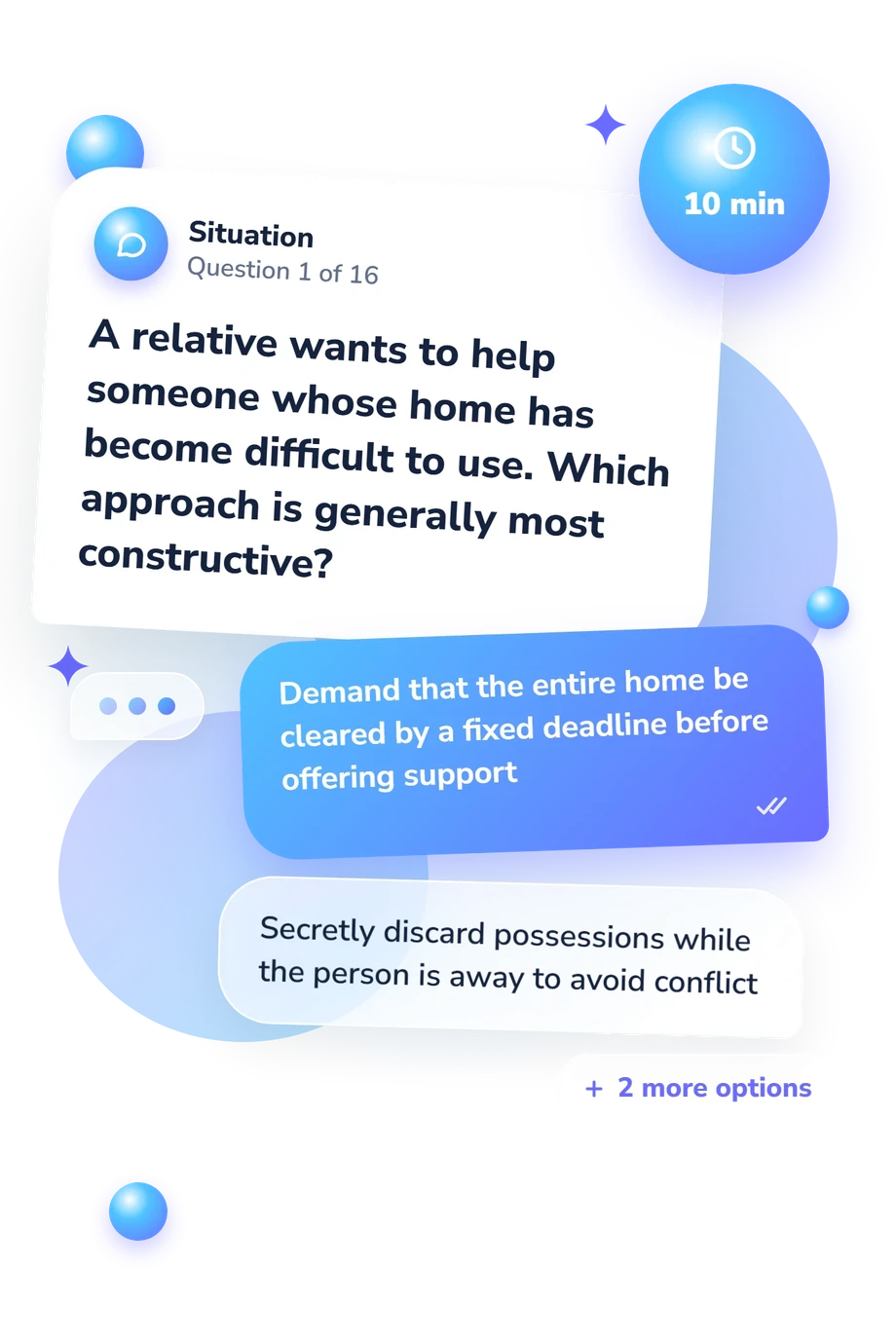
Example Questions From the Test
- Demand that the entire home be cleared by a fixed deadline before offering support
- Secretly discard possessions while the person is away to avoid conflict
- Use respectful conversation, involve the person in decisions, address hazards, and agree on manageable goals
- Avoid mentioning blocked pathways because any discussion will necessarily make matters worse
- Address the ignition hazard and seek appropriate fire-safety or professional support
- Catalog every item before changing the arrangement
- Estimate whether the stored paper has collectible value
- Move additional shelving into the kitchen before touching the stacks
- The possessions mainly belong to one recognizable category
- Other people do not share the owner's interest in the items
- Some possessions have little resale value
- The accumulation substantially compromises living spaces or everyday functioning
Hoarding Quiz - Description and methodology of the test
People who want to understand household accumulation, safety concerns, and supportive responses can use this hoarding quiz to build practical knowledge. It is intended for relatives, friends, carers, and anyone trying to distinguish collecting preferences from patterns that restrict daily living. A hoarder quiz can clarify which concepts deserve attention without judging a person by possessions alone.
What This Assessment Explores
The assessment measures hoarding-related patterns rather than tidiness, property value, or character. It asks readers to notice saving, acquisition, discarding distress, blocked living areas, animal-care problems, and impaired function. By comparing clutter with hoarding, this quiz weighs safety and function rather than belongings alone.
The result is Hoarding Knowledge, ranging from 0-16: Foundational awareness (0-6), Developing knowledge (7-12), and Strong knowledge (13-16). These bands describe recognition of key concepts and practical priorities.
The questions group the assessed knowledge into four areas:
- Safety and function show whether blocked exits, ignition hazards, and unusable rooms are recognized as priorities.
- Acquisition and saving explain how repeated accumulation, perceived future need, and discarding distress can maintain difficulty.
- Supportive responses indicate whether shared decisions, manageable goals, and harm reduction are understood.
- Complexity and welfare cover varying insight, contributing factors, and inadequate animal care.
Methodology and Evidence Base
Each item presents a practical scenario or knowledge question with four response options and one best answer. Themes address discarding difficulty, excessive acquisition, safety priorities, insight, animal welfare, supportive communication, and cognitive-behavioral strategies.
Frost, Steketee, and Tolin (2012) describe assessment domains relevant to saving, discarding, clutter, impairment, and insight. Frost and Hartl (1996) provide a cognitive-behavioral model for saving beliefs and decision-making. Tompkins (2011) supports collaborative harm reduction, while Stumpf and colleagues (2023) address animal-hoarding concerns. This questionnaire is conceptually consistent with those works, not an adaptation of them.
A broader hoarding disorder assessment may consider medical, cognitive, developmental, and other mental-health factors because similar household conditions can have different causes. Here, the displayed total is an unvalidated educational score without an established weighting, norm sample, or clinical cutoff; as a hoarding self-assessment, it cannot diagnose hoarding disorder, and self-report responses may shift with stress, memory, insight, or social desirability. Regardless of the total, blocked exits, fire hazards, unstable piles, sanitation concerns, or danger to people or animals warrant prompt attention from appropriate local services.
- Randy O. Frost, Gail Steketee, and David F. Tolin. "Diagnosis and Assessment of Hoarding Disorder." Annual Review of Clinical Psychology, vol. 8, 2012, pp. 219-242. 10.1146/annurev-clinpsy-032511-143116
- Randy O. Frost and Tamara L. Hartl. "A Cognitive-Behavioral Model of Compulsive Hoarding." Behaviour Research and Therapy, vol. 34, no. 4, 1996, pp. 341-350. 10.1016/0005-7967(95)00071-2
- Michael A. Tompkins. "Working with Families of People Who Hoard: A Harm Reduction Approach." Journal of Clinical Psychology, vol. 67, no. 5, 2011, pp. 497-506. 10.1002/jclp.20797
- Bárbara Perdigão Stumpf, Bárbara Calácio, Beatriz Castello Branco, Bruno Wilnes, Graziella Soier, Lívia Soares, Lucas Diamante, Carolina Cappi, Monicke O. Lima, Fábio Lopes Rocha, Leonardo F. Fontenelle, and Izabela Guimarães Barbosa. "Animal Hoarding: A Systematic Review." Brazilian Journal of Psychiatry, vol. 45, no. 4, 2023, pp. 356-365. 10.47626/1516-4446-2022-3003
Updated: