
Hispanic Heritage Month Quiz
How the Scales are Structured
Who Usually Takes This Test?
See How You Compare
Below is a preview of how scores are typically distributed across each scale.
Example Questions From the Test
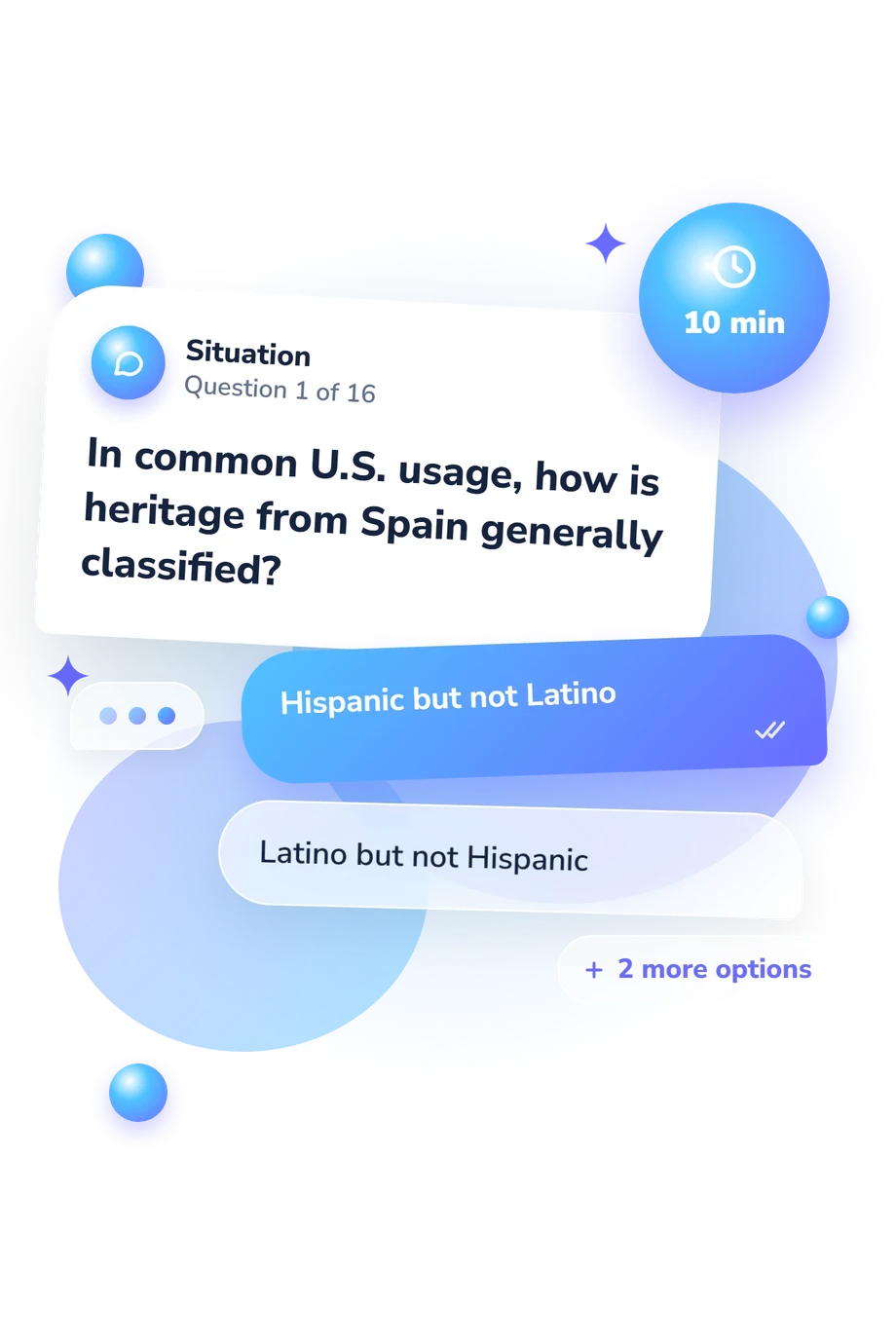
- Hispanic but not Latino
- Latino but not Hispanic
- Both Latino and Central American
- Caribbean but not Hispanic
- September 1 through September 30
- October 1 through October 31
- September 15 through October 15
- October 15 through November 15
- Isabel Allende
- Jorge Luis Borges
- Gabriela Mistral
- Federico García Lorca
Hispanic Heritage Month Quiz - Description and methodology of the test
Readers who want a grounded introduction to the observance can use the Hispanic Heritage Month Quiz to check their understanding and decide what to review next. Students, educators, families, and curious adults can use its Hispanic heritage quiz questions as a structured starting point. The result can guide review by showing where a stronger foundation may be useful.
What This Assessment Explores
Rather than treating Hispanic heritage as one uniform tradition, this assessment samples knowledge of dates, historical development, terminology, notable people, migration, and regional cultures. By including regional traditions, the assessment offers a general-knowledge check through Hispanic culture quiz questions.
The questions cover four areas:
- Terminology distinctions show whether you can separate Hispanic and Latino usage.
- History connects the observance with federal recognition and independence milestones.
- People and contributions link figures with achievements in literature, law, labor, sport, and space exploration.
- Culture and sources compare regional traditions with firsthand accounts and later summaries.
The displayed scale is Hispanic Heritage Month Knowledge, 0-16: Foundations to Build (0-6) shows some key ideas, with dates, origins, and cultural breadth to review; Developing Knowledge (7-12) shows a solid base; Strong Knowledge (13-16) reflects broad accuracy across the quiz topics.
Methodology and Evidence Base
Each item uses a short factual prompt followed by four answer choices, asking you to select the best-supported statement. The themes move between definitions, chronology, people, geography, traditions, and source selection, so the result reflects content knowledge across several domains rather than a personality trait. Because its Hispanic history quiz questions connect these domains, careful distinctions matter more than familiarity with a single country or community.
References to Hernández-Laroche (2025), Sidor (2021), and Public Law 100-402 support specific facts about the observance’s history, while the U.S. Census Bureau’s FAQ supports terminology about Hispanic origin. This questionnaire is a factual multiple-choice knowledge quiz, and its score is not presented as a standardized or validated psychometric measure.
Scoring summarizes selected answers as the displayed total and assigns the named knowledge band. Individual answer weights are not specified, so the result should be read as performance on this set of questions, not as a population norm or complete measure of cultural knowledge. Recall can also be affected by prior education, wording, and current attention. Use the result to identify topics for further reading, especially where historical accuracy and cultural variety deserve closer study.
- Hernández-Laroche, Araceli. 2025. “National Hispanic Heritage Month.” Public Humanities 1: e78, 1-5. 10.1017/pub.2025.10
- Sidor, Gary. National Hispanic Heritage Month: Fact Sheet. Congressional Research Service, Report R44191, updated September 13, 2021; originally authored by Molly Higgins.
- United States Congress. Public Law 100-402, 102 Stat. 1012, August 17, 1988: An Act to Amend Public Law 90-498 to Provide for the Designation of National Hispanic Heritage Month.
- U.S. Census Bureau. Frequently Asked Questions (FAQs) About Hispanic Origin. Page last revised August 31, 2026.
Updated: