
Hangul Quiz
How the Scales are Structured
Who Usually Takes This Test?
See How You Compare
Below is a preview of how scores are typically distributed across each scale.
Example Questions From the Test
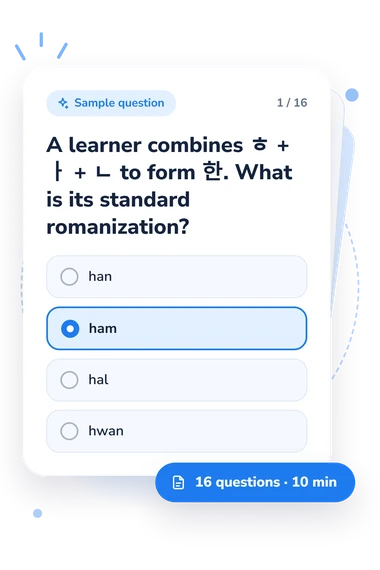
- han
- ham
- hal
- hwan
- a, o, eo, u
- a, eo, o, u
- eo, a, u, o
- a, e, o, eu
- kkot
- kkoch
- kkeot
- got
Hangul Quiz - Description and methodology of the test
For learners building a foundation in Korean writing, the hangul quiz checks whether letter shapes, romanization, and syllable rules connect accurately. It suits students, self-directed beginners, and returning learners who want a precise study checkpoint. A Hangul knowledge test can help you decide whether to revisit core letter mappings before longer syllables. Rather than measuring vocabulary or fluency, the result focuses on recognition of the writing system.
What This Assessment Explores
Rather than testing translation or vocabulary, the questionnaire checks Hangul letter-to-romanization mapping. Items cover vowels and consonants, doubled and aspirated initials, compound vowels, and consonants whose romanization changes with syllable position.
The result uses one scale, Hangul Knowledge (0-16). Its bands are Foundations to build (0-6), Developing recognition (7-12), and Strong recognition (13-16). This reflects mapping recognition, not conversational fluency.
The item themes show which areas the result can help you review:
- Basic vowels and consonants show whether core pairings are readily available.
- Doubled and aspirated consonants indicate how well you separate similar spellings.
- Compound vowels reveal whether combined shapes and labels are easy to distinguish.
- Syllable-position rules show how accurately you apply conventions initially and finally.
The result from this Korean quiz on Hangul turns uncertain mappings into focused study targets before longer syllables.
Methodology and Evidence Base
Each item presents four answer choices built around nearby romanizations. The format asks you to discriminate among vowel values, consonant conventions, compound forms, and syllable-position rules rather than translate Korean words. The displayed result summarizes those selections as a recognition score, with the bands indicating how securely the mappings were identified.
The reference point is the Revised Romanization of Korean, which supplies the conventions used for vowels, consonants, and syllables. Austerlitz and colleagues (1980) document earlier discussion of Korean romanization, and Jung (2013) examines issues that arise when a romanization system operates as a normative standard. This questionnaire is conceptually consistent with those works, not a validated reproduction or direct adaptation of them.
Using this quiz game for Hangul, game-like practice covers small mapping sets; its bands guide romanization review, not general Korean-language proficiency.
Current attention, prior instruction, and familiarity with romanization affect performance. Recognition of written mappings does not establish connected-speech pronunciation and does not measure listening, vocabulary, grammar, or reading fluency. Use the result to select a next study step, while treating broader proficiency as a separate question.
- National Academy of the Korean Language. (2000). The Revised Romanization of Korean. Seoul: National Academy of the Korean Language, Ministry of Culture & Tourism, 33 pp.
- Austerlitz, Robert, Chin-Wu Kim, Samuel E. Martin, S. Robert Ramsey, Ho-min Sohn, Seok Choong Song, and Edward W. Wagner. (1980). Report of the Workshop Conference on Korean Romanization. Korean Studies, 4, 111-125.
- Jung, Kyung-il. (2013). Some Issues on the Korean Romanization as the Normative Law. Linguistics, 21(1), 139-154. 10.24303/lakdoi.2013.21.1.139
Updated: