
Hand Hygiene Quiz
How the Scales are Structured
Who Usually Takes This Test?
See How You Compare
Below is a preview of how scores are typically distributed across each scale.
Example Questions From the Test
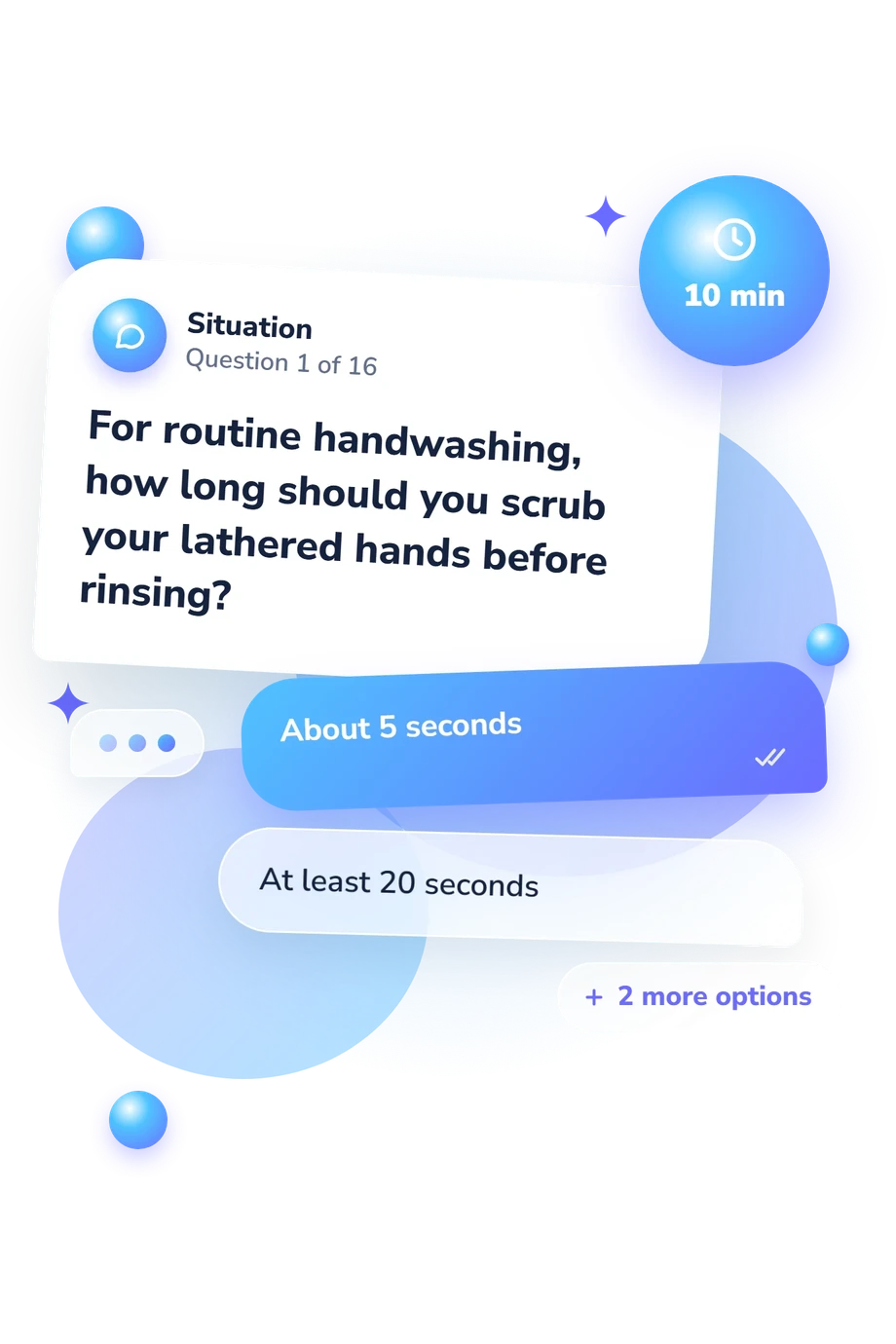
- About 5 seconds
- At least 20 seconds
- At least 60 seconds every time
- Until the water becomes hot
- Apply it only to the palms, where most contact occurs.
- Wipe it off with a towel after a few seconds.
- Cover all hand surfaces and rub until your hands are dry.
- Add water so it spreads more easily over the skin.
- Hand hygiene is unnecessary if the gloves did not tear.
- Hand hygiene can wait until the end of the shift.
- The worker only needs to clean the fingertips.
- The worker should perform hand hygiene immediately.
Hand Hygiene Quiz - Description and methodology of the test
People who want to check whether their everyday choices match basic infection-prevention guidance can use this hand hygiene quiz as a focused self-assessment. It is suited to readers reviewing routine hygiene at home, during food preparation, while travelling, or in clinical settings. Nurses can use this questionnaire as a handwashing quiz for nurses when refreshing their knowledge, while the result gives an overall indication across the covered situations.
What This Assessment Explores
The questionnaire examines practical knowledge about when hand hygiene is needed and which method fits the situation. Scenarios cover routine washing, sanitizer, visible soil, food handling, illness-related cleanup, glove removal, and aseptic care. The focus is choosing an appropriate action when contamination or recontamination is possible, not measuring dexterity.
Key themes include:
- Routine cleaning shows whether you know the sequence, duration, coverage, rinsing, drying, and nail care required.
- Context-sensitive protection reflects choices after raw-food contact, illness exposure, shared surfaces, or a minor cut.
- Clinical awareness covers hand hygiene around gloves and aseptic procedures, including moments when cleaning cannot wait.
Taken together, these items measure decision knowledge across situations. Hand Hygiene Knowledge is scored from 0-16, with Foundations to build (0-6), Developing knowledge (7-12), and Strong knowledge (13-16). These bands describe educational knowledge, not certification of technique or infection control.
Methodology and Evidence Base
Each item presents a practical situation with several answer choices, asking you to select the response that best matches established hand-hygiene guidance. The hand hygiene questionnaire reports the displayed educational result and its bands; those bands describe knowledge represented by these situations rather than observed technique.
The questionnaire is conceptually consistent with the WHO Hand Hygiene Knowledge Questionnaire but is a separate online questionnaire, with no stated standardization or norms. CDC guidance supports the everyday content on soap, sanitizer, drying, and when visibly dirty hands require washing. The consensus recommendations associated with Pittet, Allegranzi, and Boyce add clinical context for glove removal and aseptic procedures.
This handwashing quiz can prompt teaching discussion, yet written answers cannot show whether someone performs each step correctly. Self-report is also affected by recall, interpretation, and current attention. Use the result to target review of particular situations; broader assessment is needed when actual workplace competence or infection-control performance must be judged.
- World Health Organization. Hand Hygiene Knowledge Questionnaire for Health-Care Workers (revised August 2009). Geneva: World Health Organization; 2009.
- Centers for Disease Control and Prevention. About Handwashing. Clean Hands. February 16, 2024.
- Pittet D, Allegranzi B, Boyce J, World Health Organization World Alliance for Patient Safety First Global Patient Safety Challenge Core Group of Experts. The World Health Organization Guidelines on Hand Hygiene in Health Care and their consensus recommendations. Infection Control and Hospital Epidemiology. 2009;30(7):611-622. 10.1086/600379
Updated: