
Hair Porosity Quiz
How the Scales are Structured
Who Usually Takes This Test?
See How You Compare
Below is a preview of how scores are typically distributed across each scale.
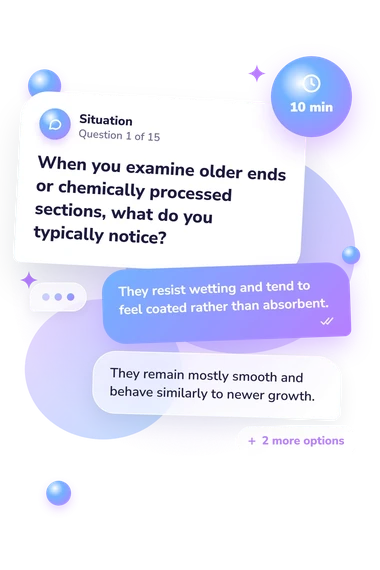
Example Questions From the Test
- They resist wetting and tend to feel coated rather than absorbent.
- They remain mostly smooth and behave similarly to newer growth.
- They are somewhat rougher or tangle more easily than the roots.
- They feel distinctly rough, catch on one another, and lose moisture much faster than newer growth.
- Droplets remain visible on the surface for a prolonged time.
- The mist distributes evenly and provides a steady, lasting refresh.
- The hair absorbs it quickly, with a moderate improvement in softness.
- The hair drinks it in immediately but soon seems to need more water or conditioner.
- It beads on the surface and takes sustained effort to work in.
- The hair wets after a moderate, steady amount of time.
- It becomes wet quickly with very little encouragement.
- It appears to soak up water almost instantly.
Hair Porosity Quiz - Description and methodology of the test
When roots, older ends, and processed sections respond differently, routine advice can feel contradictory. For readers trying to decide whether a heavy conditioner, lightweight product, or extra conditioning time fits their observations, the hair porosity quiz organizes those contrasts into a clearer picture of moisture behavior. This porosity quiz helps connect section-specific evidence with practical next steps.
What This Assessment Explores
This hair porosity test focuses on wetting, drying, conditioning, product weight, and moisture retention across roots, ends, and processed sections. Its prompts help the reader notice whether water beads, absorbs quickly, or is followed by rapid dryness. It suits anyone comparing routine observations, especially when different areas behave differently.
The three displayed profiles are:
- High-Porosity Affinity (0-15) indicates rapid absorption and moisture loss; Limited affinity (0-5), Mixed affinity (6-10), and Strong affinity (11-15) mark increasing alignment.
- Low-Porosity Affinity (0-15) indicates surface resistance; Limited affinity (0-5), Mixed affinity (6-10), and Strong affinity (11-15) mark increasing alignment.
- Medium-Porosity Affinity (0-15) indicates steady wetting and retention; Limited affinity (0-5), Mixed affinity (6-10), and Strong affinity (11-15) mark increasing balance.
Together, they support section-specific care rather than assigning one fixed label to the whole head.
Methodology and Evidence Base
Each item describes a familiar hair-care situation and offers four response descriptions, covering resistant wetting, surface buildup, rapid absorption, moisture loss, or steadier behavior. Answer from repeated experience rather than a single observation. Responses are grouped into the displayed profile totals; because the per-answer key is not stated, the exact points assigned to individual choices should not be inferred.
The study by Gasparin and colleagues is the closest match because it examines porosity alongside physical and chemical damage under consumer-relevant conditions. Hessefort and colleagues distinguish practical observations from laboratory measurement, while Fuse and colleagues show that water uptake varies across time and locations in human hair. The questionnaire is conceptually consistent with this research, but it is not an adaptation of any of those published studies.
Taken together, the hair porosity results form an informal care profile rather than a standardized or laboratory-confirmed classification. Buildup can resemble low porosity, and older or processed sections can behave more like high porosity. Product buildup, weather, current hair condition, and self-report bias can shape responses, so use the result to guide observation and modest routine changes.
- Mantuan Gasparin, Rebeca, Carolina Botelho Lourenço, and Gislaine Ricci Leonardi. "Porosity and Resistance of Textured Hair: Assessing Chemical and Physical Damage Under Consumer-Relevant Conditions." Cosmetics, 2025, 12(3), 93. 10.3390/cosmetics12030093
- Hessefort, Yin Z., Brian T. Holland, and Richard W. Cloud. "True Porosity Measurement of Hair: A New Way to Study Hair Damage Mechanisms." Journal of Cosmetic Science, 2008, 59(4), 303-315.
- Fuse, Naoya, Masashi Matsui, and Yukako Matsue. "Temporal and Spatial Visualization of Water Uptake into Human Hair Studied by Infrared Microscopy." Analytical Sciences, 2022, 38(3), 601-605. 10.1007/s44211-022-00074-x
Updated: