
Gerund Quiz
How the Scales are Structured
Who Usually Takes This Test?
See How You Compare
Below is a preview of how scores are typically distributed across each scale.
Example Questions From the Test
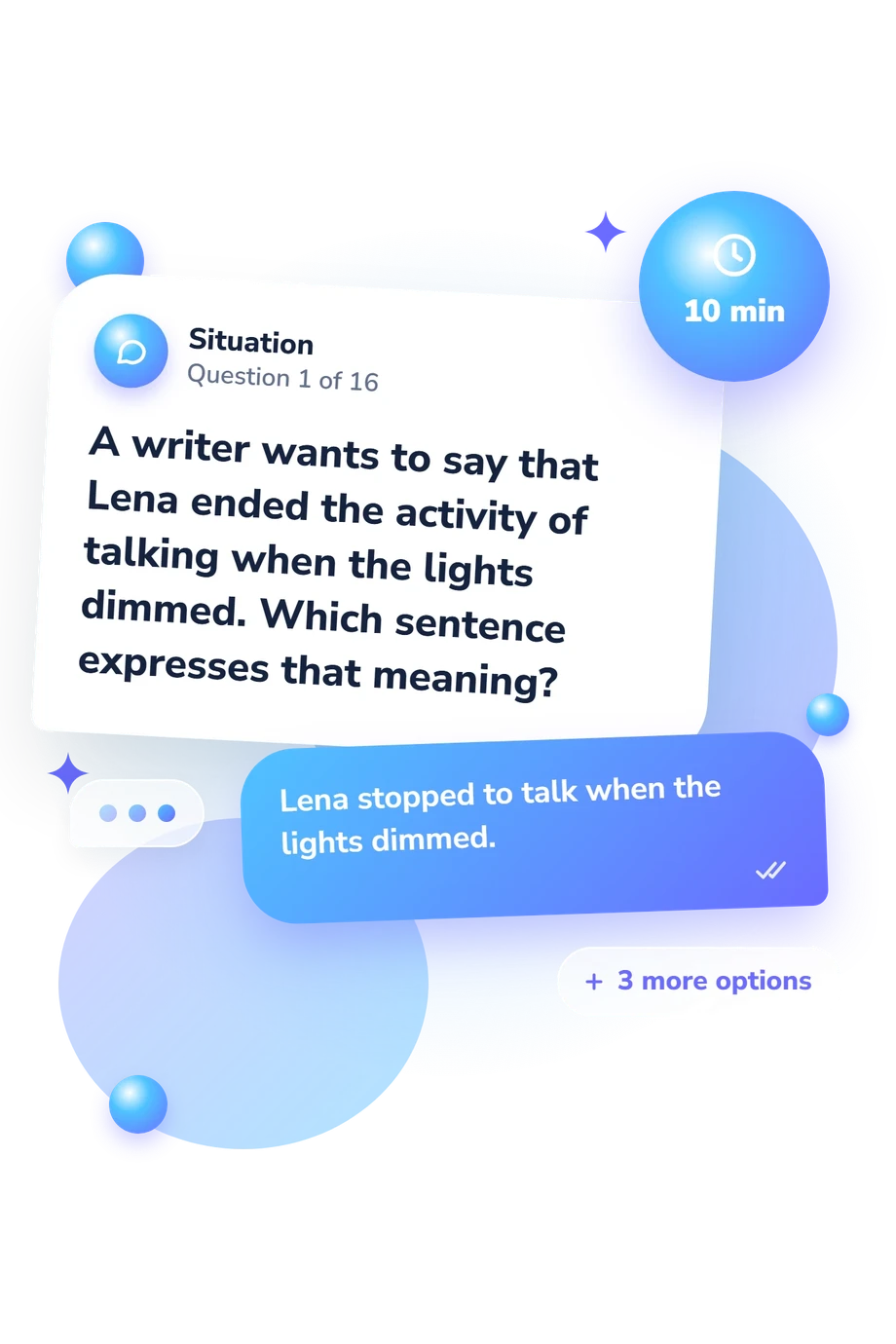
- Lena stopped to talk when the lights dimmed.
- Lena stopped talking when the lights dimmed.
- Lena was stopping to talk when the lights dimmed.
- Lena stopped for a talk when the lights dimmed.
- Nora likes hike, swim, and cycling.
- Nora likes hiking, to swim, and cycling.
- Nora likes to hike, swimming, and to cycle.
- Nora likes hiking, swimming, and cycling.
- Painting landscapes helps Mara relax.
- Mara enjoys painting the hallway.
- They talked about painting the hallway.
- They are painting the hallway today.
Gerund Quiz - Description and methodology of the test
Students, teachers, and independent learners can use this Gerund Quiz to check whether they understand how -ing forms behave in English sentences. It focuses on practical recognition and application rather than memorizing a single definition. This gerund practice quiz can show which grammatical distinctions deserve review, so the result points toward more precise reading, editing, and writing.
What This Assessment Explores
These items assess whether you can identify an -ing form by function, not spelling alone. The questions also examine gerund phrases, distinguishing noun-like gerunds from other -ing forms and checking how surrounding words complete each construction.
The main areas are:
- Grammatical roles show whether you can separate gerunds from other -ing forms.
- Phrase structure shows whether you can recognize objects, modifiers, and complements within a complete gerund phrase.
- Sentence functions show whether gerund phrases act as subjects, objects, objects of prepositions, or subject complements.
- Usage patterns show whether you can apply parallel structure, agreement, and verb-complement choices.
These areas contribute to the Gerund Knowledge scale, scored from 0-16 by correct answers. Its bands are Foundations to build (0-6), Developing understanding (7-12), and Strong understanding (13-16), indicating increasing control of gerunds and gerund phrases in varied contexts.
Methodology and Evidence Base
Each item uses a multiple-choice format with one best answer. As a gerund grammar test, it asks learners to interpret meaning, identify phrase boundaries, classify an -ing form, or complete a sentence; closely related options make the grammatical distinction matter. The method therefore checks applied recognition rather than terminology recall alone.
The score is based on the number of correct answers, reflecting performance on the grammatical distinctions tested here. The displayed categories summarize performance on this item set rather than rank a respondent against a norm group.
Hudson’s analysis of gerunds considers relationships among words, phrases, and sentence functions. Huddleston and Pullum’s grammatical framework supports distinctions here, including gerunds, participles, complements, and clause roles. The questionnaire is conceptually consistent with these analyses, but it is not presented as an adaptation of either published work.
This online questionnaire has no reported norm comparison or reliability estimate, so the result is best read as a focused learning profile. Familiarity with terminology, attention to wording, and the examples encountered can affect performance; the score describes the tested skills, not every possible use of gerunds in English.
- Hudson, Richard. "Gerunds." In Language Networks: The New Word Grammar, 183-210. Oxford University Press, 2006. 10.1093/oso/9780199267309.003.0004
- Huddleston, Rodney, and Geoffrey K. Pullum. The Cambridge Grammar of the English Language. Cambridge University Press, 2002. 10.1017/9781316423530
Updated: