
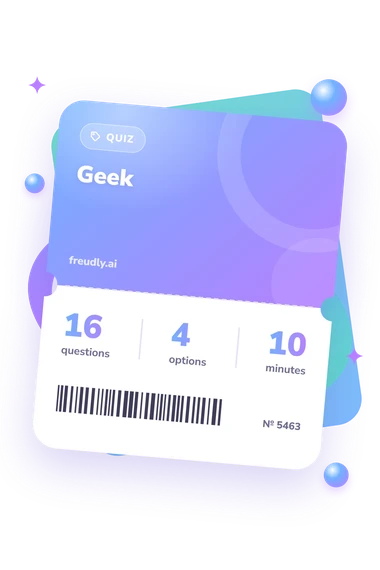
Geek Quiz
How the Scales are Structured
Who Usually Takes This Test?
See How You Compare
Below is a preview of how scores are typically distributed across each scale.
Example Questions From the Test
- A 6-sided die
- A 12-sided die
- A 10-sided die
- A 20-sided die
- Reliance on luck
- Pursuit of personal wealth
- Discipline through logic
- Rejection of scientific inquiry
- The paragraph element, <p>
- The image element, <img>
- The anchor element, <a>
- The heading element, <h1>
Geek Quiz - Description and methodology of the test
People who enjoy technology, science, games, comics, fantasy, or science fiction can use this geek quiz to see how widely their knowledge travels across geek culture. It suits curious fans, casual participants, and experienced enthusiasts who want a focused profile of familiar and less familiar ground. A quiz asking whether you are a geek is most useful here as a prompt for self-reflection, not as an identity label.
What This Assessment Explores
Rather than measuring enthusiasm, status, or personality, the questionnaire checks recognition of facts across geek culture. Its items move from HTML, DNS, binary notation, and logic to science, games, comics, fantasy, and science fiction. A quiz about being a nerd or a geek is useful here for showing knowledge patterns, not declaring identity.
The thematic groups represented are:
- Technology and computing cover code, networks, number systems, and tools.
- Science and logic test measurement, circuits, astronomy, and reasoning.
- Games and strategy examine rules, tactics, and play systems.
- Comics and media check characters, worlds, and cultural details.
- Fantasy and science fiction assess recall of settings and terms.
Geek Culture Knowledge (0-16) counts correct answers. Foundations Forming (0-6) shows room to build, Developing Range (7-12) reflects solid but uneven knowledge, and Strong Range (13-16) indicates broad, accurate coverage. It describes this quiz only, not intelligence or personal value.
Methodology and Scientific Basis
Each item presents a question with four answer choices. The format tests factual recall or basic application, so prior exposure, wording, and guessing can affect the total. Scoring is a direct count of correct responses; no norm-based conversion or hidden weighting is stated.
Results from a quiz asking how geek you are are therefore a snapshot across selected topics, not a percentile or measure of general ability.
The subject matter is conceptually consistent with the Geek Culture Engagement Scale (McCain et al., 2015), which examines engagement with geek interests and activities. This questionnaire is not an adaptation: it tests knowledge rather than participation, identity, motivation, or personality.
Haladyna, Downing, and Rodriguez support clear stems and plausible alternatives, while the 2014 testing standards support cautious interpretation. The questionnaire is an online self-reflection tool, not a standardized test with population norms.
A quiz asking whether you are a nerd or a geek can be influenced by language, education, franchise exposure, current attention, and uneven familiarity. Honest responses improve the profile, but one total cannot represent every interest or level of expertise.
- McCain, Jessica, Brittany Gentile, and W. Keith Campbell. “A Psychological Exploration of Engagement in Geek Culture.” PLOS ONE 10, no. 11 (2015): e0142200. 10.1371/journal.pone.0142200
- Haladyna, Thomas M., Steven M. Downing, and Michael C. Rodriguez. “A Review of Multiple-Choice Item-Writing Guidelines for Classroom Assessment.” Applied Measurement in Education 15, no. 3 (2002): 309-333. 10.1207/S15324818AME1503_5
- American Educational Research Association, American Psychological Association, and National Council on Measurement in Education. Standards for Educational and Psychological Testing. Washington, DC: American Educational Research Association, 2014.