
Future Partner Quiz
How the Scales are Structured
Who Usually Takes This Test?
See How You Compare
Below is a preview of how scores are typically distributed across each scale.
Example Questions From the Test
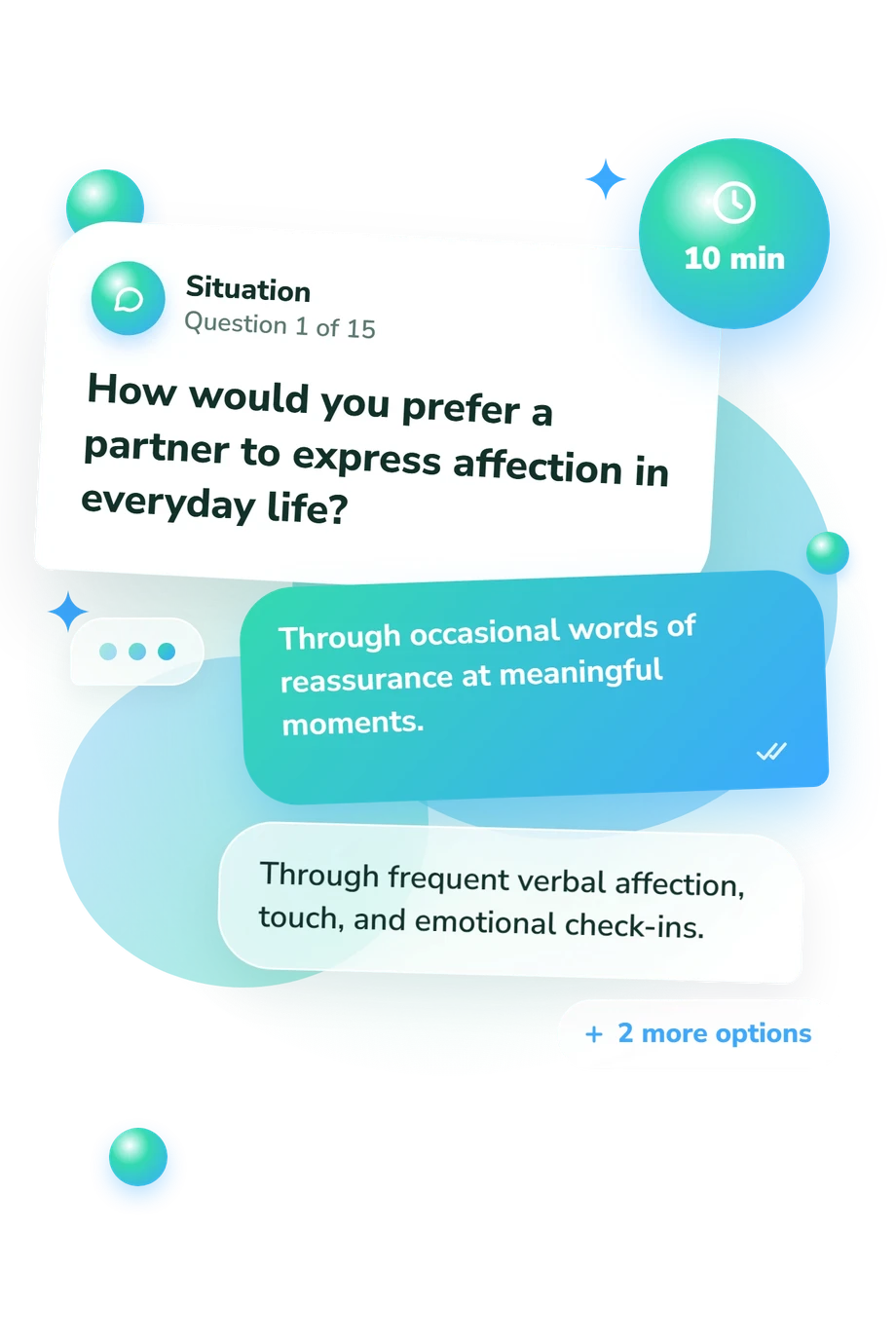
- Through occasional words of reassurance at meaningful moments.
- Through frequent verbal affection, touch, and emotional check-ins.
- Through regular moments of warmth and a few deeper conversations each week.
- Mostly through reliability, help, and actions rather than emotional language.
- Explore the concern together, while keeping the conversation focused.
- Reassure them mainly through consistent behaviour over the following days.
- Offer brief reassurance and ask whether they want to say more.
- Invite a full conversation about the fear, its source, and what each of us needs.
- Mostly shared, with us attending social events together whenever possible.
- Strongly connected, though each person could sometimes see friends separately.
- A mix of mutual friends, separate friendships, and both joint and solo plans.
- Largely independent social circles, with selected occasions brought together.
Future Partner Quiz - Description and methodology of the test
People considering what they need from a committed relationship can use this future partner quiz to examine preferences before turning them into expectations. Instead of predicting a specific person, the assessment organizes closeness, independence, and joint planning that may feel natural to you. It reframes the question behind a who will be my life partner quiz as a profile of relationship preferences.
What This Assessment Explores
Scenarios about affection, conflict, social lives, money, and future decisions reveal which patterns feel natural to you. The profile helps you compare preferences for closeness, independence, and joint planning with the relationship you want, clarifying preferred partnership dynamics in everyday life. The profile has three dimensions:
- Emotional Openness: A 0-15 result reflects how much emotional expression and discussion you prefer: Private Connection (0-5), Selective Openness (6-10), or Deep Openness (11-15).
- Personal Autonomy: A 0-15 result reflects how much independence and personal space you prefer: Closely Interwoven (0-5), Balanced Space (6-10), or Strong Autonomy (11-15).
- Shared Direction: A 0-15 result reflects how strongly you want a partner to coordinate plans, priorities, and long-term choices: Flexible Path (0-5), Coordinated Direction (6-10), or Shared Blueprint (11-15).
Together, these bands describe style preferences, not relationship quality. Higher or lower scores are not measures of caring, commitment, or success.
Methodology and Evidence Base
Each scenario offers four response options; choose the one closest to your preferred pattern. Prompts cover affection, reassurance, social connection, private time, money, conflict, and long-term decisions, keeping the focus on practical expectations rather than right answers.
The questionnaire groups responses into the displayed profile, but no response-by-response point formula is provided. Treat the ranges as descriptive summaries and do not infer extra scoring rules from them. This online questionnaire has no stated population norms or validation; its bands describe preference patterns rather than population cutoffs or diagnostic thresholds.
The questionnaire is conceptually consistent with the Ideal Partner Scales (Fletcher et al., 1999), which examines desired qualities in intimate relationships. Its future partner profile is not an adaptation of that instrument. Closeness alongside independence is consistent with autonomy-in-relatedness research (Kluwer et al., 2020).
Because it is a self-report profile, current circumstances, past experiences, and self-awareness can influence the result; use it to reflect on the partnership style you prefer.
- Fletcher, Garth J. O., Jeffry A. Simpson, Geoff Thomas, and Louise Giles. (1999). Ideals in intimate relationships. Journal of Personality and Social Psychology, 76(1), 72-89. 10.1037/0022-3514.76.1.72
- Fowers, Blaine J., Jean-Philippe Laurenceau, Randall D. Penfield, Laura M. Cohen, Samantha F. Lang, Meghan B. Owenz, and Elizabeth Pasipandoya. (2016). Enhancing Relationship Quality Measurement: The Development of the Relationship Flourishing Scale. Journal of Family Psychology, 30(8), 997-1007. 10.1037/fam0000263
- Kluwer, Esther S., Johan C. Karremans, Larisa Riedijk, and C. Raymond Knee. (2020). Autonomy in Relatedness: How Need Fulfillment Interacts in Close Relationships. Personality and Social Psychology Bulletin, 46(4), 603-616. 10.1177/0146167219867964
Updated: