
Funny Sex Quiz
How the Scales are Structured
Who Usually Takes This Test?
See How You Compare
Below is a preview of how scores are typically distributed across each scale.
Example Questions From the Test
- They only date people with similar personalities
- They prefer activities they regard as conventional or non-kinky
- They avoid discussing intimacy
- They are inexperienced in every kind of relationship
- The number of sexual partners the person has had
- How many people the person has dated online
- How many serious relationships the person has had
- How many dates the person has ended early
- Ending relationships before major holidays
- Avoiding dating while the weather is cold
- Trying new dating apps at the start of spring
- Seeking a steady partner during colder months
Funny Sex Quiz - Description and methodology of the test
People who want to understand sexual and dating language can use the Funny Sex Quiz as a knowledge check rather than a measure of personal experience. It suits readers who encounter terms online, in conversation, or in culture and want to build sex vocabulary while distinguishing familiar meanings from expressions that need context. Its playful questions keep the vocabulary approachable, while the score leaves consent and boundaries outside the assessment.
What This Assessment Explores
The questionnaire measures recognition of sexual and dating slang, especially whether a reader can identify common meanings without assuming that every expression is precise. Items cover casual arrangements, sexual interests, communication practices, dating patterns, online behavior, and affectionate physical terms. This assessment helps clarify dating slang terms and highlights where further explanation matters.
Its displayed scale is Sexual Slang Knowledge (0-16). The result describes vocabulary familiarity, not sexual experience, consent skill, health knowledge, or safety behavior. These are the bands shown to the reader:
- Slang Starter (0-6) indicates recognition of familiar expressions while suggesting that meanings may need checking.
- Conversationally Clued-In (7-12) indicates understanding of much of the vocabulary, including terms whose meaning changes with context.
- Slang Savvy (13-16) indicates strong recognition of widely used sexual and dating slang alongside awareness that clarification still matters.
Methodology and Evidence Base
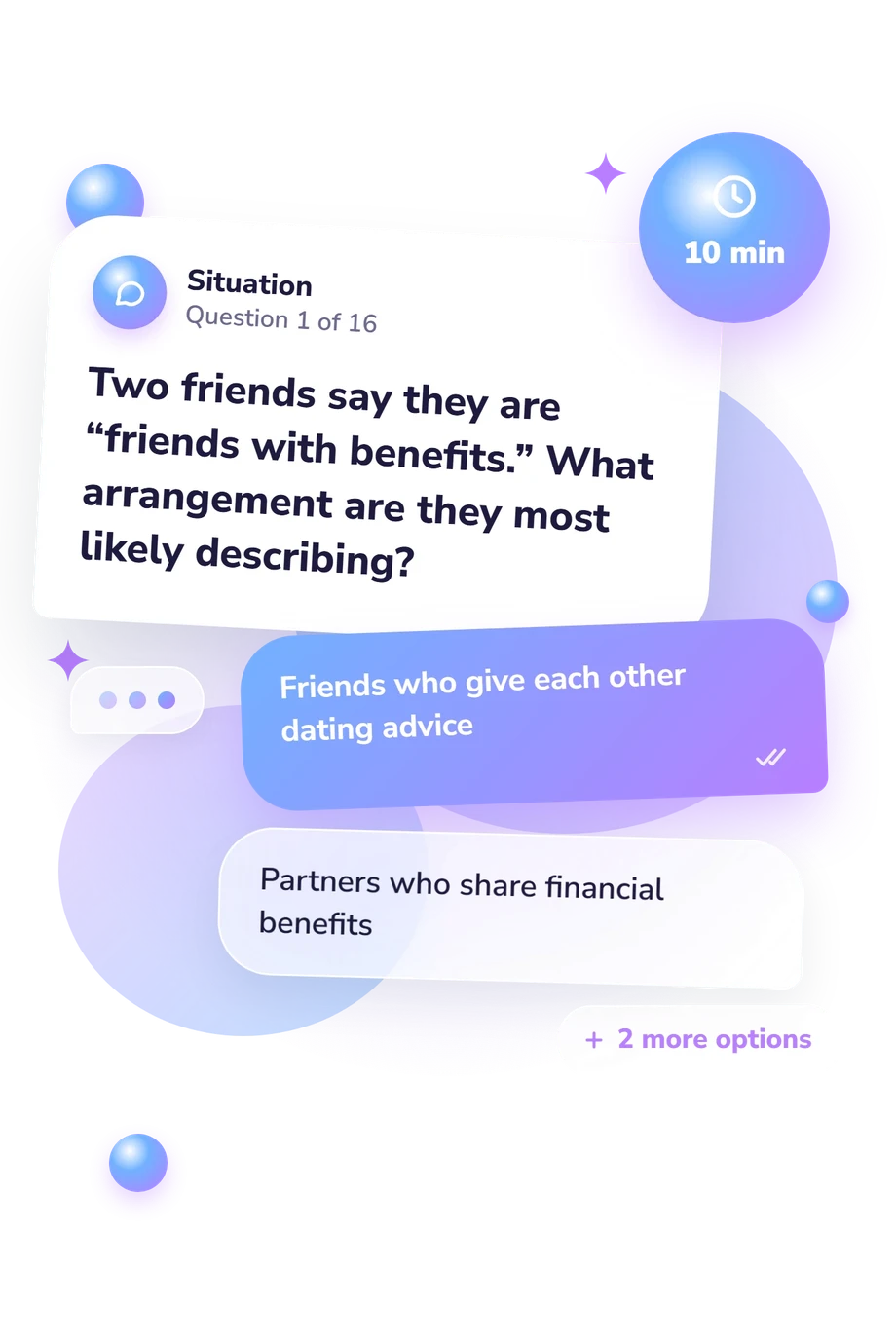
Each item presents a brief scenario or definition with four answer choices. The respondent selects the best-fitting meaning, and the questionnaire presents one displayed knowledge scale rather than separate category scores. The result bands describe performance on vocabulary recognition.
Braun and Kitzinger provide the closest conceptual reference because sexual slang can be nonspecific and shaped by context. Wentland and Reissing help situate terms for casual sexual relationships, while Wells treats erotic vocabulary as part of interpersonal communication. These studies are conceptual comparisons, not source instruments adapted into this questionnaire.
Slang changes across regions, generations, peer groups, and platforms, and sexual slang meanings may shift; terms such as hookup or third base may remain deliberately broad. Results may also reflect current context, personal familiarity, and the tendency to choose an expected answer, so this questionnaire can clarify ambiguous wording and prompt discussion about communication. This online format is an educational self-reflection tool. The displayed bands are descriptive, and the questionnaire has no stated population norms or validation statistics.
- Braun, Virginia, and Celia Kitzinger. "Snatch," "Hole," or "Honey-pot"? Semantic categories and the problem of nonspecificity in female genital slang. Journal of Sex Research, 38(2), 146-158 (2001). 10.1080/00224490109552082
- Wentland, Jocelyn J., and Elke Reissing. Casual sexual relationships: Identifying definitions for one night stands, booty calls, fuck buddies, and friends with benefits. The Canadian Journal of Human Sexuality, 23(3), 167-177 (2014). 10.3138/cjhs.2744
- Wells, Joel W. The sexual vocabularies of heterosexual and homosexual males and females for communicating erotically with a sexual partner. Archives of Sexual Behavior, 19(2), 139-147 (1990). 10.1007/BF01542228
- Ousley, Opal Y., and Gary B. Mesibov. Sexual attitudes and knowledge of high-functioning adolescents and adults with autism. Journal of Autism and Developmental Disorders, 21(4), 471-481 (1991). 10.1007/BF02206871
Updated: