
Flags of Asia Quiz
How the Scales are Structured
Who Usually Takes This Test?
See How You Compare
Below is a preview of how scores are typically distributed across each scale.
Example Questions From the Test
- Bhutan
- Qatar
- Nepal
- Sri Lanka
- Indonesia
- Japan
- Singapore
- Vietnam
- Kazakhstan
- Kyrgyzstan
- Bhutan
- Mongolia
Flags of Asia Quiz - Description and methodology of the test
For learners building visual geography knowledge, the Flags of Asia Quiz offers a focused way to test recognition of national symbols rather than recall of capital cities or political facts. Its visual approach makes it a practical Asia flag quiz for people who want to read information directly from a flag. The exercise rewards close attention to color, geometry, and national emblems.
What This Assessment Explores
Rather than measuring history knowledge, this assessment asks readers to identify Asian national flags from visible features. Questions use color sequences, field shapes, emblems, crescents, stars, circles, dragons, and other symbols. This Asian flags quiz suits learners, travelers, teachers, and anyone developing awareness through visual practice.
The item groups are:
- Color arrangements show whether you use bands, fields, and repeated stripes as clues.
- Symbols test recognition of suns, moons, stars, wheels, animals, and national devices.
- Structure reveals attention to pennant shapes, diagonal divisions, proportions, and emblem placement.
- Regional comparison shows how well you separate neighboring or visually similar designs.
The questionnaire tests recognition in this Asian countries flag quiz and produces one overall result. Flags of Asia Knowledge (0-16) is reported as Foundation to Build (0-6), Developing Knowledge (7-12), or Strong Knowledge (13-16), showing your level of Asian flag knowledge.
Methodology and Evidence Base
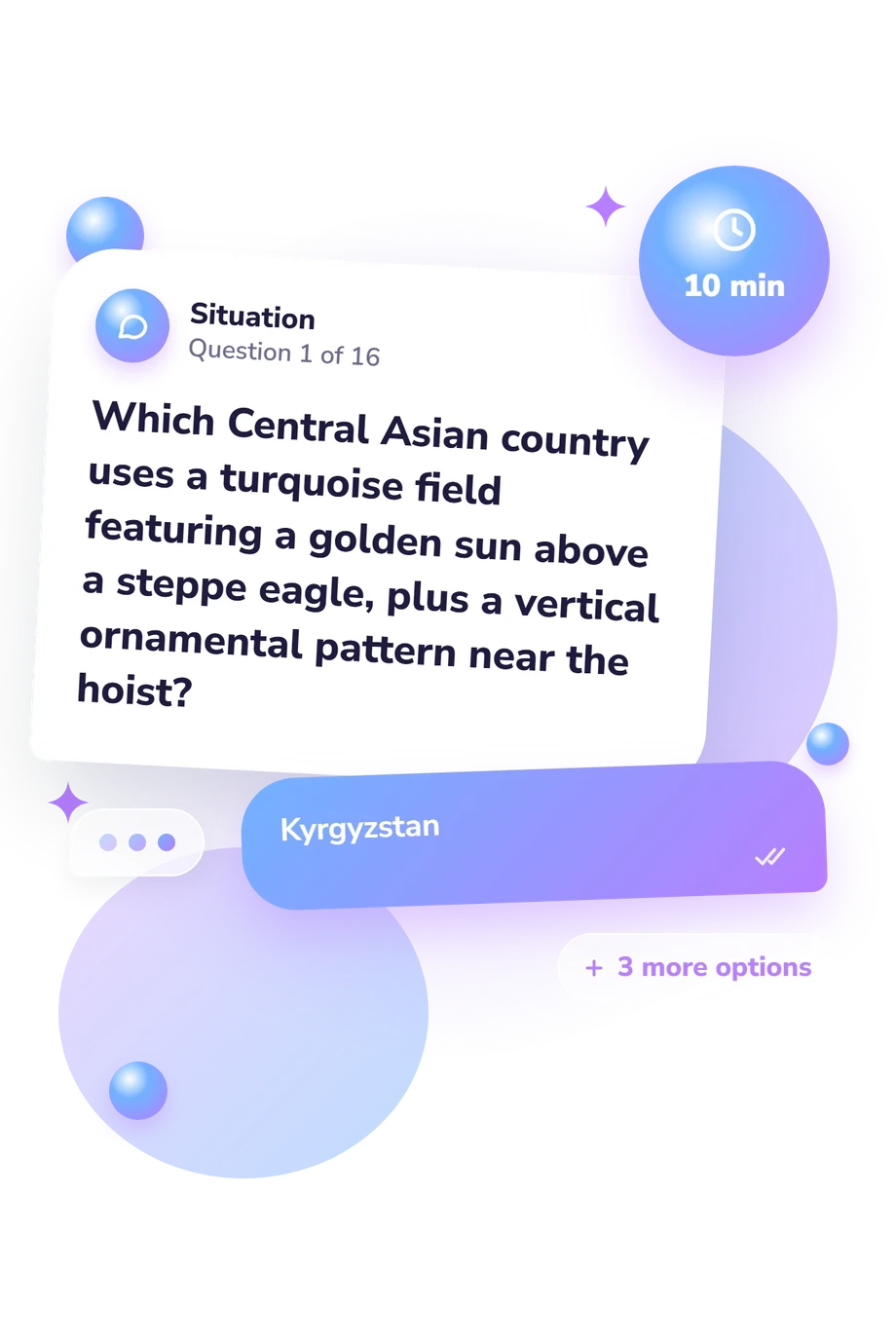
Each item in this flags of Asian countries quiz presents a verbal description of one flag and four country choices. The respondent selects the option matching its colors, layout, or emblem. Scoring is based on correct-answer performance, so the displayed result summarizes how many flag descriptions the respondent identifies accurately. The format relies on visual discrimination rather than written recall when identifying flags of Asian countries.
Morales-Ramírez (2023) reports a conceptually related study linking map knowledge with national-flag recognition. This questionnaire is conceptually consistent with that work, but it is not an adaptation of it. Znamierowski (2020) offers descriptive reference material for comparing international flags, while Hart, Cha, and Tappert (2004) provide relevant format literature on interactive identification tasks. These sources do not standardize or validate this online questionnaire.
Interpret the result as a snapshot of current familiarity. Travel, schooling, media exposure, and previous practice can affect performance, while visual confusion or rushed choices can reduce accuracy. The bands are descriptive learning categories, not population norms or clinical thresholds.
- Morales-Ramírez, Carlos A. (2023). "Seeing the World through Maps: The Effectiveness of Map Knowledge in Flag Recognition." Cartographica: The International Journal for Geographic Information and Geovisualization, 58(1), 39-46. 10.3138/cart-2022-0021.
- Znamierowski, Alfred (2020). The World Encyclopedia of Flags: An Illustrated Guide to International Flags, Banners, Standards and Ensigns. Lorenz Books, 256 pages. ISBN 9780754834809.
- Hart, Eduardo; Cha, Sung-Hyuk; and Tappert, Charles C. (2004). "Interactive Flag Identification." CSIS Technical Reports, no. 17. Pace University.
Updated: