
Fitzpatrick Skin Type Quiz
How the Scales are Structured
Who Usually Takes This Test?
See How You Compare
Below is a preview of how scores are typically distributed across each scale.
Example Questions From the Test
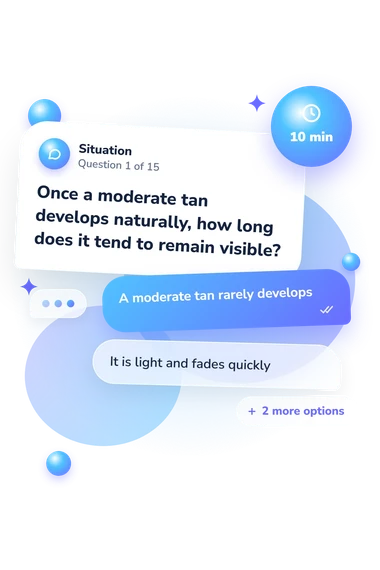
- A moderate tan rarely develops
- It is light and fades quickly
- It remains deep or visible for many months
- It usually remains visible for several weeks
- I tended to burn repeatedly rather than gain color
- I gained only a slight amount of color
- I gained a deep color quite quickly
- I developed a progressive, moderate tan
- I developed a painful burn or peeling with little tanning
- I developed clear redness or tenderness before tanning
- My skin mostly deepened, with mild discomfort at most
- My skin usually deepened without an obvious visible burn
Fitzpatrick Skin Type Quiz - Description and methodology of the test
People who want to understand their typical response to sunlight can use the Fitzpatrick Skin Type Quiz to organize memories of burning, tanning, pigmentation, and seasonal change. It is intended for personal reflection by anyone unsure how to describe their sun response. The result offers a structured skin-type profile, so a Fitzpatrick scale quiz can turn scattered experiences into a clearer starting point for protection choices.
What This Assessment Explores
The questions cover burning, tanning, baseline pigmentation, and the visibility or persistence of color change. They ask about natural tone, freckles, seasonal shifts, tan duration, and reactions to ordinary or intense exposure. A Fitzpatrick skin quiz organizes lived sun-response patterns rather than judging appearance alone.
Three displayed patterns are compared:
- Fitzpatrick Types I-II Pattern (0-15) reflects very fair, readily burning skin with little or limited tanning; Low affinity: 0-5; Mixed affinity: 6-10; Strong affinity: 11-15.
- Fitzpatrick Types III-IV Pattern (0-15) reflects progressive tanning that can still include burns; Low affinity: 0-5; Mixed affinity: 6-10; Strong affinity: 11-15.
- Fitzpatrick Types V-VI Pattern (0-15) reflects deeper pigmentation and tanning, when redness may be less visible; Low affinity: 0-5; Mixed affinity: 6-10; Strong affinity: 11-15.
The highest score is the closest affinity, while scores within one point indicate a blended result.
Methodology and Scientific Basis
Each item presents four response choices about a familiar sun history or reaction. The options distinguish burning, tanning, pigmentation, redness, discomfort, and seasonal change without a physical examination. It is a self-report comparison of remembered patterns.
Responses are combined into separate affinity scores for the three pattern groups. The displayed bands describe low, mixed, or strong affinity; the highest score is the strongest match, while scores within one point indicate a blend. No item-level points or clinical cutoff should be inferred beyond that displayed logic.
Conceptually, the framework is consistent with the Fitzpatrick skin phototype scale (Fitzpatrick, 1988), but this questionnaire is not an adaptation of that published instrument. Eilers et al. (2013) reported differences between self-reported and assessed phototypes. Sommers et al. (2019) found that these categories do not capture every difference in cancer risk across diverse populations.
As a Fitzpatrick quiz, the result is best read with actual exposure history and current skin observations. Memory, recent tanning, lighting, and uncertainty about past burns can affect answers. It is an unvalidated reflective summary, not a diagnosis or clinical risk cutoff.
- Fitzpatrick TB. The validity and practicality of sun-reactive skin types I through VI. Archives of Dermatology. 1988;124(6):869-871. 10.1001/archderm.124.6.869
- Eilers S, Bach DQ, Gaber R, Blatt H, Guevara Y, Nitsche K, Kundu RV, Robinson JK. Accuracy of Self-report in Assessing Fitzpatrick Skin Phototypes I Through VI. JAMA Dermatology. 2013;149(11):1289-1294. 10.1001/jamadermatol.2013.6101
- Sommers MS, Fargo JD, Regueira Y, Brown KM, Beacham BL, Perfetti AR, Everett JS, Margolis DJ. Are the Fitzpatrick Skin Phototypes Valid for Cancer Risk Assessment in a Racially and Ethnically Diverse Sample of Women? Ethnicity and Disease. 2019;29(3):505-512. 10.18865/ed.29.3.505
Updated: