
Father's Day Gift Quiz
How the Scales are Structured
Who Usually Takes This Test?
See How You Compare
Below is a preview of how scores are typically distributed across each scale.
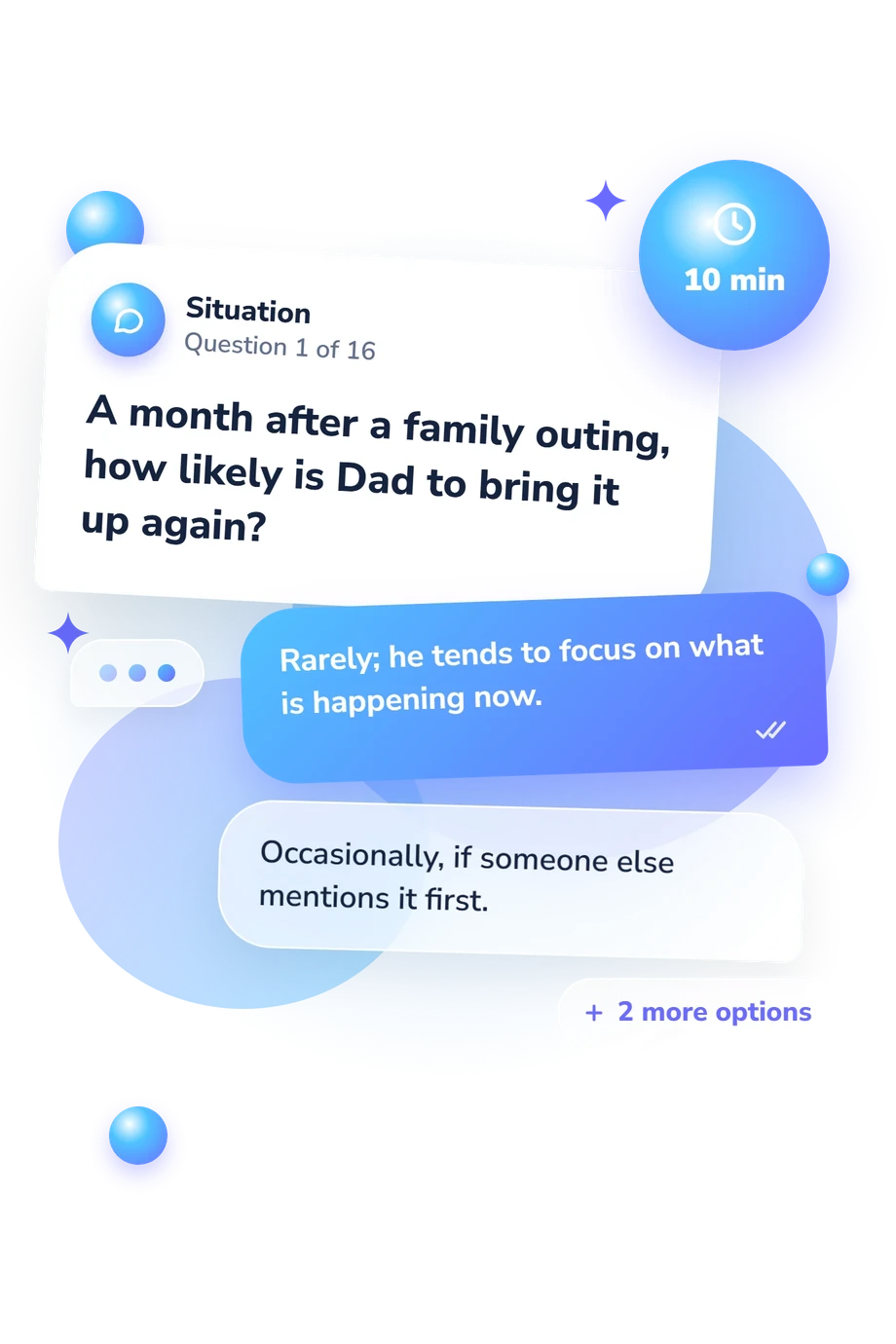
Example Questions From the Test
- Read it, smile, and place it back somewhere protected.
- Enjoy the memory, then decide whether he still needs to keep it.
- Take a quick look before returning to the task at hand.
- Focus more on clearing the space than on the item's history.
- Call someone or suggest meeting up.
- Work on, read about, or practice a favorite interest.
- Handle a useful job he has been meaning to finish.
- Look through photos, music, or objects tied to past memories.
- Seeing that the event has been organized smoothly.
- Hearing a brief toast that recalls a meaningful moment.
- Receiving an item he had planned to buy for himself.
- Watching relatives reconnect and share old stories.
Father's Day Gift Quiz - Description and methodology of the test
Gift-givers who know Dad well but feel unsure can use the Fathers Day Gift Quiz to organize clues from his habits, interests, memories, and social preferences. It asks you to turn your observations of Dad into a focused profile rather than relying on a generic gift list. The result helps answer what should I get my dad for Father's Day, while this quiz focuses on likely fit rather than popularity.
What This Assessment Explores
Questions use familiar situations to reveal Dad's response to interests, practical problems, memories, and time with others. The result suits gift-givers with firsthand knowledge and ranks or blends gift directions instead of selecting a specific product.
Four dimensions organize Father's Day gifts by value; they can also inform what to get my dad for his birthday, giving the quiz a secondary use:
- Hobby Fuel (0-12) shows whether a gift linked to an interest fits: Broader Focus (0-4), Interest Supporter (5-8), or Passion Project (9-12).
- Practical Upgrade (0-12) shows whether a useful improvement fits: Utility Is Secondary (0-4), Purposeful Pick (5-8), or Everyday Upgrade (9-12).
- Sentimental Keepsake (0-12) shows whether personal meaning fits: Meaning Through Other Routes (0-4), Quietly Meaningful (5-8), or Lasting Keepsake (9-12).
- Shared Experience (0-12) shows whether time together fits: Independent Enjoyment (0-4), Selective Companion (5-8), or Time Together (9-12).
Methodology and Evidence Base
Each item presents a familiar situation and several responses, asking you to choose the option that best matches Dad. Scenarios involve free time, purchases, memories, routines, gift presentation, and plans, so answers rest on behavioral clues.
Four outcome scores are compared. Because the response-to-point mapping is not stated, read the profile by comparing the displayed dimensions: results within one point indicate a blended fit. The same profile can also help the quiz answer what to get your dad for his birthday, if Dad's preferences remain the focus.
Conceptually, the questionnaire is consistent with Galak, Givi, and Williams (2016), whose framework addresses perspective errors in gift giving. Baskin, Wakslak, Trope, and Novemsky (2014) address feasibility; Chan and Mogilner (2017) examine experiential gifts and relationships; and Givi and Galak (2017) examine sentimental value. This questionnaire is not an adaptation of those studies, and its displayed profile has no stated norms or reliability estimates.
The result reflects the gift-giver's estimate of Dad and may be affected by limited familiarity, projection, or current context, so compare ideas rather than let one result decide automatically.
- Galak, Jeff, Julian Givi, and Elanor F. Williams. “Why Certain Gifts Are Great to Give but Not to Get: A Framework for Understanding Errors in Gift Giving.” Current Directions in Psychological Science, 2016, 25(6), 380-385. 10.1177/0963721416656937
- Baskin, Ernest, Cheryl J. Wakslak, Yaacov Trope, and Nathan Novemsky. “Why Feasibility Matters More to Gift Receivers than to Givers: A Construal-Level Approach to Gift Giving.” Journal of Consumer Research, 2014, 41(1), 169-182. 10.1086/675737
- Chan, Cindy, and Cassie Mogilner. “Experiential Gifts Foster Stronger Social Relationships than Material Gifts.” Journal of Consumer Research, 2017, 43(6), 913-931. 10.1093/jcr/ucw067
- Givi, Julian, and Jeff Galak. “Sentimental Value and Gift Giving: Givers’ Fears of Getting It Wrong Prevents Them from Getting It Right.” Journal of Consumer Psychology, 2017, 27(4), 473-479. 10.1016/j.jcps.2017.06.002
Updated: