
Famous Actors Quiz
How the Scales are Structured
Who Usually Takes This Test?
See How You Compare
Below is a preview of how scores are typically distributed across each scale.
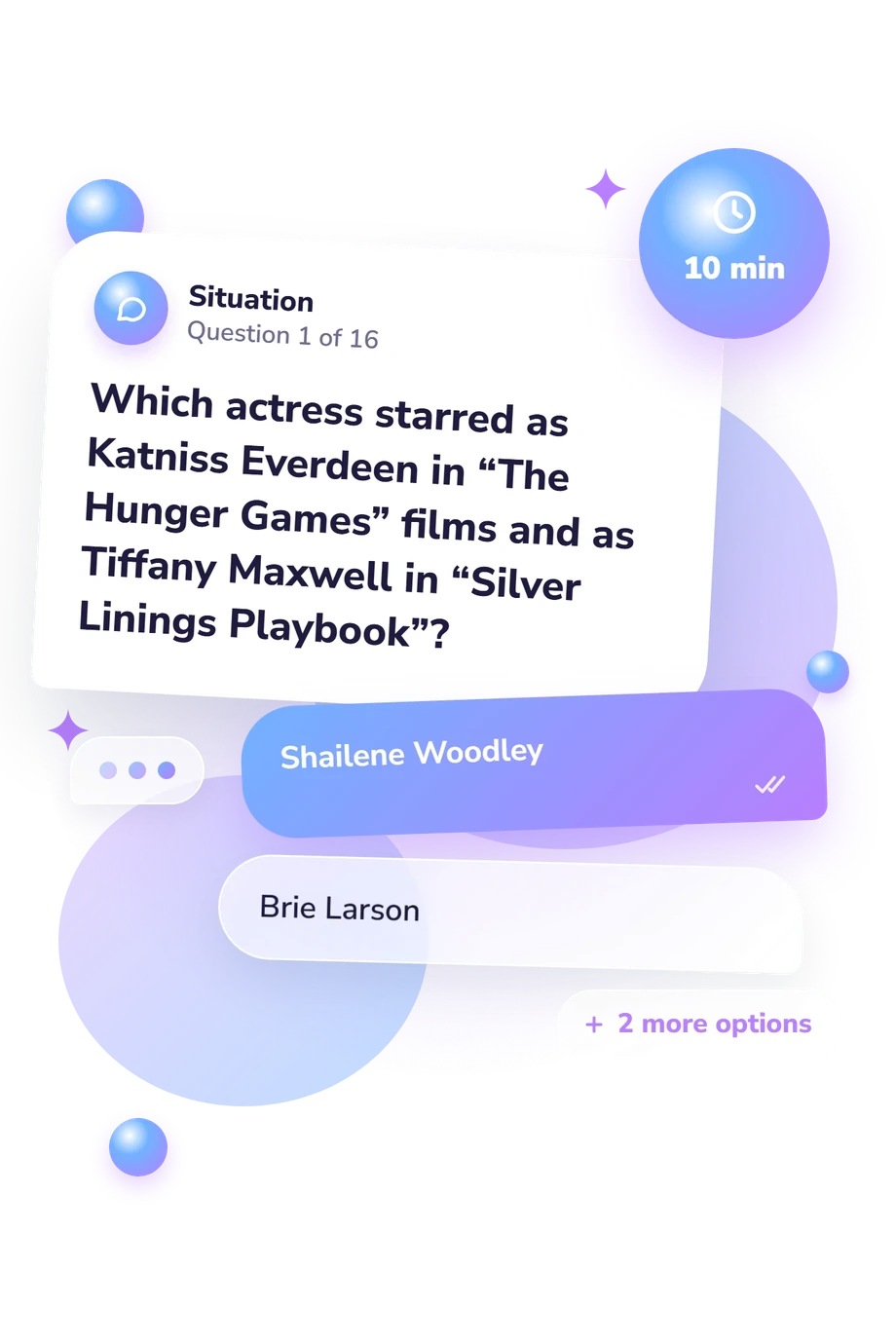
Example Questions From the Test
- Shailene Woodley
- Brie Larson
- Jennifer Lawrence
- Natalie Portman
- Leonardo DiCaprio
- Christian Bale
- Matt Damon
- Brad Pitt
- Chadwick Boseman
- Michael B. Jordan
- Anthony Mackie
- John Boyega
Famous Actors Quiz - Description and methodology of the test
Readers choosing a light cinema challenge can use this famous actors quiz to decide whether its role clues match their interests and familiarity with mainstream film. The result gives a practical snapshot for self-reflection, friendly comparison, or selecting a next step, such as revisiting major releases or broadening a personal watchlist. The name that actor quiz format focuses on recognition rather than acting skill.
What This Assessment Explores
The familiar-film emphasis makes this an actor trivia quiz about links between performers and memorable screen roles, not performance technique. It suits readers who want to see which names, characters, and movie associations they can retrieve without preparation.
The questions cover these recognition patterns:
- Character recognition shows how readily you identify an actor from a defining role.
- Cross-film connections show whether one performer comes to mind across multiple movies, franchises, genres, or eras.
- Classic and biographical-film recall indicates how comfortably you recognize performers beyond one familiar type of film.
The single result scale is Famous Actors Knowledge: 0-16. Opening Credits (0-6) means you recognize some prominent names or roles; Growing Film Knowledge (7-12) reflects broad recall with less familiar credits to strengthen; Leading-Billing Knowledge (13-16) indicates strong connections between famous actors and signature roles across genres and eras.
Methodology and Evidence Base
Each item presents a film or role clue followed by four actor choices. Some ask directly who played a character; others require one performer to be connected with two films or a franchise. Selecting one best answer tests retrieval from familiar cultural knowledge rather than self-rated confidence.
Its role-based format also makes it a famous actors test with a catalogue-specific total. The displayed result is placed in the named band; those bands describe breadth of recognition, not acting quality, complete film expertise, or general intelligence.
The evidence base is conceptual, not a claim that this online questionnaire reproduces a published instrument. Westmacott and Moscovitch’s 2002 study is relevant because it examines links between people and semantic knowledge. McCarthy and Warrington’s 1992 study likewise distinguishes recognizing actors from recalling events or scripts. These studies support the questionnaire's memory-oriented approach, but the present items are not an adaptation of either one.
No published norms are attached to this catalogue score, so interpret it as a descriptive snapshot. Cinema exposure, language, release-era familiarity, and current attention can all influence the result.
- Robyn Westmacott and Morris Moscovitch, "Temporally graded semantic memory loss in amnesia and semantic dementia: Further evidence for opposite gradients," Cognitive Neuropsychology, 2002, 19(2), 135-163. 10.1080/02643290143000123
- Rosaleen A. McCarthy and Elizabeth K. Warrington, "Actors but not scripts: The dissociation of people and events in retrograde amnesia," Neuropsychologia, 1992, 30(7), 633-644. 10.1016/0028-3932(92)90068-w
Updated: