
Fall Quiz
How the Scales are Structured
Who Usually Takes This Test?
See How You Compare
Below is a preview of how scores are typically distributed across each scale.
Example Questions From the Test
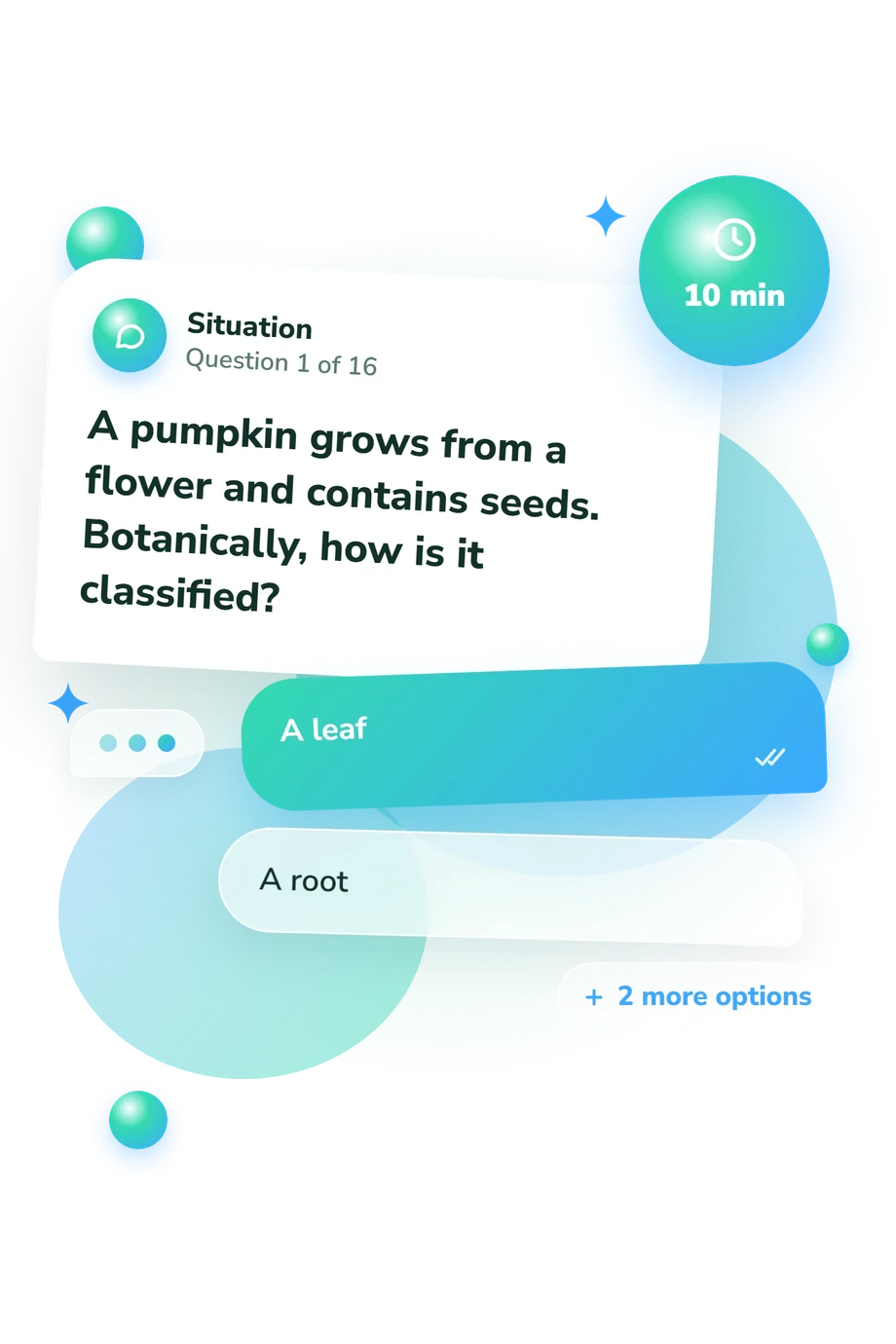
- A leaf
- A root
- A fruit
- A tuber
- White and silver starches
- Blue and violet melanins
- Black and gray keratins
- Yellow and orange carotenoids
- The juice seals the apple beneath a layer of sugar
- The juice removes all browning enzymes from the apple
- Its acidity and antioxidants slow enzymatic oxidation
- The juice raises the apple’s temperature above the reaction point
Fall Quiz - Description and methodology of the test
Readers who want to check how well they understand the seasonal changes around them can use this compact knowledge assessment. The fall quiz is intended for curious learners who enjoy connecting autumn observations with basic biology, astronomy, weather, food science, and everyday safety. As an autumn quiz, it offers a structured way to understand the overall level reached across these seasonal topics.
What This Assessment Explores
Rather than measuring personality or mood, the questionnaire checks applied seasonal knowledge. Its scenarios ask readers to identify biological processes, explain weather events, and choose practical responses. This fall-themed quiz suits curious learners who want to connect autumn facts with observations and everyday decisions.
The topic groups are:
- Plant and food science shows how pumpkin classification, leaf pigments, dormancy, evergreen needles, and apple browning fit seasonal biology.
- Weather, astronomy, and ecology connect frost, equinoxes, daylight, Earth’s tilt, cooling, migration, and animal food storage.
- The Fall Knowledge scale runs from 0-16: Emerging (0-6) indicates basic recognition, Developing (7-12) shows a useful foundation, and Strong (13-16) reflects broad, accurate performance across facts and scenarios.
The result describes current knowledge, not a permanent trait. It provides an overall indication of performance across sampled autumn topics rather than separate scores for individual areas.
Methodology and Scientific Basis
The form uses 16 items with four answer choices each. The items combine direct factual questions with applied seasonal scenarios. The questionnaire produces the displayed score with the listed result bands; it summarizes performance in plain language rather than measuring agreement, symptoms, or personality.
Methodologically, this is a structured knowledge assessment, not a standardized psychological instrument. As a fall knowledge test, it is most useful for learning and self-checking; its interpretation is not a population norm or clinical cutoff.
The content is conceptually consistent with Gallinat, Primack, and Wagner (2015), which emphasizes autumn as an ecologically meaningful period in climate research. Keskitalo, Bergquist, and Jansson (2005) addresses the cellular timing of autumn senescence, while Schwartz (2025) places phenology within an integrative environmental framework. These sources support the scientific context of the questions; they do not make this online questionnaire an adaptation or validation of those works.
Interpretation should account for education, language, experience, guessing, and conventions. Because it samples selected topics, a lower result may identify review areas without representing broader scientific knowledge.
- Gallinat, Amanda S., Richard B. Primack, and David L. Wagner. Autumn, the neglected season in climate change research. Trends in Ecology & Evolution, 30(3), 169-176 (2015). DOI 10.1016/j.tree.2015.01.004
- Keskitalo, Johanna, Gustaf Bergquist, Per Gardeström, and Stefan Jansson. A cellular timetable of autumn senescence. Plant Physiology, 139(4), 1635-1648 (2005). DOI 10.1104/pp.105.066845
- Schwartz, Mark D., editor. Phenology: An Integrative Environmental Science, 3rd ed. Springer Cham (2025). DOI 10.1007/978-3-031-75027-4
Updated: