
Elf Quiz
How the Scales are Structured
Who Usually Takes This Test?
See How You Compare
Below is a preview of how scores are typically distributed across each scale.
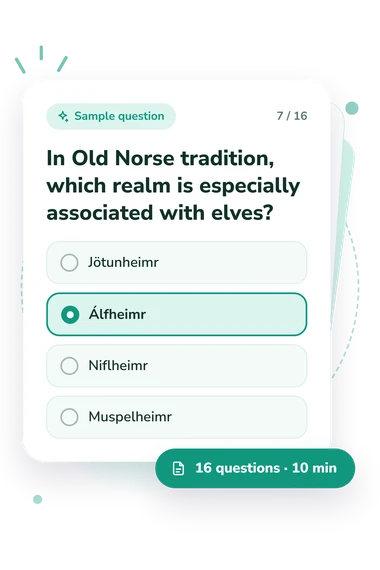
Example Questions From the Test
- The Deathless Guardians
- The Elder Wizards
- The Firstborn
- The Children of the Sun
- The Elves of Tolkien’s Beleriand
- The ljósálfar of Old Norse literature
- Modern Christmas popular culture
- The fairy court of Shakespeare
- Thor
- Heimdallr
- Týr
- Freyr
Elf Quiz - Description and methodology of the test
Readers who want to distinguish historical traditions from later fantasy conventions can use this elf quiz as a focused knowledge check. It is suited to curious fans of mythology, literature, Tolkien, folklore, and popular culture, and functions as an elf knowledge test with a single result indicating an overall level of knowledge across the traditions represented in the questions. Seasonal Christmas imagery appears as one strand within a wider comparison of folklore, literature, and fantasy.
What This Assessment Explores
The questions examine how well a reader separates elves by tradition, source, setting, and cultural role. They move among Tolkien, Old Norse and Old English material, Grimm folklore, Shakespeare, modern fantasy, and Christmas imagery, often requiring interpretation within a story rather than transfer between traditions.
These item groups show what the result draws on:
- Tolkien items test recognition of peoples, characters, realms, and journeys.
- Norse and Old English items measure elf vocabulary and cosmology.
- Folklore and literature items match helpers, courts, and scenes to sources.
- Fantasy and Christmas items examine newer portrayals.
The displayed Elf Knowledge scale runs from 0-16: Starting Explorer (0-6), Developing Lorekeeper (7-12), and Accomplished Lorekeeper (13-16). Higher categories reflect broader accuracy; the bands describe an overall level of knowledge across the question set. This elf lore quiz uses a comparative format that rewards attention to cultural context.
Methodology and Evidence Base
Each item presents four answer choices and asks for the best-supported response, moving between factual recall and source-sensitive interpretation. One point is awarded for each correct answer, producing the displayed total; the method assesses knowledge, not personality traits.
Its evidence base is historical and literary. Scholarship on changing ideas about elves and fairies, Tolkien reference works, a translation of Norse material, and the Grimm collection provide context for the source distinctions. Shakespeare, Harry Potter, Zelda, and Christmas references extend the comparison into later fictional traditions.
The questionnaire is conceptually consistent with these sources, but it is not presented as an adaptation or standardized administration of a published instrument. Prior reading, guessing, and familiarity with a particular story version can affect the outcome, and the displayed bands describe performance on this question set rather than population percentiles or clinical conclusions. The limited modern Christmas material appears alongside Tolkien, Norse, folklore, and fantasy content, so this elf traditions quiz remains a comparative exercise rather than a Christmas-only test.
- Matthias Egeler, Elves and Fairies: A Short History of the Otherworld. New Haven: Yale University Press, 2026. 10.12987/9780300285833
- Christina Scull and Wayne G. Hammond, The J. R. R. Tolkien Companion and Guide. Boston: Houghton Mifflin, 2006.
- The Poetic Edda, translated with an introduction and notes by Carolyne Larrington, 2nd ed. Oxford: Oxford University Press, 2014.
- Jacob Grimm and Wilhelm Grimm, The Original Folk and Fairy Tales of the Brothers Grimm: The Complete First Edition, translated and edited by Jack Zipes. Princeton: Princeton University Press, 2014. 10.1515/9781400851898