
Easy Pokemon Quiz
How the Scales are Structured
Who Usually Takes This Test?
See How You Compare
Below is a preview of how scores are typically distributed across each scale.
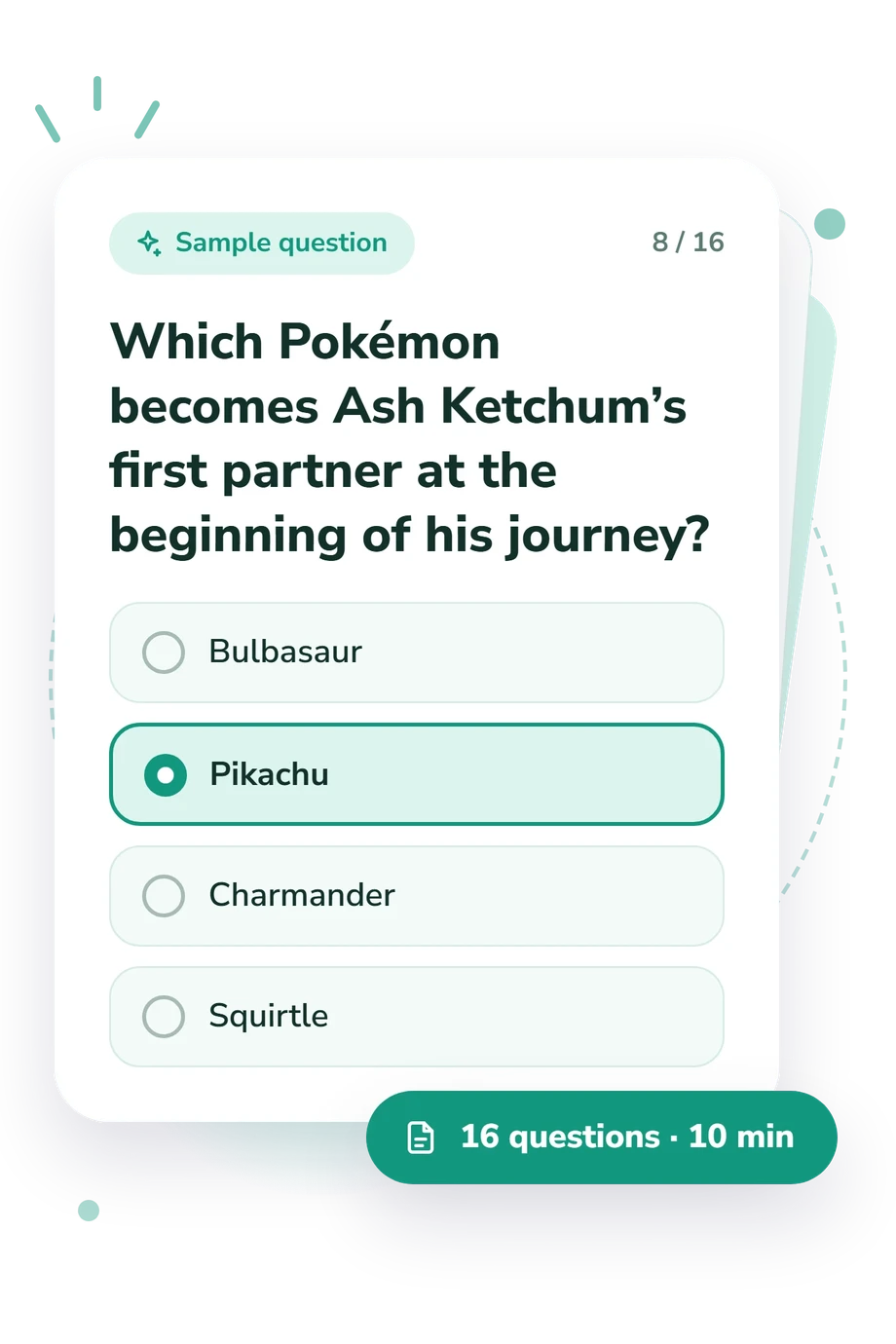
Example Questions From the Test
- Water
- Bug
- Grass
- Ice
- Teach every Pokémon a new move
- Join Team Rocket
- Qualify to compete in the regional Pokémon League
- Become the region’s professor
- Nurse Joy
- Officer Jenny
- Professor Oak
- Delia Ketchum
Easy Pokemon Quiz - Description and methodology of the test
For fans deciding whether the Easy Pokemon Quiz matches their interests, this assessment offers a focused way to revisit the knowledge used to follow the Pokémon anime. It suits viewers who enjoy Ash’s journeys, familiar companions, Gym challenges, Team Rocket, and basic type logic. Its accessible wording also makes it a Pokémon quiz for kids who already know the show’s central characters and adventures.
What This Assessment Explores
The questions turn familiar anime knowledge into a focused recall exercise. They cover type advantages, Gym affiliations, evolution, locations, devices, recurring characters, and comic moments. It offers Pokémon anime trivia for fans checking foundational knowledge rather than every game, season, or generation.
One result scale, Pokémon Knowledge (0-16), reflects performance on these basic Pokémon anime questions. New Trainer (0-6) marks some essentials, Growing Trainer (7-12) shows a solid grasp, and Pokémon Expert (13-16) signals strong command of the covered basics. It describes performance on the covered basics rather than the full Pokémon universe.
The result draws on these question groups:
- Type and evolution items show whether you connect matchups with development lines.
- Character and location items test recall of companions, hometowns, Gyms, and recurring figures.
- Story and Team Rocket items measure recognition of familiar situations and distinctive behavior.
Methodology and Evidence Base
Each item uses four-option multiple choice. Prompts ask for one recognizable fact or relationship, such as a type advantage, a character’s role, an evolutionary sequence, or a familiar object’s function. The method emphasizes recall and simple application rather than open-ended interpretation.
As a Pokémon knowledge test, the questionnaire reports the result through displayed performance bands that reflect performance on the covered questions. These labels are descriptive bands for an unofficial entertainment score; the online quiz is not a standardized psychological measure or an adaptation of a published test.
The content is conceptually consistent with Pokémon: Indigo League through its recurring characters, settings, type logic, and story conventions. The 2008 visual guide by Cris Silvestri and Katherine Fang offers a compact reference for names, forms, and relationships, while Vivian Vasquez’s 2003 discussion considers how the franchise can engage learning and literacy. These sources support the subject matter and help situate its characters, settings, and learning themes.
Interpret the result in context. Familiarity with the anime, recency of viewing, and attention to small details can affect performance. A lower band may reflect limited exposure rather than weak general knowledge, so the score works best as a snapshot of current recall.
- Shudo, Takeshi, and Kunihiko Yuyama. Pokémon: Indigo League. OLM and TV Tokyo, 1997-1999.
- Silvestri, Cris, and Katherine Fang. Pokémon Visual Guide. Indianapolis, IN: DK/BradyGames, 2008, 160 pp. ISBN 9780756644307.
- Vasquez, Vivian. “What Pokemon Can Teach Us about Learning and Literacy.” Language Arts, vol. 81, no. 2, 2003, pp. 118-125. 10.58680/la20032885
Updated: