
Easter Quiz
How the Scales are Structured
Who Usually Takes This Test?
See How You Compare
Below is a preview of how scores are typically distributed across each scale.
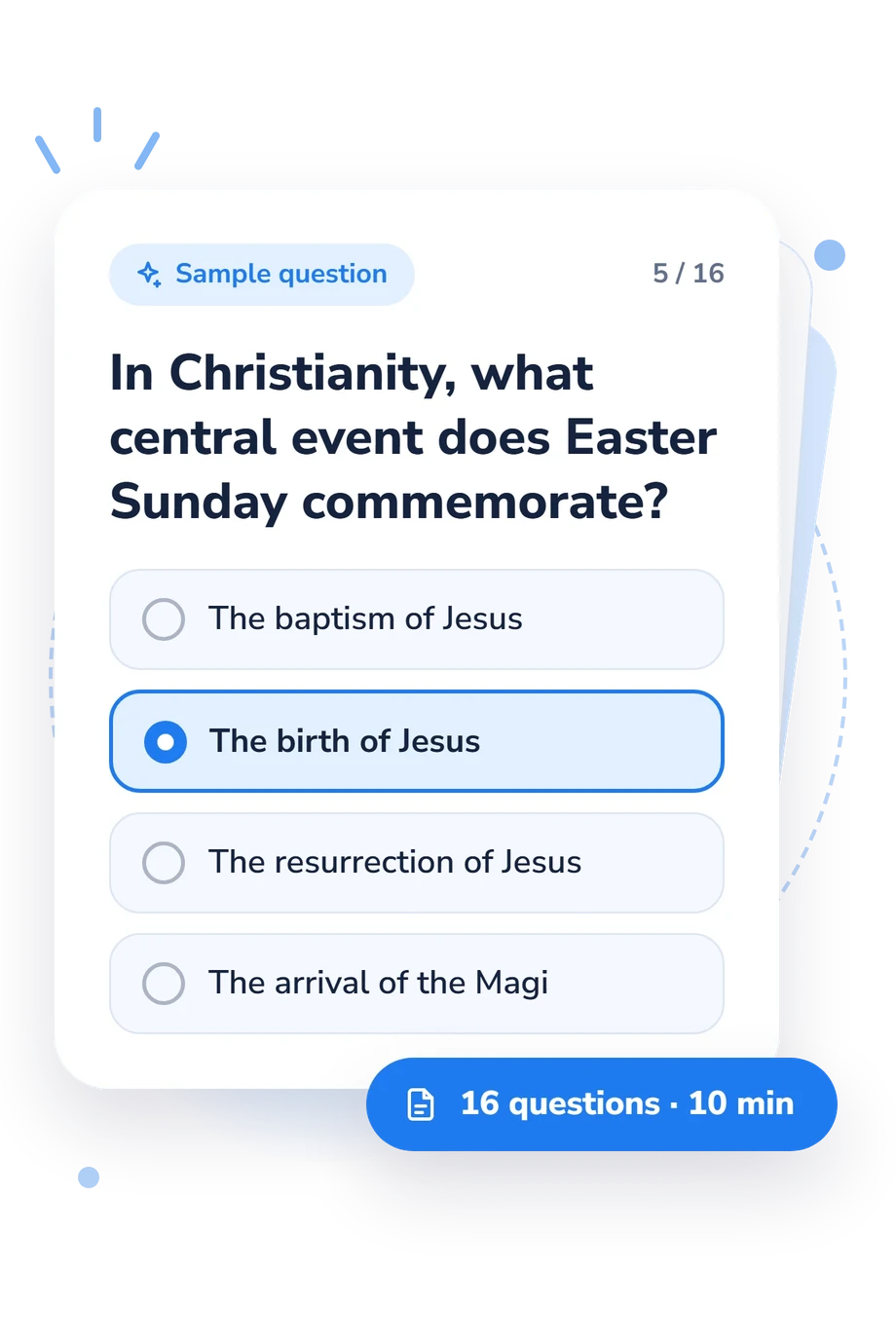
Example Questions From the Test
- Palm Sunday
- Ascension Day
- Maundy Thursday
- Epiphany
- The four seasons of the year
- The crucifixion of Jesus
- The division of bread among the disciples
- The routes of medieval spice traders
- Palm Sunday
- Ascension Day
- Holy Saturday
- Maundy Thursday
Easter Quiz - Description and methodology of the test
For readers who want to check their general knowledge, this Easter quiz offers a focused way to test recall without relying on personal belief or experience. It also works as a quiz about Easter for adults who enjoy learning independently, sharing questions with family, or using a result as a starting point for further exploration.
What This Assessment Explores
The questions present Easter as a Christian observance and wider cultural tradition. They cover Holy Week, the resurrection, the Paschal cycle, calendar differences, familiar symbols, British customs, and references such as Rapa Nui. The focus is factual knowledge, not personal belief or practice.
Results appear under Easter Knowledge, ranging from 0-16. The bands are Easter Explorer (0-6), Developing Knowledge (7-12), and Easter Expert (13-16). The score reflects knowledge of Easter’s religious background and cultural traditions; the multiple-choice items elicit that knowledge through recognition and recall.
The main groups are:
- Religious observances connect important days with their commemorated events.
- Calendar and chronology test sequence, timing, and Easter-date calculations.
- Symbols and customs cover foods, flowers, clothing, eggs, and folk traditions.
- Historical and cultural references place Easter in social and geographical contexts.
Questions about Easter in the quiz reveal strengths and gaps across topics.
Methodology and Evidence Base
Each item presents a scenario or direct question with four answer choices. Selecting one tests recognition and recall rather than open-ended explanation. The displayed scoring gives one overall result with bands and no separate weights for choices.
Content is conceptually consistent with Bradshaw and Johnson (2011), whose work clarifies Christian feasts, fasts, and seasons. Bradshaw and Hoffman (1999) provide historical context for Passover and Easter, while Hutton (1996) supports British ritual-year customs. These historical and scholarly works frame the subject, while the online question set is separate from them and is not an adaptation of a published psychometric instrument. Its questions support independent study, family discussion, or guided group activity.
It is an online quiz whose bands are descriptive classifications rather than reported psychometric norms. A higher band signals stronger performance; a lower one points to topics for review. Religious education, cultural exposure, memory, and answer-choice clues can affect recognition, so the result describes selected content rather than complete knowledge of Easter or personal belief. Four choices make this a multiple-choice quiz about Easter useful at home or in groups.
- Bradshaw, Paul F., and Maxwell E. Johnson. The Origins of Feasts, Fasts, and Seasons in Early Christianity. Collegeville, MN: Liturgical Press, 2011.
- Bradshaw, Paul F., and Lawrence A. Hoffman, eds. Passover and Easter: Origin and History to Modern Times. Two Liturgical Traditions, vol. 5. Notre Dame, IN: University of Notre Dame Press, 1999. 10.2307/j.ctvpj7618.
- Hutton, Ronald. The Stations of the Sun: A History of the Ritual Year in Britain. Oxford: Oxford University Press, 1996. 10.1093/acprof:oso/9780198205708.001.0001.
Updated: