
Dog Breed Quiz
How the Scales are Structured
Who Usually Takes This Test?
See How You Compare
Below is a preview of how scores are typically distributed across each scale.
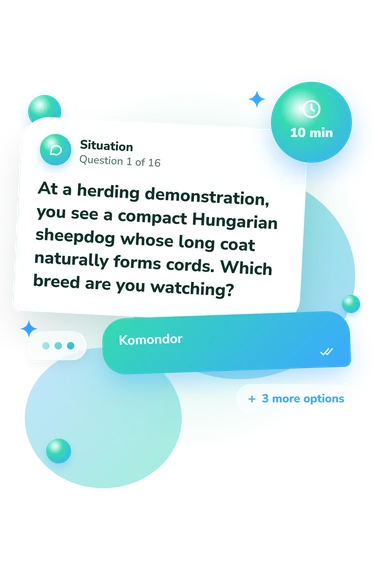
Example Questions From the Test
- Great Pyrenees
- Maremma Sheepdog
- Samoyed
- Kuvasz
- Irish Wolfhound
- Borzoi
- Scottish Deerhound
- Otterhound
- Basset Hound
- Dachshund
- Scottish Terrier
- Pembroke Welsh Corgi
Dog Breed Quiz - Description and methodology of the test
People who enjoy dogs, study breed history, or want a clearer starting point for breed research can use this dog breed quiz to test practical recognition. It is designed for readers who want to connect visible traits with origins and working roles. As a dog quiz, it returns a knowledge profile that highlights how confidently you interpret common breed clues.
What This Assessment Explores
The questionnaire measures breed recognition from structure, coat, facial features, movement, history, and working purpose. Clues may involve a corded coat, blue-black tongue, scenting build, guarding role, or herding style. It suits readers building breed literacy for general interest or focused comparison.
Its result describes performance on identification in this set, not temperament, ownership readiness, or household compatibility. It is not a what dog should I get quiz; instead, it supplies vocabulary for researching exercise, grooming, size, and behavior.
The single Dog Breed Knowledge scale (0-16) is reported in these bands:
- Breed Beginner (0-6) means some clue recognition with room to learn breed groups and signature traits.
- Capable Identifier (7-12) means solid knowledge with room to separate similar dogs.
- Breed Expert (13-16) means consistently linking detailed physical or historical clues to the correct breeds.
Methodology and Evidence Base
Each item gives a breed description and four answer choices. Appearance, history, geography, and working-role clues must be connected. Correct answers are counted and mapped to the displayed knowledge bands; there is no separate compatibility or temperament score.
Used as a best dog for me quiz, it would be incomplete: breed knowledge can guide follow-up research, but it cannot decide which dog suits a home, routine, budget, or experience.
The approach is conceptually consistent with Voith et al. (2009), which reported differences between visual and DNA-based breed identification in shelters. Voith et al. (2013) examined disagreement between visual observers, while Gunter et al. (2018) illustrates the complexity of genetic breed heritage. The American Kennel Club provides a reference framework for breed traits. This questionnaire is not an adaptation of those publications.
No population norms, reliability estimates, or standardization are stated for this online set. Prior exposure, guessing, ambiguous clues, and variation within breeds can affect performance. It should therefore not be treated as a what dog fits me best quiz; the result reflects success on these educational questions rather than definitive expertise or ancestry.
- Voith, Victoria L., Elizabeth Ingram, Katherine Mitsouras, and Kristopher Irizarry. (2009). "Comparison of Adoption Agency Breed Identification and DNA Breed Identification of Dogs." Journal of Applied Animal Welfare Science, 12(3), 253-262. 10.1080/10888700902956151
- Voith, Victoria L., Rosalie Trevejo, Seana Dowling-Guyer, Colette Chadik, Amy Marder, Vanessa Johnson, and Kristopher Irizarry. (2013). "Comparison of Visual and DNA Breed Identification of Dogs and Inter-Observer Reliability." American Journal of Sociological Research, 3(2), 17-29.
- Gunter, Lisa M., Rebecca T. Barber, and Clive D. L. Wynne. (2018). "A canine identity crisis: Genetic breed heritage testing of shelter dogs." PLOS ONE, 13(8), e0202633. 10.1371/journal.pone.0202633
- American Kennel Club. (2006). The Complete Dog Book (20th ed.). Ballantine Books.