
Do I Need Braces Quiz
How the Scales are Structured
Who Usually Takes This Test?
See How You Compare
Below is a preview of how scores are typically distributed across each scale.
Example Questions From the Test
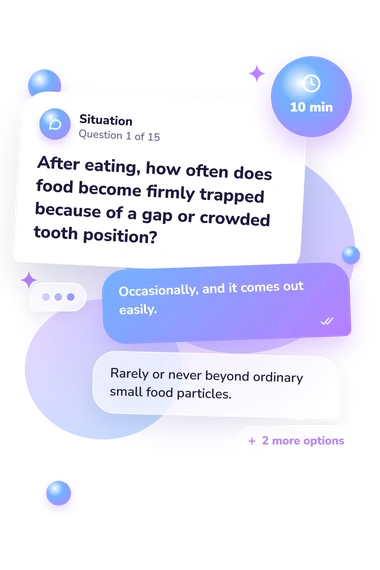
- Occasionally, and it comes out easily.
- Rarely or never beyond ordinary small food particles.
- Frequently enough that I need to clean the same area after many meals.
- Repeatedly, with pain, gum swelling, bad taste, or difficulty removing it.
- Never; they do not contact that tissue.
- Occasionally, without lasting tenderness.
- Often enough to leave tenderness or a temporary mark.
- Regularly, with pain, sores, bleeding, or visible tissue injury.
- I sometimes favor one side, but it does not limit what I eat.
- I chew comfortably on either side without thinking about my bite.
- I frequently reposition food or avoid chewing on one side because the bite feels uneven.
- My bite causes persistent pain, repeated tooth collisions, or substantial difficulty chewing.
Do I Need Braces Quiz - Description and methodology of the test
People noticing crowding, gaps, unusual tooth contact, or cleaning difficulty can use the Do I Need Braces Quiz to organize concerns before a dental conversation. It is designed for personal reflection about whether bite or alignment signs deserve attention. If you are wondering how long you will need braces, the result highlights observations to discuss with a dentist or orthodontist.
What This Assessment Explores
The questionnaire focuses on observable experiences rather than appearance alone. It asks whether tooth contact affects chewing or tissues, whether alignment interferes with eating, and whether crowding or spacing complicates cleaning. This braces quiz can organize these signs, but it cannot establish that braces are necessary or explain their cause.
The three result scales are:
- Bite and Jaw Function (0-15) reflects tooth contact and chewing; No listed signal (0-0), Monitor or mention (1-2), and Arrange an assessment (3-15) mark increasing concern.
- Oral Care and Comfort Impact (0-15) reflects cleaning difficulty, irritation, trapped food, and wear; No listed signal (0), Monitor or mention (1-2), and Arrange an assessment (3-15) are the displayed bands.
- Tooth Alignment and Space (0-15) reflects gaps, crowding, rotation, and eruption position; No listed signal (0), Monitor or mention (1-2), and Arrange an assessment (3-15) show increasing reason to seek review.
Methodology and Scientific Basis
Each item uses ordered choices that move from no sign through manageable experiences to repeated, painful, or tissue-damaging patterns. Answers are combined within the relevant scale, but no validated weighting or norms are claimed. A red-flag response scored 3 overrides the total, so one serious experience remains important. That makes the result useful for someone asking whether they will need braces while keeping its purpose focused on identifying concerns rather than predicting treatment.
The structure is conceptually consistent with the Index of Orthodontic Treatment Need (Brook & Shaw, 1989), which links orthodontic priority with dental irregularity and functional concern. This online questionnaire is not an adaptation of that index, and its bands have not been validated by the published work. Borzabadi-Farahani (2012) situates treatment-need indices within oral-health evidence, while Shaw, Richmond, O’Brien, Brook, and Stephens (1991) addresses quality control in their use.
Self-report can be affected by current discomfort, memory, visual judgment, and self-awareness. The result can help show how to tell if you need braces by identifying observations worth raising, but clinical decisions require examination and appropriate records.
- Brook, Peter H., and William C. Shaw. "The development of an index of orthodontic treatment priority." European Journal of Orthodontics 11, no. 3 (1989): 309-320. 10.1093/oxfordjournals.ejo.a035999
- Borzabadi-Farahani, Ali. "A review of the oral health-related evidence that supports the orthodontic treatment need indices." Progress in Orthodontics 13, no. 3 (2012): 314-325. 10.1016/j.pio.2012.03.002
- Shaw, W. C., S. Richmond, K. D. O'Brien, P. Brook, and C. D. Stephens. "Quality control in orthodontics: indices of treatment need and treatment standards." British Dental Journal 170, no. 3 (1991): 107-112. 10.1038/sj.bdj.4807429