
Do I Have Supernatural Abilities Quiz
How the Scales are Structured
Who Usually Takes This Test?
See How You Compare
Below is a preview of how scores are typically distributed across each scale.
Example Questions From the Test
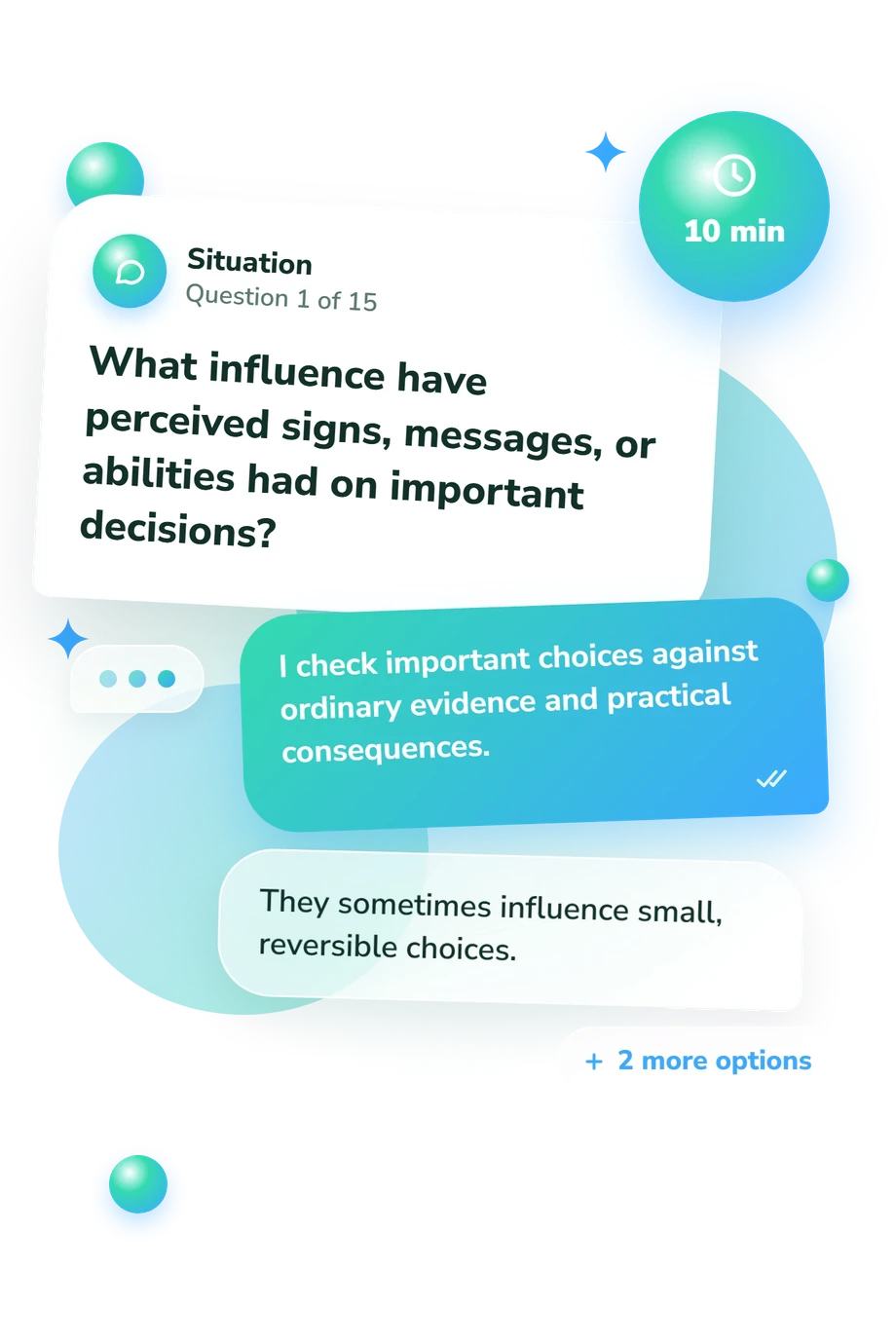
- I check important choices against ordinary evidence and practical consequences.
- They sometimes influence small, reversible choices.
- They have led me to miss obligations or spend more money than intended.
- They have led me toward a dangerous, major financial, legal, or medical decision.
- I consider their explanation alongside my own and look for checkable evidence.
- I feel somewhat misunderstood but remain willing to compare explanations.
- I listen, although I usually keep my original interpretation.
- I dismiss their view because I am certain outsiders cannot understand what is happening.
- They have not changed my sleep.
- I have occasionally stayed awake a little longer thinking about them.
- I repeatedly lose substantial sleep by watching for signs or messages.
- I have had little or no sleep for several nights because I felt compelled to monitor or respond.
Do I Have Supernatural Abilities Quiz - Description and methodology of the test
People who notice striking coincidences, sensed presences, or felt guided by signs can use the Do I Have Supernatural Abilities Quiz to examine those experiences carefully. It is intended for self-reflection, not for confirming a supernatural gift. This supernatural power quiz organizes unusual events, interpretations, and practical consequences for reflection.
What This Assessment Explores
The questionnaire looks beyond an extraordinary event. It considers unusual perceptions and coincidences, confidence in a supernatural explanation, and effects on choices, sleep, relationships, and safety. It suits anyone who wants to pause before treating an experience as proof.
The profile contains three dimensions:
- Daily Impact and Safety (0-15) summarizes practical disruption, not supernatural ability, with Baseline 0, Impact to Notice 1-2, and Act on Impact 3-15.
- Interpretation Flexibility (0-15) reflects openness to alternatives, not whether events were supernatural, with Tentative interpretations 0, Leaning toward one explanation 1-2, and Strong certainty (support recommended) 3-15.
- Unusual Experiences (0-15) summarizes reported perceptions and coincidences, not ability or diagnosis, with Baseline 0, Experience to notice 1-2, and Support recommended 3-15.
Anyone asking what is my supernatural power quiz meant to clarify can separate experience, interpretation, and impact, then identify the area needing attention.
Methodology and Evidence Base
Each item offers four choices moving from no experience, ordinary explanations, or safety toward greater frequency, conviction, disruption, pressure, or danger. Scores appear across three scales, and a single red-flag response overrides the total.
Questions cover unusual perceptions, sleep, relationships, money, safety, and commands. Other items test alternative explanations; one asks whether the respondent favors recording predictions in advance, blinded testing, and counting misses. Interpretation and behavior sit alongside experiences.
Conceptually, it is consistent with work by Wahbeh et al. (2019), the PDI (Peters et al., 2004), the Cardiff Anomalous Perceptions Scale (Bell et al., 2006), and Schofield et al. (2018), but it is not an adaptation of them. The displayed scales are unvalidated.
To clarify what is your supernatural power quiz measuring, the result organizes your account, while context helps determine how to interpret it. Stress, sleep, memory, expectation, and response style can affect answers. A single red-flag response overrides the total; commands to harm, immediate danger, severe sleep loss, injury, or inability to stay in control call for urgent local help.
- Wahbeh, Helané, Garret Yount, Cassandra Vieten, Dean Radin, and Arnaud Delorme. “The Noetic Experience and Belief Scale: A validation and reliability study.” F1000Research 8 (2020): 1741. 10.12688/f1000research.20409.3
- Peters, Emmanuelle R., Stephen Joseph, Samantha Day, and Philippa Garety. “Measuring Delusional Ideation: The 21-Item Peters et al. Delusions Inventory (PDI).” Schizophrenia Bulletin 30(4) (2004): 1005-1022. 10.1093/oxfordjournals.schbul.a007116
- Bell, Vaughan, Peter W. Halligan, and Hadyn D. Ellis. “The Cardiff Anomalous Perceptions Scale (CAPS): A New Validated Measure of Anomalous Perceptual Experience.” Schizophrenia Bulletin 32(2) (2006): 366-377. 10.1093/schbul/sbj014
- Schofield, Malcolm B., Ian S. Baker, Paul Staples, and David Sheffield. “Creation and Validation of the Belief in the Supernatural Scale.” Journal of Parapsychology 82(1) (2018): 41-64. 10.30891/jopar.2018.01.04
Updated: