
Extensive vs Intensive Properties Quiz
How the Scales are Structured
Who Usually Takes This Test?
See How You Compare
Below is a preview of how scores are typically distributed across each scale.
Example Questions From the Test
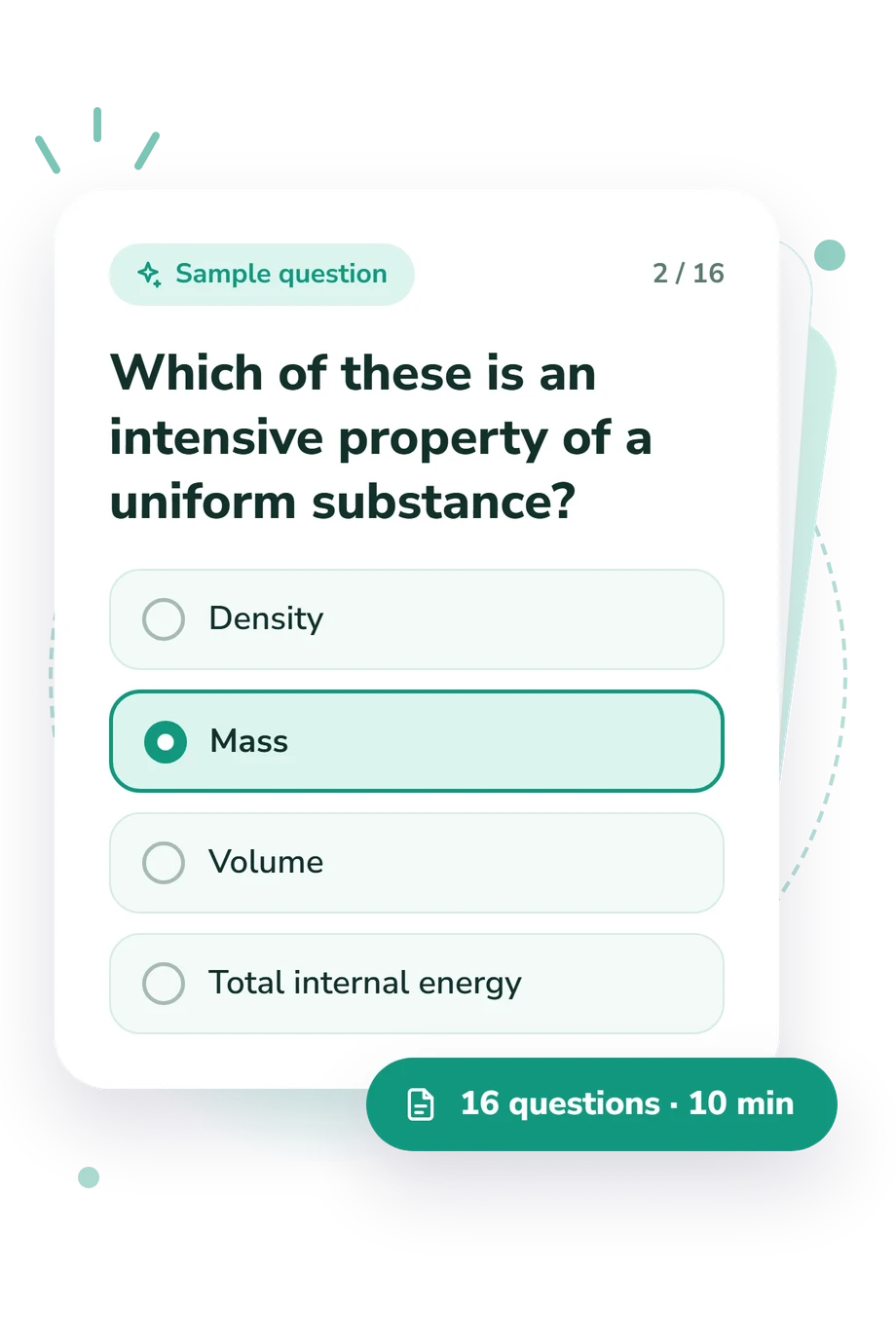
- Density
- Mass
- Volume
- Total internal energy
- Total volume of solution
- Amount of solute
- Total mass of solution
- Solute concentration
- Temperature
- Amount of substance in moles
- Molar mass
- Pressure in an equilibrium system
Extensive vs Intensive Properties Quiz - Description and methodology of the test
Students, teachers, and curious learners can use this extensive vs intensive properties quiz to examine how quantities behave when a system changes size. It suits chemistry and physics revision when learners need to distinguish totals, ratios, and properties that remain stable as a uniform system is proportionally resized under unchanged composition and conditions. By testing both categories, this intensive vs extensive quiz can help focus your review before problem solving.
What This Assessment Explores
Questions test whether a property changes with system size or stays unchanged when a uniform system is proportionally resized. Totals, ratios, and samples make the result reflect applied understanding rather than label recall.
This extensive vs intensive properties assessment examines both categories through examples involving cutting, combining, enlarging, and comparing uniform systems. It shows whether you can classify each category and apply scaling principles.
The questions address four related themes contributing to one knowledge score:
- Amount dependence shows whether a quantity changes with system size.
- Proportional invariance shows whether a property stays constant during resizing.
- Additivity shows whether separate contributions form a total.
- Ratio reasoning tests whether numerator and denominator scale together.
Extensive vs Intensive Properties Knowledge ranges from 0-16. Foundations to strengthen (0-6) marks concepts to review; Developing knowledge (7-12) suggests more practice; Strong knowledge (13-16) reflects accurate classification and scaling.
Methodology and Scientific Basis
Each item presents a definition or situation with four answer choices. Some ask you to classify a quantity; others require proportional reasoning when samples are cut, combined, enlarged, or compared. Examples include density, heat capacity, concentration, total charge, and specific energy, so the format tests recognition and application.
Every correct answer earns one point, and the total summarizes performance across the items. This questionnaire works best as an extensive and intensive properties knowledge check: missed answers can show whether review should target amount dependence, ratios, additivity, or particular quantities.
Redlich (1970) anchors the distinction between extensive and intensive quantities. The questionnaire is conceptually consistent with that work, not an adaptation of it. Mannaerts (2014) supports its thermodynamic treatment, while IUPAC 2007 supports terminology for quantities, units, and symbols.
As an online knowledge check, it has no stated norms or validation statistics, so scores are an educational snapshot. Performance can reflect terminology familiarity, attention to wording, or current study context. A high total supports accurate handling of tested examples; a lower result indicates that review may help, and missed questions may identify particular topics to revisit, although the score does not establish a fixed ability level.
- Redlich, Otto. "Intensive and extensive properties." Journal of Chemical Education 47, no. 2 (1970): 154-156. 10.1021/ed047p154.2
- Mannaerts, Sebastiaan H. "Extensive quantities in thermodynamics." European Journal of Physics 35, no. 3 (2014): 035017. 10.1088/0143-0807/35/3/035017
- International Union of Pure and Applied Chemistry, Physical and Biophysical Chemistry Division. Quantities, Units and Symbols in Physical Chemistry, 3rd ed., prepared for publication by E. Richard Cohen, Tomislav Cvitas, Jeremy G. Frey, Bertil Holmstrom, Kozo Kuchitsu, Roberto Marquardt, Ian Mills, Franco Pavese, Martin Quack, Juergen Stohner, Herbert L. Strauss, Michio Takami, and Anders J. Thor. Royal Society of Chemistry, 2007. 10.1039/9781847557889
Updated: