
Fake Smile Quiz
How the Scales are Structured
Who Usually Takes This Test?
See How You Compare
Below is a preview of how scores are typically distributed across each scale.
Example Questions From the Test
- A brief glimpse of the upper teeth
- An abrupt onset or offset, or a smile held in a fixed form
- A smile accompanied by direct eye contact
- Movement on both sides of the mouth
- Calculates whether a person is being honest
- Separates genuine emotions from fake emotions with certainty
- Describes observable facial movements using defined action units
- Measures how friendly a face appears to an observer
- A deliberately displayed smile that may not match felt enjoyment
- Any smile shown while a photograph is being taken
- A genuine smile that occurs in a formal setting
- Any smile that does not expose the teeth
Fake Smile Quiz - Description and methodology of the test
Readers who want to judge smiles more carefully can use the fake smile quiz to test whether their interpretations stay close to observable evidence. It also functions as a quiz for spotting fake smiles, suited to curious adults, students, and anyone navigating social interactions who wants to separate useful clues from confident guesses. The result describes knowledge of facial behavior, context, and uncertainty rather than revealing another person’s inner state.
What This Assessment Explores
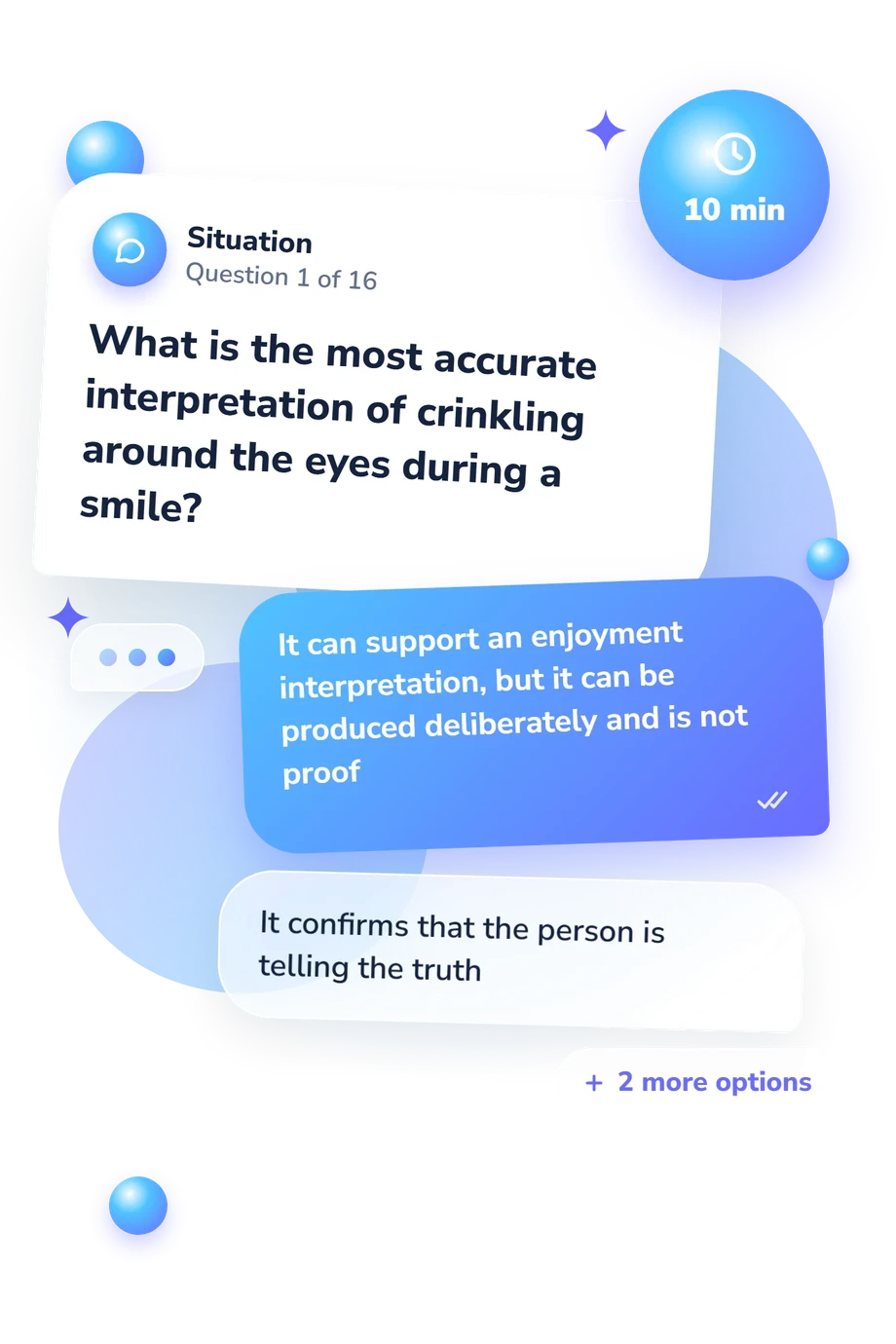
Smiles are treated as social behavior, not transparent proof of honesty or emotion. Items cover eye-area movement, timing, symmetry, masking, posed displays, cultural expectations, and conversational context. A fake smile test asks whether a respondent can separate a possible cue from a conclusion it cannot establish.
The main themes covered by the questions are:
- Eye-area movement and timing can suggest enjoyment without proving spontaneity or truthfulness.
- Masking, politeness, work displays, and posed smiles can coexist with different feelings.
- Situation, culture, voice, body behavior, and patterns over time refine interpretation while uncertainty remains.
Fake Smile Knowledge runs from 0 to 16: Foundations to build (0-6) reflects unsupported shortcuts; Developing understanding (7-12) reflects useful cues with contextual limits; Strong understanding (13-16) reflects nuanced understanding of facial behavior, context, and uncertainty. These bands summarize knowledge, not another person’s feelings or honesty.
Methodology and Scientific Basis
Each item uses a single-best-answer format built around a concrete social or research situation. The displayed score gives one point for each correct answer, so the total reflects keyed knowledge responses rather than emotional intensity or clinical severity.
The evidence base is conceptually consistent with Krumhuber and Manstead (2009), which supports separating visible smile behavior from assumptions about felt enjoyment. Frank, Ekman, and Friesen (1993) examine markers associated with enjoyment smiles; the Facial Action Coding System manual supplies a vocabulary for observable facial movements; and Mui et al. (2020) supports attention to situation and culture when people judge genuineness.
This questionnaire is not an adaptation of those publications. It is an online knowledge assessment with its own wording, answer key, and result bands, so the score is a performance summary for this item set rather than a norm-referenced standing. The online fake smile assessment may still be influenced by prior exposure, wording interpretation, memory, self-awareness, or a cautious response style.
Use the result to identify concepts to review and slow down snap judgments; it is a knowledge summary rather than a lie detector and cannot establish another person’s feelings or honesty.
- Krumhuber, Eva G., and Antony S. R. Manstead. "Can Duchenne Smiles Be Feigned? New Evidence on Felt and False Smiles." Emotion 9, no. 6 (2009): 807-820. 10.1037/a0017844
- Frank, Mark G., Paul Ekman, and Wallace V. Friesen. "Behavioral Markers and Recognizability of the Smile of Enjoyment." Journal of Personality and Social Psychology 64, no. 1 (1993): 83-93. 10.1037/0022-3514.64.1.83
- Mui, Phoebe H. C., Yangfan Gan, Martijn B. Goudbeek, and Marc G. J. Swerts. "Contextualising Smiles: Is Perception of Smile Genuineness Influenced by Situation and Culture?" Perception 49, no. 3 (2020): 357-366. 10.1177/0301006620904510
- Ekman, Paul, Wallace V. Friesen, and Joseph C. Hager. "Facial Action Coding System: The Manual on CD-ROM." 2nd ed. Salt Lake City, UT: Research Nexus, 2002.
Updated: