
Ever Never Quiz
How the Scales are Structured
Who Usually Takes This Test?
See How You Compare
Below is a preview of how scores are typically distributed across each scale.
Example Questions From the Test
- Call me unless you ever need help.
- If you never need help, call me.
- If you ever need help, call me.
- If you need ever help, call me.
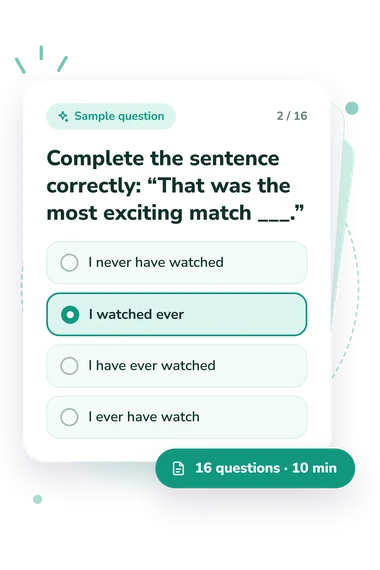
- I never have watched
- I watched ever
- I have ever watched
- I ever have watch
- have I
- didn't I
- haven't I
- do I
Ever Never Quiz - Description and methodology of the test
Readers who want to check their command of standard-English grammar can use this quiz about ever and never to examine how accurately they choose between these forms in meaningful sentences. The Ever Never Quiz is aimed at learners who are reviewing present-perfect grammar, sentence patterns, or recurring usage problems. It offers a focused picture of this topic rather than a broad estimate of overall English ability.
What This Assessment Measures
The questions examine whether a respondent can distinguish the meanings and grammatical positions of “ever” and “never” across standard-English contexts. They address experience before now, absence of experience, “at any time” questions, emphatic negative statements, frequency expressions such as “hardly ever,” and fixed patterns such as “ever since” and “than ever.” For learners comparing forms, this quiz on ever and never also checks present-perfect auxiliaries, past participles, word order, inversion, and question tags.
The result is organized around one knowledge scale, Ever/Never Knowledge (0-16). The three displayed bands describe the practical meaning of the score:
- Foundations to review (0-6) indicates that basic meanings and present-perfect structure need renewed attention.
- Developing command (7-12) shows that common uses are understood, while inversion, tags, or fixed expressions may still require practice.
- Strong command (13-16) reflects accurate use across varied standard-English situations.
Methodology and Evidence Base
Each item presents a sentence, question, dialogue, or meaning-based situation with four answer choices. The respondent selects the option that matches standard usage, testing meanings, auxiliary placement, present-perfect forms, negative constructions, and idiomatic patterns. Because the questionnaire focuses on ever and never in English, it turns those selections into a topic-specific result.
Scoring is direct: each correct answer adds one point, and the total is interpreted through the result categories. Because it is a focused online knowledge check, the displayed bands provide a narrow, topic-specific result rather than an estimate of general English proficiency; use them to choose what to review next, bearing in mind that attention, familiarity with test-style choices, and current study context can affect performance.
Its content is conceptually consistent with Thumvichit (2016), which examines present-perfect usage by learners and native speakers. Grammar descriptions by Carter, McCarthy, Mark, and O’Keeffe, and by Huddleston and Pullum, support the distinctions tested here, including experience, duration, emphasis, inversion, and auxiliary selection. The questionnaire is not an adaptation of those publications.
- Athip Thumvichit. A Comparative Corpus Analysis of the Use of the Present Perfect by Thai EFL Learners and by Native Speakers. Journal of Studies in the Field of Humanities, 23(1), 239-259, 2016.
- Ronald Carter, Michael McCarthy, Geraldine Mark, and Anne O'Keeffe. English Grammar Today: An A-Z of Spoken and Written Grammar. Cambridge University Press, 2016. ISBN 978-0-521-73175-1.
- Rodney Huddleston and Geoffrey K. Pullum. The Cambridge Grammar of the English Language. Cambridge University Press, 2002. DOI 10.1017/9781316423530.
Updated: