
Erin Condren Planner Quiz
How the Scales are Structured
Who Usually Takes This Test?
See How You Compare
Below is a preview of how scores are typically distributed across each scale.
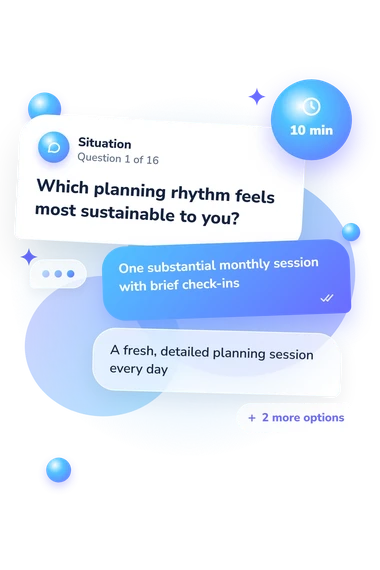
Example Questions From the Test
- One substantial monthly session with brief check-ins
- A fresh, detailed planning session every day
- One weekly setup followed by small daily updates
- Quick notes whenever plans arise, usually away from home
- Major milestones, deadlines, and progress across the months
- The exact tasks for every day of the first week
- A portable list of the next few actions
- How project tasks fit alongside each upcoming week
- A month view showing Wednesday as one important date
- A full daily page with a timeline and separate task space
- A weekly spread that shows Wednesday beside the other days
- A compact checklist I can consult while moving around
Erin Condren Planner Quiz - Description and methodology of the test
People choosing among planner layouts often know what they need to organize but not which page structure will make that work feel easiest. The Erin Condren Planner Quiz is intended for anyone comparing writing space, planning rhythm, portability, and the amount of daily detail they actually use. An Erin Condren quiz result turns those preferences into a practical profile of formats worth considering.
What This Assessment Explores
The responses indicate which layout feels natural. Items cover rhythm, detail, writing space, time-blocking, portability, and preference for daily, weekly, monthly, or immediate-task views. The profile helps narrow Erin Condren planner styles by fit.
These are four format affinities:
- A5 Compact Vertical LifePlanner (0-12) measures affinity for portable, concise planning: Occasional Fit (0-4), Flexible Fit (5-8), Strong Fit (9-12).
- Daily Duo (0-12) measures affinity for daily space, time structure, and focused task lists: Occasional Fit (0-4), Flexible Fit (5-8), Strong Fit (9-12).
- Monthly Planner (0-12) measures affinity for broad deadlines, projects, and progress: Occasional Fit (0-4), Flexible Fit (5-8), Strong Fit (9-12).
- Weekly LifePlanner (0-12) measures affinity for a week-at-a-glance approach to appointments, tasks, and routines: Occasional Fit (0-4), Flexible Fit (5-8), Strong Fit (9-12).
The highest score shows strongest affinity; scores within one point indicate a blended result.
Methodology and Scientific Basis
Each item presents a planning situation with four response choices. The options contrast daily detail, weekly visibility, monthly mapping, and compact capture, while also probing time blocks, writing space, portability, shifting commitments, project horizons, and planning across locations. Responses produce four affinity scores rather than a pass/fail judgment; the highest is the strongest match, while near-ties create a blended profile for practical comparison.
A study comparing paper and mobile calendars provides the closest conceptual support: format can influence everyday planning and plan fulfillment. Research using the Time Management Behavior Scale links time-management behaviors with academic performance and stress, supporting attention to planning structure and perceived control.
The questionnaire is conceptually consistent with those findings, but it is not an adaptation of either study. When comparing Erin Condren planner options, read the displayed bands as fit categories for comparing planner formats; they are not population norms or evidence that this online questionnaire has been validated. Because responses are self-reported, current workload, mood, and self-awareness can shift the outcome; compare it with your experience using a layout.
- Huang, Yanliu, Zhen Yang, and Vicki G. Morwitz. (2023). How using a paper versus mobile calendar influences everyday planning and plan fulfillment. Journal of Consumer Psychology, 33(1), 115-122. 10.1002/jcpy.1297
- Macan, Therese Hoff, Comila Shahani, Robert L. Dipboye, and Amanda Peek Phillips. (1990). College Students' Time Management: Correlations With Academic Performance and Stress. Journal of Educational Psychology, 82(4), 760-768. 10.1037/0022-0663.82.4.760