
Famous Picture Quiz
How the Scales are Structured
Who Usually Takes This Test?
See How You Compare
Below is a preview of how scores are typically distributed across each scale.
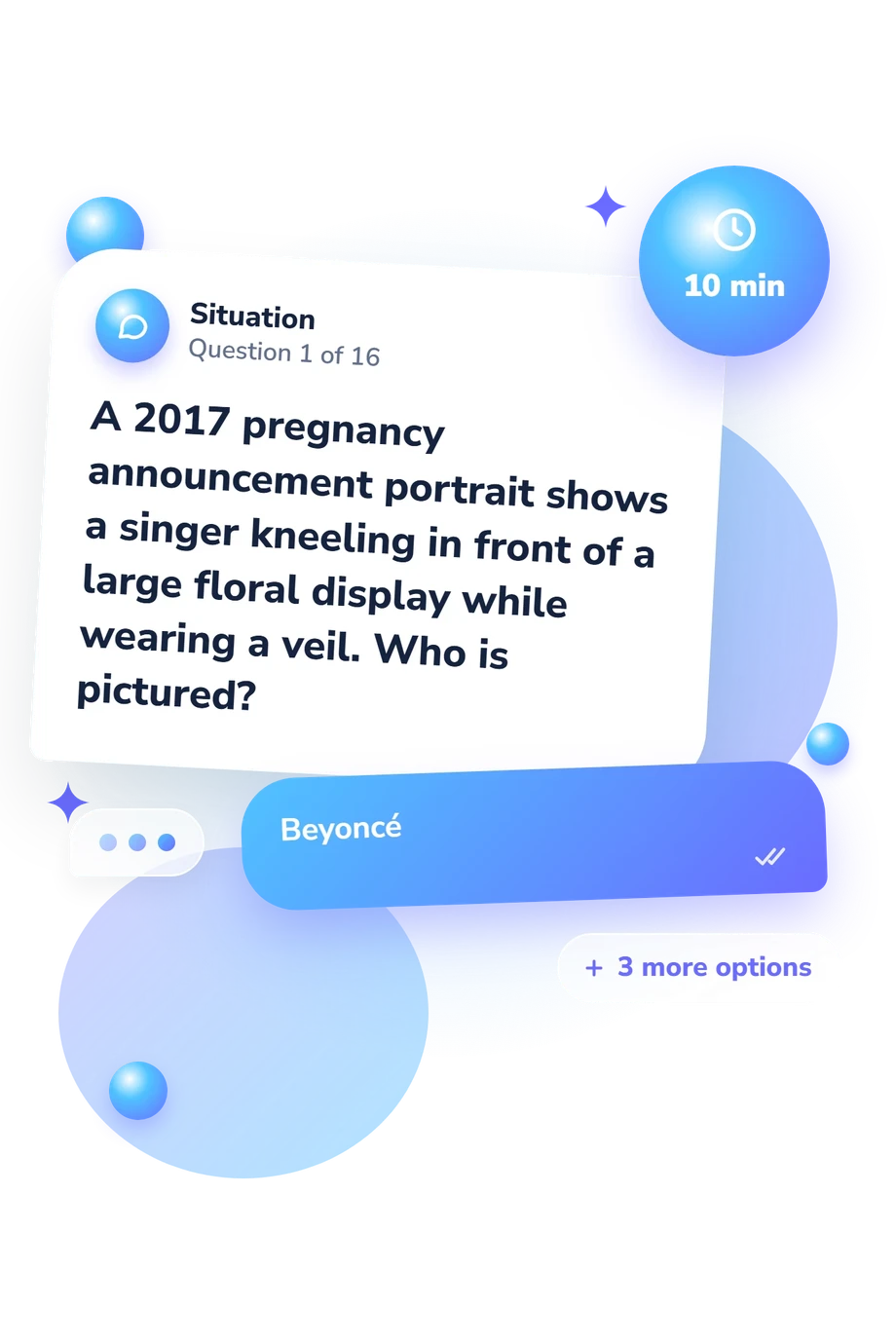
Example Questions From the Test
- Jayne Mansfield
- Doris Day
- Marilyn Monroe
- Brigitte Bardot
- Diana, Princess of Wales
- Princess Margaret
- Sarah, Duchess of York
- Queen Elizabeth II
- Joe Frazier
- Muhammad Ali
- George Foreman
- Floyd Patterson
Famous Picture Quiz - Description and methodology of the test
For readers who enjoy visual culture, the famous picture quiz offers a focused way to examine how readily they recognize widely circulated images and the people associated with them. It suits curious readers who want a people picture quiz that also spans art, sport, entertainment, and other visual references. The result gives a compact picture of recognition across this mix of material.
What This Assessment Explores
The questions combine recognizable faces with contextual clues and visual details. They suit readers seeking an iconic image quiz without specialist training in art, photography, or popular culture.
Several prompts focus on celebrity portraits; others use logos, album covers, artworks, sporting gestures, film scenes, or distinctive details to identify a person, group, or subject.
The main visual groups represented are:
- Portraits and public figures show how appearance and context support identification.
- Art, logos, and album imagery test recognition of references linked to a creator or performer.
- Historic, sporting, and entertainment photographs show how setting, gesture, or costume supports recognition.
The result uses one scale, Famous Picture Knowledge (0-16). Emerging Recognition (0-6) indicates some major images were identified; Developing Eye (7-12) indicates recognition across several fields; Picture Expert (13-16) indicates strong knowledge of iconic celebrity imagery.
Methodology and Scientific Basis
Each item gives a brief description of a recognizable image and four named answer choices. The respondent selects the option that best identifies the person, object, group, or event. The displayed result condenses those selections into one recognition score, without separate subscores for photography, art, sport, or entertainment.
This online picture-recognition questionnaire is a knowledge quiz: it records answers to the pictured material rather than confidence ratings. Cultural familiarity, media exposure, and uncertainty about plausible distractors can affect performance when more than one option seems familiar.
Its format is conceptually consistent with Carbon (2008), whose work distinguishes felt familiarity from recognition accuracy. Russell, Duchaine, and Nakayama (2009) provide a related reference point through research on unusually strong face-recognition ability. Isola et al. (2014) help explain how visual distinctiveness, meaning, and encounter context can affect memorability.
These studies provide conceptual context, while this online questionnaire has no reported norms or validation; its bands describe performance on this picture set. Interpret the result as recognition of these items, with guessing or distractor familiarity affecting answers.
- Claus-Christian Carbon. "Famous Faces as Icons. The Illusion of Being an Expert in the Recognition of Famous Faces." Perception, 2008, 37(5), 801-806. 10.1068/p5789
- Richard Russell, Brad Duchaine, and Ken Nakayama. "Super-recognizers: People with extraordinary face recognition ability." Psychonomic Bulletin & Review, 2009, 16(2), 252-257. 10.3758/PBR.16.2.252
- Phillip Isola, Jianxiong Xiao, Devi Parikh, Antonio Torralba, and Aude Oliva. "What Makes a Photograph Memorable?" IEEE Transactions on Pattern Analysis and Machine Intelligence, 2014, 36(7), 1469-1482. 10.1109/TPAMI.2013.200
Updated: