
End of the World Quiz
How the Scales are Structured
Who Usually Takes This Test?
See How You Compare
Below is a preview of how scores are typically distributed across each scale.
Example Questions From the Test
- Their fear quickly becomes my focus, making it difficult to evaluate anything else.
- I notice my own reaction, acknowledge their concern, and return attention to confirmed facts and present needs.
- I stay functional, but their repetition makes me increasingly tense or impatient.
- I try to avoid the conversation so I can preserve my own equilibrium.
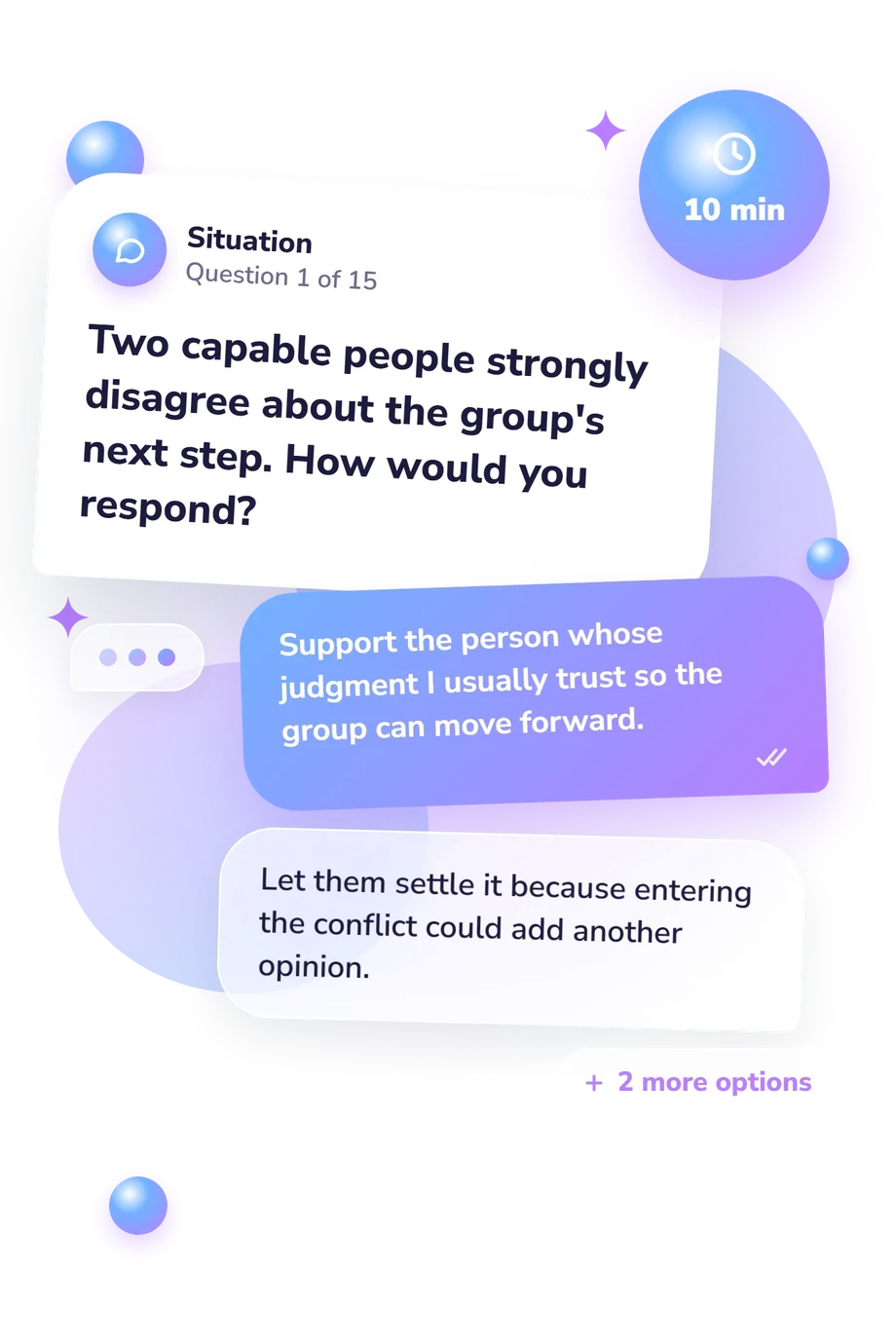
- Support the person whose judgment I usually trust so the group can move forward.
- Let them settle it because entering the conflict could add another opinion.
- Ask each person to state their evidence and priorities, then help identify a reversible next step.
- Suggest a quick vote after giving both people a short chance to explain.
- Break the task into parts, identify what the group does know, and seek reliable instructions for the gaps.
- Try a familiar method that seems close enough and see what happens.
- Delay the task because partial knowledge could create complications.
- Ask who has relevant experience and begin with the lower-consequence parts.
End of the World Quiz - Description and methodology of the test
People wanting to examine how they think, coordinate, and contain reactions under uncertainty may find the end of the world quiz useful as structured reflection. It is intended for readers who want to update decisions, coordinate under strain, and contain reactions as facts change. The end of the world preparedness quiz uses imagined disruption to examine these capacities.
What This Assessment Explores
Across its scenarios, it examines changing evidence, competing needs, interpersonal strain, and ambiguity. Framed as a quiz about when the end of the world comes, this questionnaire examines how people update decisions, coordinate with others, and contain reactions when information is incomplete. The result helps readers notice how their habits may shape decisions, coordination, and reactions with others.
The three displayed dimensions are:
- Adaptive Problem-Solving (0-15) shows how readily you test assumptions and update plans: Plan Dependent (0-5), Practical Adapter (6-10), or Flexible Strategist (11-15).
- Collaborative Resilience (0-15) reflects how you share responsibility and coordinate under strain: Self-Contained Contributor (0-5), Situational Teammate (6-10), or Resilience Builder (11-15).
- Composure Under Uncertainty (0-15) describes staying responsive when worry narrows attention: Easily Disrupted (0-5), Regaining Balance (6-10), or Steady Under Pressure (11-15).
Methodology and Scientific Basis
Each item presents a situation with four options about unverified messages, scarce supplies, conflict, mistakes, rest, or support for an overwhelmed member. Choosing the response closest to your usual tendency makes this a self-report method, so honest answers and self-awareness matter.
Selected responses produce the displayed dimensions and their bands.
These unvalidated reflective scores can be shaped by current stress, response bias, limited self-awareness, and imagined scenarios; read them as prompts to examine habits such as checking evidence, clarifying roles, and taking one manageable next step, not as evidence of crisis competence.
The dramatic setting uses end of the world scenarios to examine how people update decisions, sustain cooperation, and contain reactions when facts change. It is conceptually consistent with DARS (First et al., 2021) on individual protection and adaptation, ADAPTER (van der Beek and Schraagen, 2015) on team adaptability, and Clough, Earle, and Sewell’s (2002) mental toughness model. It is not an adaptation or validation of those instruments.
That reflection can help identify where updating a plan, clarifying a role, or containing a reaction may deserve practice.
- First, Jennifer M.; Yu, Mansoo; Houston, J. Brian. (2021). The Disaster Adaptation and Resilience Scale: development and validation of an individual-level protection measure. Disasters, 45(4), 939-967. 10.1111/disa.12452
- van der Beek, Dolf; Schraagen, Jan Maarten. (2015). ADAPTER: Analysing and developing adaptability and performance in teams to enhance resilience. Reliability Engineering & System Safety, 141, 33-44. 10.1016/j.ress.2015.03.019
- Clough, Peter J.; Earle, Keith; Sewell, Danny. (2002). Mental toughness: The concept and its measurement. In Ian Cockerill (Ed.), Solutions in sport psychology (pp. 32-45). London: Thomson Learning.
Updated: