
Famous Date Quiz
How the Scales are Structured
Who Usually Takes This Test?
See How You Compare
Below is a preview of how scores are typically distributed across each scale.
Example Questions From the Test
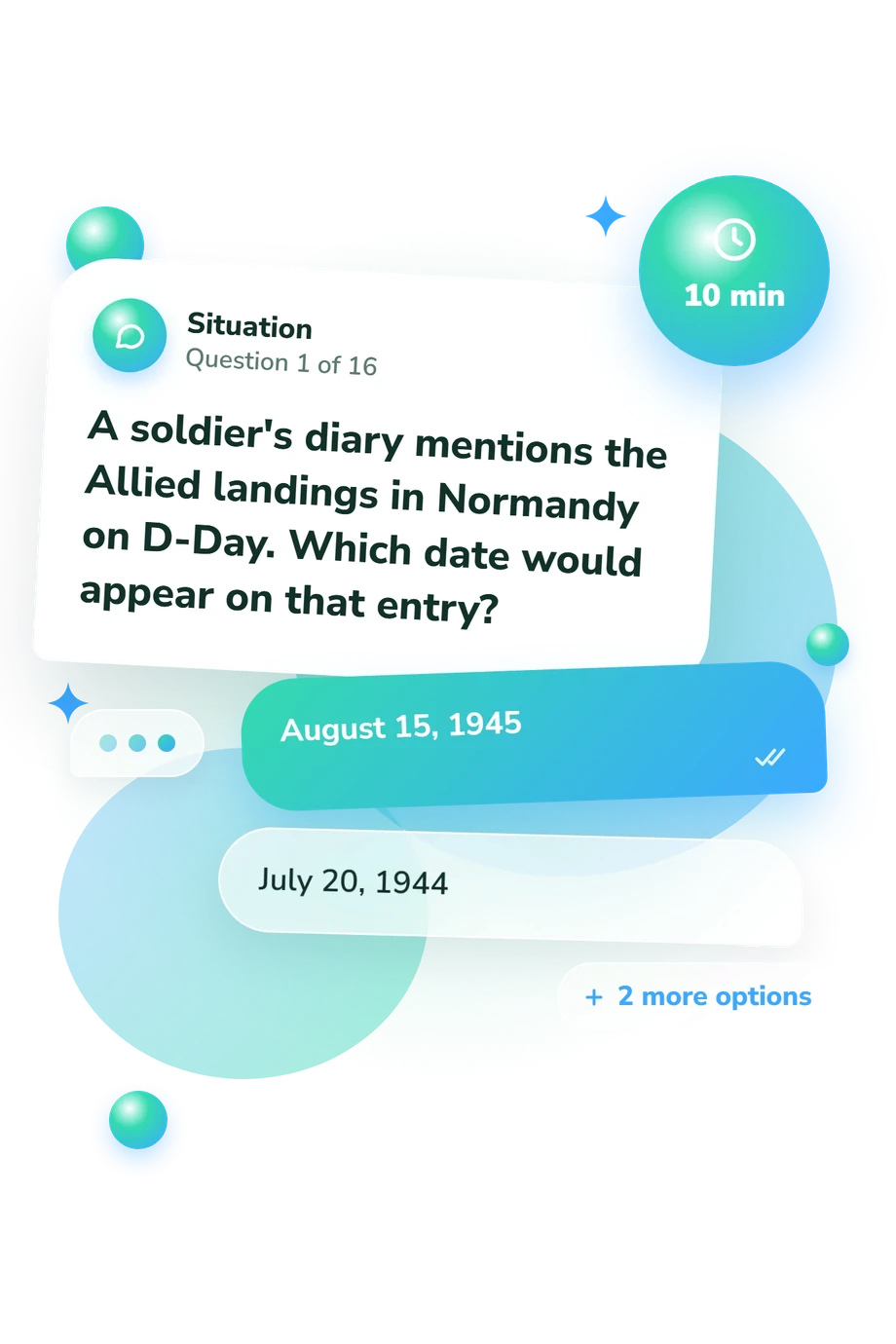
- August 15, 1945
- July 20, 1944
- May 8, 1945
- June 6, 1944
- March 12, 1938
- September 1, 1939
- June 22, 1941
- September 30, 1938
- August 15, 1947
- June 3, 1947
- January 26, 1947
- January 26, 1950
Famous Date Quiz - Description and methodology of the test
Readers who want a focused check of historical recall can use this famous date quiz to see how securely they place major events in time. It suits students, lifelong learners, and anyone revisiting world-history milestones through an accessible knowledge task. This important dates quiz samples questions about identifying landmark dates, distinguishing years, and ordering events.
What This Assessment Explores
The questionnaire tests historical recall and chronology, not opinions or traits. Items ask readers to identify a landmark date or year, recognize an event from its date, or arrange milestones from earliest to latest. Questions in this historical dates quiz sample event-date association, sequencing, and coverage across eras rather than separately scored abilities.
The result brings together these content areas:
- Famous Dates Knowledge (0-16) is the single displayed score: it counts correct answers across the set and places performance in Building Foundations (0-6), Developing Knowledge (7-12), or Strong Date Knowledge (13-16).
- Event-date association is sampled when a reader links an occurrence with its day, month, or year.
- Chronological ordering is sampled when periods are placed in sequence.
- Cross-era coverage is sampled across wars, political change, exploration, rights, institutions, and space history.
The result is a snapshot of date recall and timeline understanding.
Methodology and Evidence Base
Each item uses multiple choice with one intended answer and several alternatives. The set mixes date recognition, year identification, and chronological sequencing; distractors may come from nearby events or plausible periods, so careful reading matters as well as memory. The displayed total assigns one point for each correct answer and maps it to the named performance bands.
The format keeps this famous dates quiz focused on retrieval and sequencing rather than open-ended historical argument. Its use of multiple-choice recall and sequencing is conceptually consistent with Reich's history-assessment research and with the study by Smith, Breakstone, and Wineburg. The National Assessment Governing Board places historical knowledge within wider historical learning; the bands here describe performance on this item set, not population norms or clinical meaning.
This is an online knowledge and self-reflection tool. Guessing, prior schooling, cultural familiarity with selected events, and memory for exact dates can influence the result, so treat it as one snapshot when choosing topics for review.
- Reich, Gabriel A. (2013). Imperfect Models, Imperfect Conclusions: An Exploratory Study of Multiple-Choice Tests and Historical Knowledge. The Journal of Social Studies Research, 37(1), 3-16. 10.1016/j.jssr.2012.12.004
- Smith, Mark, Joel Breakstone, and Sam Wineburg. (2019). History Assessments of Thinking: A Validity Study. Cognition and Instruction, 37(1), 118-144. 10.1080/07370008.2018.1499646
- National Assessment Governing Board. (2018). U.S. History Framework for the 2018 National Assessment of Educational Progress. Washington, DC: National Assessment Governing Board.
Updated: