
English Grammar Quiz for Class 5
How the Scales are Structured
Who Usually Takes This Test?
See How You Compare
Below is a preview of how scores are typically distributed across each scale.
Example Questions From the Test
- The players thanked their coach.
- Running through the busy playground.
- After the football match.
- Because the final whistle sounded.
- the bicycle owned by Amirs
- Amir’s bicycle
- the bicycle of several Amirs
- Amir bicycles
- The basket of apples are on the table.
- The basket of apples is on the table.
- The basket of apples be on the table.
- The basket of apples were on the table now.
English Grammar Quiz for Class 5 - Description and methodology of the test
For pupils, parents, and teachers seeking a focused review of school grammar, this English Grammar Quiz for Class 5 shows how confidently a learner applies common rules in context. As an English quiz for Class 5, it offers a useful starting point for targeted revision, while the result places performance in a broad practice band and can help guide further revision.
What This Assessment Explores
The questions sample practical grammar decisions rather than isolated definitions. They examine complete sentences, subject-verb agreement, plurals and possessives, pronouns, prepositions, comparisons, conjunctions, tense, punctuation, and parts of speech. This makes the quiz useful for class 5 grammar practice: each answer points to a rule that can be revisited in a new sentence.
The English Grammar Knowledge scale (0-16) awards one point for each correct answer. The displayed result uses these bands:
- Foundations to build (0-6) shows that core rules need review and short-sentence practice.
- Developing knowledge (7-12) indicates that many rules are understood, although selected topics need focused work.
- Strong knowledge (13-16) indicates accurate application of Class 5 grammar rules across most contexts.
The result describes performance on the tested skills at completion. It supports revision planning, not a broad judgement about overall English ability.
Methodology and Evidence Base
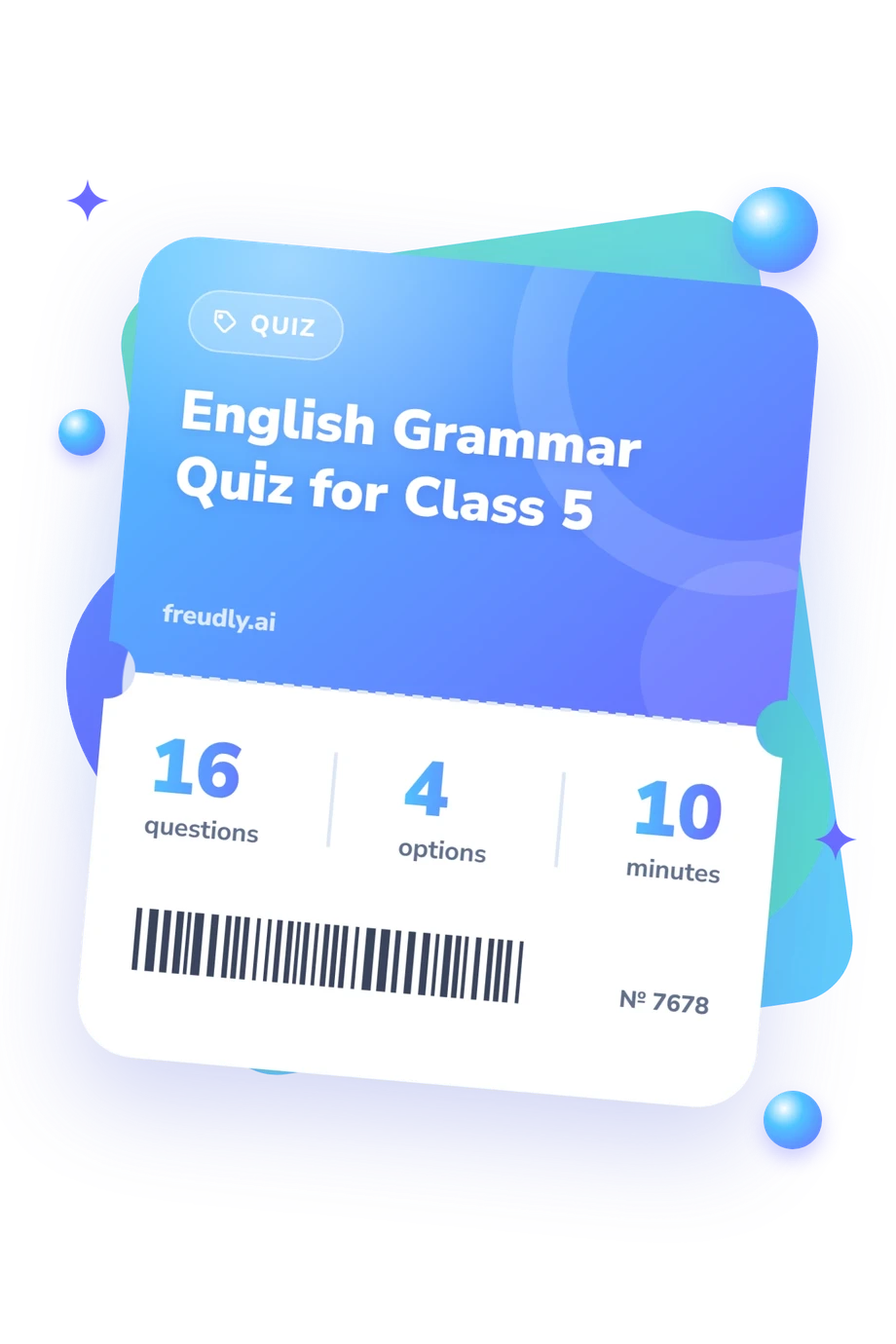
Each item uses selected-response format with four answer choices. The learner chooses the option that best completes a sentence or identifies a grammatical feature, so the score reflects correct selections rather than confidence. This structure makes errors specific enough to discuss with a teacher, parent, or tutor.
The item topics overlap with the 2010 U.S. standards framework for English language arts and grammatical distinctions discussed by Huddleston and Pullum (2002). It is conceptually consistent with the English Grammar Awareness Measure (Li & Hu, 2025), but it is not that published measure or a validated adaptation. These sources do not establish alignment, norms, reliability, or standardization for this questionnaire.
For a learner taking this Class 5 grammar quiz, the most useful interpretation is practical: revisit the grammar rule represented by each missed item, then practise it in new sentences. Results can be influenced by attention, reading comprehension, familiarity with examples, and current learning context. Comparing errors across sentence structure, word forms, tense, and punctuation can help organise that practice.
- Li, Bangbiao, and Junzhen Hu. (2025). Development and Validation of an English Grammar Awareness Measure for Upper Primary Students. Journal of Teaching Innovation and Practice, 1(2), 23-30. 10.65170/jtr.v1i2.20
- National Governors Association Center for Best Practices, and Council of Chief State School Officers. (2010). Common Core State Standards for English Language Arts & Literacy in History/Social Studies, Science, and Technical Subjects. Washington, DC: National Governors Association Center for Best Practices, Council of Chief State School Officers.
- Huddleston, Rodney, and Geoffrey K. Pullum. (2002). The Cambridge Grammar of the English Language. Cambridge University Press.
Updated: