
Enemy Quiz
How the Scales are Structured
Who Usually Takes This Test?
See How You Compare
Below is a preview of how scores are typically distributed across each scale.
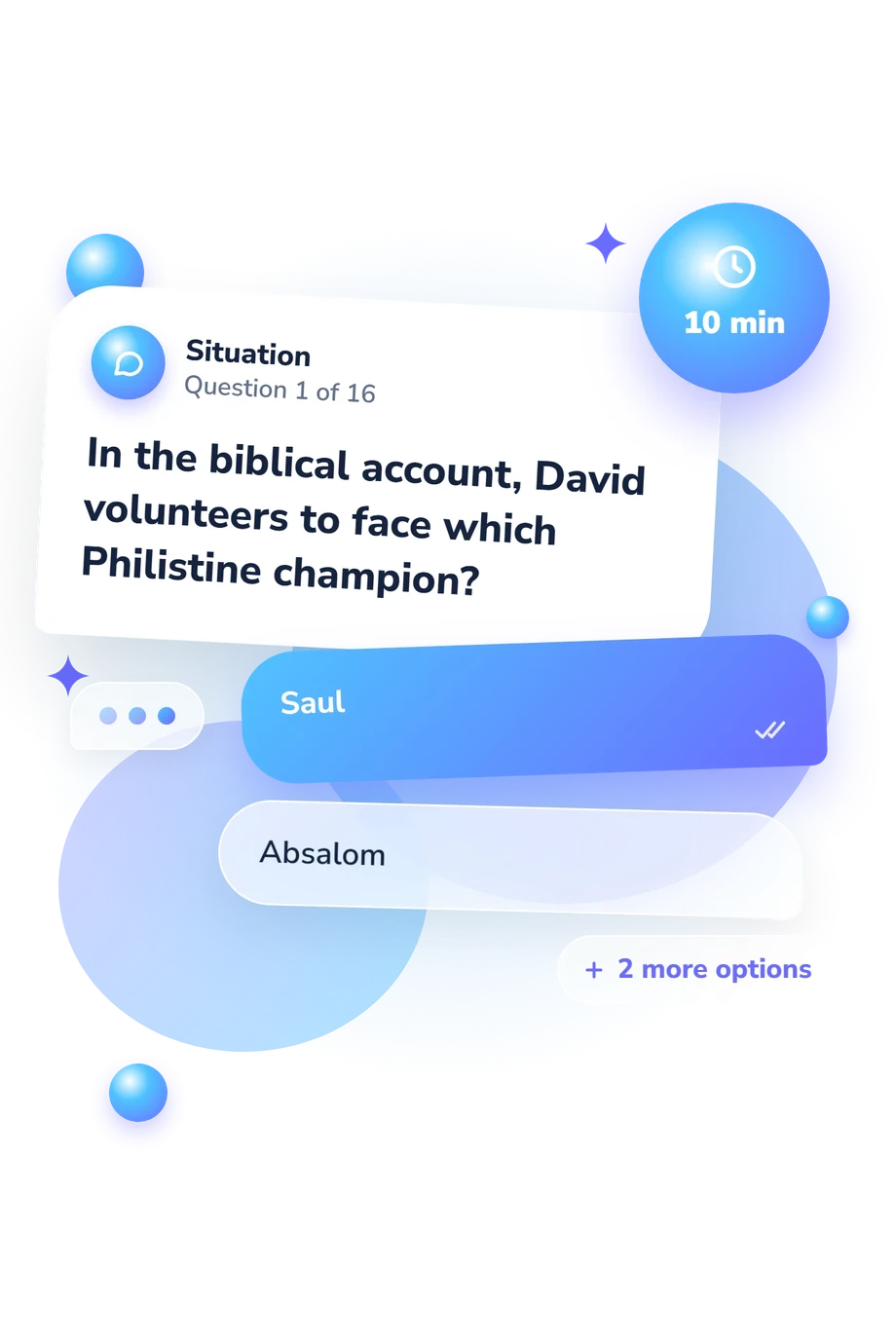
Example Questions From the Test
- Saul
- Absalom
- Goliath
- Samson
- Tudor and Stuart
- Plantagenet and Hanover
- Wessex and Normandy
- Lancaster and York
- Mr. Tumnus
- Peter Pevensie
- Father Christmas
- Aslan
Enemy Quiz - Description and methodology of the test
Readers who enjoy broad cultural recall can use the Enemy Quiz to see what an overall knowledge band says about their recognition of classic rivals. It suits anyone who wants a compact mythology and history quiz without turning the result into a personality assessment. The outcome gives a clear place to begin revisiting familiar material or exploring less familiar sources.
What This Assessment Explores
The questionnaire measures recognition of famous adversaries, not aggression or interpersonal danger. Clues connect a familiar situation with an opposing figure, house, state, alliance, or creature. It suits anyone curious about cultural recall.
Here, an enemy means a cultural adversary in mythology, history, literature, or related sources. This famous enemies quiz tests recognition of classic rivals, not personal threat.
The questions cover four thematic groups:
- Biblical conflicts show whether scriptural episodes lead you to the correct opponent.
- Mythological rivalries show how you connect gods, heroes, monsters, and older powers.
- Historical conflicts show whether you recognize competing houses, states, and coalitions.
- Literary and popular-culture confrontations show how plot clues identify an antagonist.
Enemy Knowledge, 0-16, is reported in three bands: Emerging Knowledge (0-6), Developing Knowledge (7-12), and Strong Knowledge (13-16). These bands describe recall within the selected material only.
Methodology and Evidence Base
Methodologically, this is a structured multiple-choice knowledge assessment rather than a published psychometric instrument. Each item presents a clue with four answer choices, and the respondent selects the figure, rival group, or enemy force that best fits. The clues range from named figures and creatures to rival houses, states, and alliances, requiring a link between context and the matching adversary. The format measures recognition and association, not personal experience or behavior.
The displayed result summarizes performance on the selected material. As a cultural knowledge quiz, it offers a focused snapshot of recall rather than estimating general ability.
The cited works provide subject-matter grounding for the literary, classical, historical, and biblical identities represented here. The questionnaire is not an adaptation of any one source; these references do not validate this online version.
No standardization or norms are stated for this online questionnaire. Prior exposure to books, films, lessons, historical traditions, or cultural references can affect performance, as can attention to wording and current recall. Treat the result as a focused knowledge snapshot for identifying strengths and choosing subjects for further exploration.
- The Oxford Companion to English Literature, 7th ed., edited by Dinah Birch, Oxford University Press, 2009. 10.1093/acref/9780192806871.001.0001
- The Oxford History of the Classical World, edited by John Boardman, Jasper Griffin, and Oswyn Murray, Oxford University Press, 1986. ISBN 9780198721123
- The Oxford Illustrated History of Britain, edited by Kenneth O. Morgan, Oxford University Press, 1984. ISBN 9780198226840
- The Holy Bible: New Revised Standard Version Updated Edition, National Council of the Churches of Christ in the United States of America, National Council of Churches, 2021.
Updated: