
Environmental Health Quiz
How the Scales are Structured
Who Usually Takes This Test?
See How You Compare
Below is a preview of how scores are typically distributed across each scale.
Example Questions From the Test
- A child or pregnant person has had direct contact with paint chips or dust, or testing has identified a serious lead hazard.
- Older painted surfaces are present, but they are intact and no dusty renovation is occurring.
- There is no known older paint hazard, or professional testing and controls have addressed it.
- Paint is peeling, or sanding, demolition, or renovation dust is reaching occupied areas without effective containment.
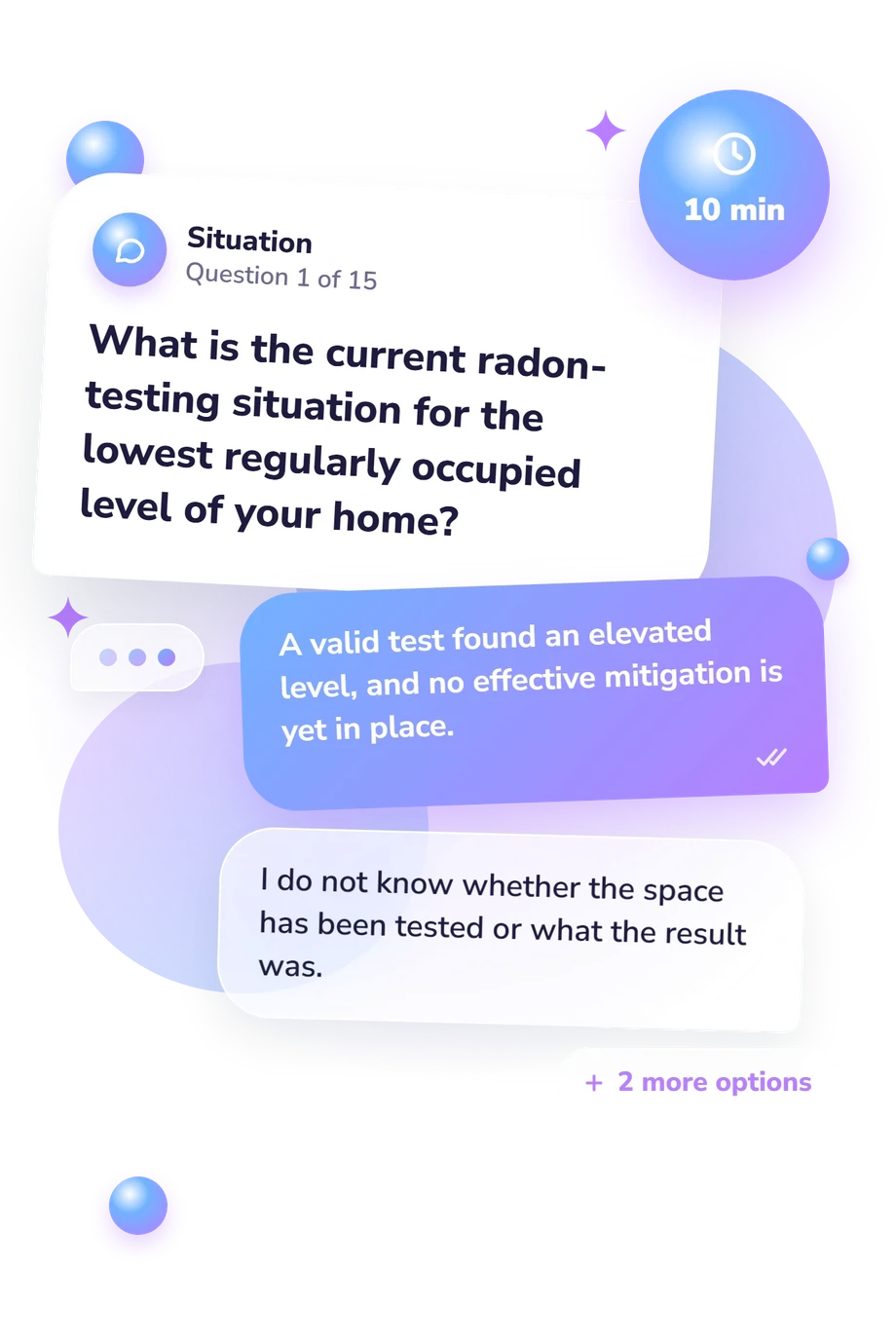
- A valid test found an elevated level, and no effective mitigation is yet in place.
- I do not know whether the space has been tested or what the result was.
- A valid test was not elevated, or an installed mitigation system has a current follow-up result showing it works.
- A result was elevated, but professional assessment or mitigation is already underway.
- Occasional dust or odors have been noticeable but have not persisted or entered living areas.
- No recurring floodwater, sewage, unusual dust, smoke, or chemical odors have reached the property.
- Flood dampness, smoke, dust, sewage odor, or chemical odor repeatedly enters occupied areas.
- There has been direct contact with sewage or a chemical release, visible contamination indoors, or an official order to evacuate or shelter.
Environmental Health Quiz - Description and methodology of the test
People seeking a practical review of conditions in their living environment may find the environmental health quiz useful when deciding what deserves closer attention. It is intended for adults reflecting on a home, rental, or nearby setting when symptoms, odors, dampness, heat, noise, water concerns, or household hazards raise questions. In this assessment, questions about environmental health focus on observable situations rather than laboratory measurements or a clinical history.
What This Assessment Explores
It groups warning signs into home and neighborhood conditions, indoor air and combustion, and water or household chemicals. Topics include paint dust, radon, flooding, fuel-burning equipment, carbon monoxide, dampness, temperature, pests, noise, water changes, and advisories.
In practical use, the questionnaire works as a home environmental health assessment with three result dimensions:
- Home and Neighborhood Exposure Warning Signs (0-15) covers property indicators; bands are No indicators reported (0), Indicator to review (1-2), and Prompt action warranted (3-15).
- Indoor Air and Combustion Warning Signs (0-15) covers fumes, ventilation, alarms, and related symptoms; bands are No indicators reported (0), Indicator to review (1-2), and Prompt action warranted (3-15).
- Water and Household Chemical Warning Signs (0-15) covers water changes, storage, handling, and spills; bands are No indicators reported (0), Indicator to review (1-2), and Prompt action warranted (3-15).
This profile points to conditions to document, verify, reduce, or discuss with an appropriate service.
Methodology and Scientific Basis
Each item presents a situation with four response choices. Options distinguish no known indicator, a controlled or resolved condition, an issue to review, and a potentially urgent warning. The wording asks about observable events, household practices, testing history, space-related symptoms, and official advisories rather than requiring a diagnosis.
Topic scores remain separate rather than forming one overall judgment. The displayed bands are unvalidated summaries, not severity or medical cutoffs; any score-3 response overrides the total for action purposes. Since individual point values are not specified, the bands should not be reverse-engineered.
The framework is conceptually consistent with the Housing Hazard Index (Nriagu et al., 2011). WHO housing-health guidance and CDC/HUD housing guidance support the topics, but this online questionnaire is not presented as an adaptation of those works and has no stated population norms or validation statistics.
Its indoor air quality and water safety quiz format can organize observations, but memory, uncertainty, changing conditions, and incomplete testing may affect self-report. A zero means no listed indicator was reported, not proof that no hazard exists; use the result to prioritize verification or urgent help when serious exposure signs appear.
- Nriagu, Jerome, Pamela Smith, and Deborah Socier. (2011). A rating scale for housing-based health hazards. Science of the Total Environment, 409(24), 5423-5431. 10.1016/j.scitotenv.2011.08.018
- World Health Organization. (2018). WHO Housing and health guidelines. Geneva: World Health Organization.
- Centers for Disease Control and Prevention and U.S. Department of Housing and Urban Development. (2006). Healthy housing reference manual. Atlanta: U.S. Department of Health and Human Services.
Updated: