
Evidence Law Quiz
How the Scales are Structured
Who Usually Takes This Test?
See How You Compare
Below is a preview of how scores are typically distributed across each scale.
Example Questions From the Test
- Past recollection recorded
- Statement against interest
- Then-existing state of mind
- Present-sense impression
- It may be treated as an opposing party's statement because it concerned a matter within the driver's employment and was made during that relationship.
- It is admissible only if it qualifies as a present-sense impression.
- It is automatically a business record because the driver discussed company operations.
- It is hearsay because only statements made by company executives can be used against a company.
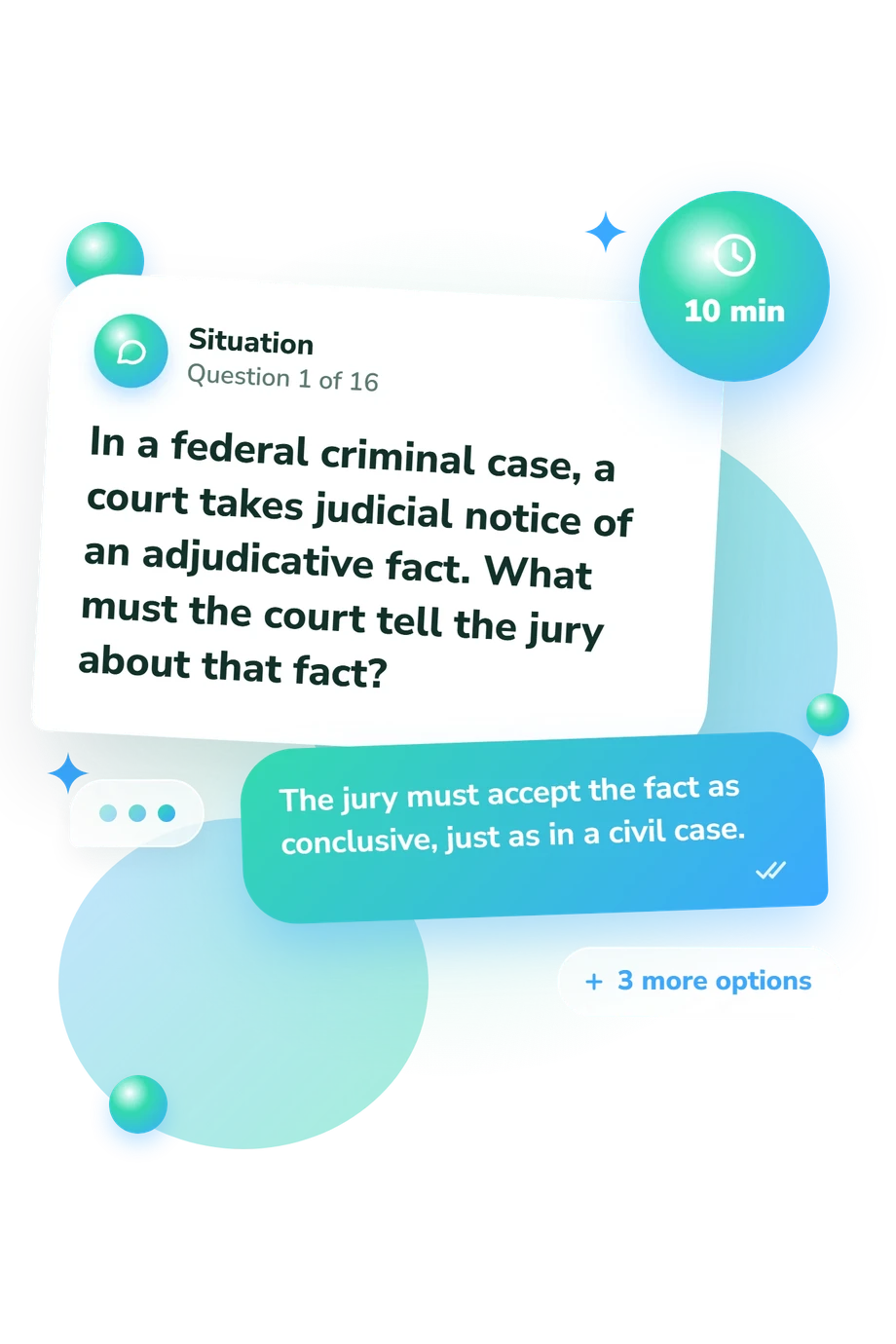
- The jury must accept the fact as conclusive, just as in a civil case.
- The jury must disregard the fact unless both parties formally stipulated to it.
- The jury may consider the fact only if an expert witness independently verifies it.
- The jury may, but is not required to, accept the noticed fact as conclusive.
Evidence Law Quiz - Description and methodology of the test
Learners preparing for a first course, exam, or practical review can use this evidence law quiz to check their performance on recurring federal evidence problems. The scenarios offer practice with federal evidence law, including identifying a doctrine, applying an exception, and distinguishing admissibility from the weight a jury may give evidence.
What the Questionnaire Measures
Short civil and criminal scenarios cover hearsay, relevance, judicial notice, lay and expert opinion, character, habit, records, privilege, repairs, and authentication. The score indicates performance on questions requiring recognition and application of the covered rules, exceptions, and foundations. It suits students and readers reviewing federal evidence concepts, especially those consolidating classroom learning through applied examples.
The format makes this a rules of evidence quiz: each item offers four choices and asks for the most accurate classification or consequence. Evidence Law Knowledge (0-16) is reported in these bands:
- Foundation to Build (0-6) indicates that core concepts need structured review.
- Developing Command (7-12) shows workable foundations with exceptions and courtroom applications still needing practice.
- Strong Command (13-16) reflects a strong grasp of the federal principles covered by the questions.
Methodology and Scientific Basis
Items present either a short fact pattern or a direct rule question, followed by four answer choices. The selected responses produce the displayed knowledge total, which is interpreted through the educational bands listed above. The questions test rule recognition and application rather than written analysis, citation format, or a full legal argument.
The questionnaire is conceptually consistent with Federal Rules of Evidence (2024), which supplies the federal framework for relevance, hearsay, privileges, writings, authentication, and other doctrines represented here. The 2025 McCormick treatise provides a practitioner-oriented reference for interpreting those doctrines. The expert-testimony item is conceptually consistent with the gatekeeping issue studied by Helland and Klick (2012), although that empirical work does not validate this questionnaire.
These evidence law practice questions help learners review federal evidence rules and identify subjects to revisit, but performance depends on careful reading, prior instruction, and the respondent’s chosen answer. The profile is an educational snapshot: it does not provide legal advice or assess every federal rule or jurisdiction.
- United States Courts. Federal Rules of Evidence, as amended to December 1, 2024. Administrative Office of the United States Courts, 2024.
- Mosteller, Robert P., general editor; Broun, Kenneth S.; Harris, Jasmine E.; Imwinkelried, Edward J.; Kaye, David H.; and Kinports, Kit. McCormick on Evidence. 9th ed. Thomson Reuters, 2025.
- Helland, Eric, and Jonathan Klick. "Does Anyone Get Stopped at the Gate? An Empirical Assessment of the Daubert Trilogy in the States." Supreme Court Economic Review, 20(1), 1-33, 2012. 10.1086/668621
Updated: