
Current Affairs Quiz
How the Scales are Structured
Who Usually Takes This Test?
See How You Compare
Below is a preview of how scores are typically distributed across each scale.
Example Questions From the Test
- It falls because newly issued bonds can offer more competitive returns.
- It rises because its fixed payments become more attractive.
- It remains fixed because bond prices cannot change after issuance.
- It automatically becomes equal to the issuing government’s annual budget.
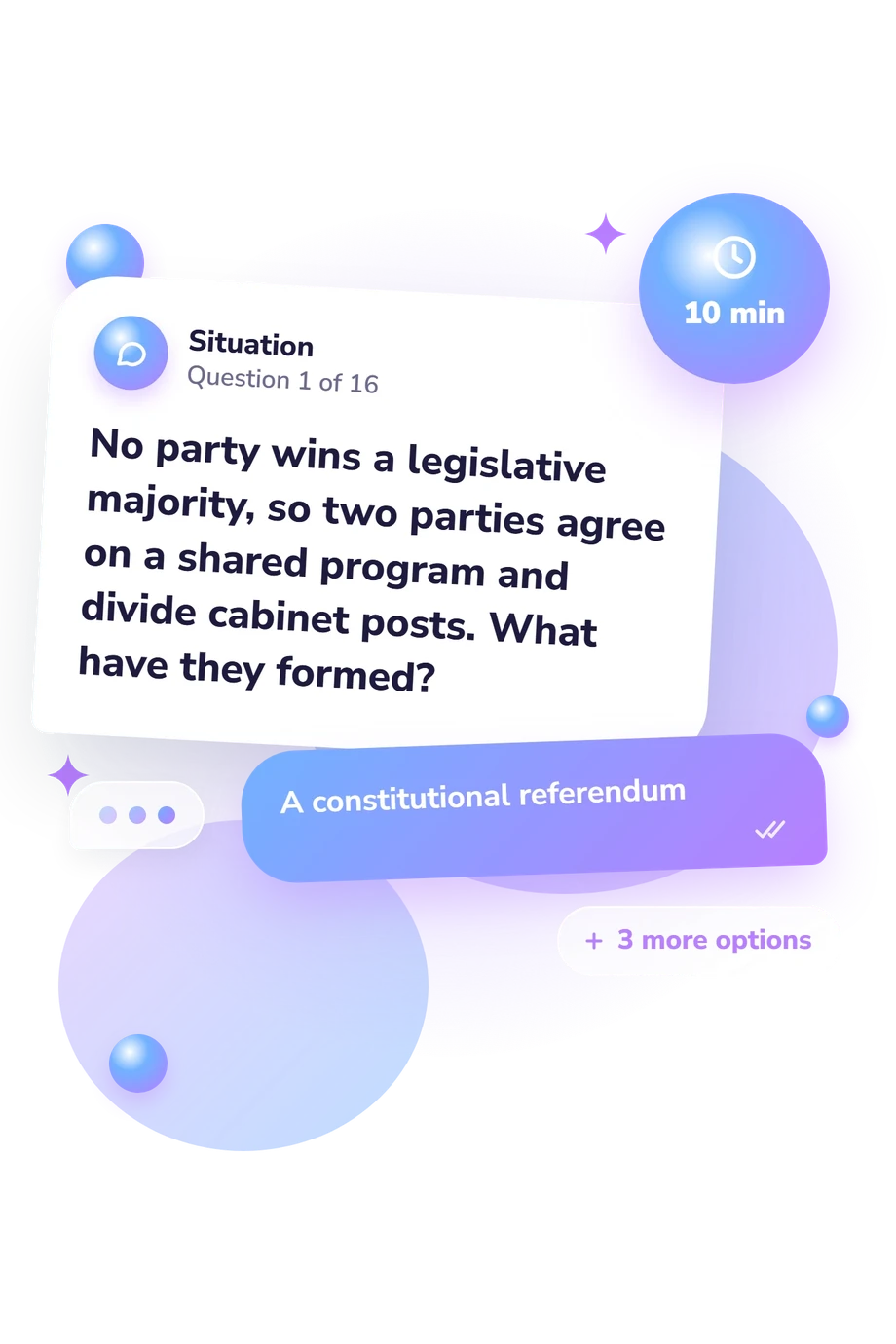
- A constitutional referendum
- A caretaker judiciary
- A presidential veto
- A coalition government
- Real output must have grown by exactly 14%.
- The country must have recorded a trade surplus.
- The government necessarily collected less tax revenue.
- After adjusting for inflation, economic output likely declined.
Current Affairs Quiz - Description and methodology of the test
People who want a clearer grasp of public events can use this current affairs quiz to examine practical news literacy. As a quiz about current affairs, it suits readers who want to interpret economic indicators, political institutions, climate policy, health statistics, international protection, and media evidence more confidently. Applying these concepts in context helps connect definitions with real situations rather than relying on recognition of familiar headlines.
What This Assessment Explores
This assessment checks whether you can apply concepts in contemporary reporting rather than recall a particular news cycle. Its items ask about interest rates, inflation, emissions, sanctions, elections, public-health data, refugee protection, ceasefires, international institutions, polling uncertainty, projections, and image verification.
These situations make it a practical news literacy assessment for readers seeking clearer civic understanding or self-directed learning. The result reflects tested knowledge, not intelligence or civic engagement.
The displayed Current Affairs Knowledge scale runs from 0 to 16 and uses these result bands:
- Building foundations (0-6) means you recognize some concepts but can review institutions, economic indicators, and evidence.
- Developing news literacy (7-12) means you understand many recurring ideas, with room to strengthen distinctions and applied reasoning.
- Strong news literacy (13-16) means you interpret most tested concepts and reporting scenarios accurately.
Methodology and Scientific Basis
The closest conceptual comparison is Maksl and colleagues' published 15-item news-literacy knowledge measure. This questionnaire is not an adaptation of it; the relationship is conceptual, not evidence of authorship or validation for this online test. Tully and colleagues define news literacy through accessing, evaluating, and using news, while Altay, Hoes, and Wojcieszak link news engagement with knowledge, belief accuracy, and trust.
The quiz uses scenario-based multiple-choice items: each presents a public-affairs situation and asks you to choose the most accurate concept, inference, source, or consequence from four answer choices. Topics include coalition government, ceasefires, incidence, policy-rate changes, polling uncertainty, image verification, and vetoes.
The output is one overall result measuring current events knowledge, interpreted through the displayed bands rather than separate topic scores. Their progression runs from foundational recognition through developing understanding to accurate performance across most tested concepts and scenarios. Read the result as a single snapshot across the item topics, not separate results for economics, politics, health, or media.
Performance can vary with prior exposure, language comprehension, guessing, and difficulty distinguishing related concepts.
- Altay, S., Hoes, E., & Wojcieszak, M. (2025). Following news on social media boosts knowledge, belief accuracy and trust. Nature Human Behaviour, 9(9), 1833-1842. 10.1038/s41562-025-02205-6
- Maksl, A., Boedeker, P. J., Vraga, E. K., Craft, S., Tully, M., & Ashley, S. (2024). Developing and validating a 15-item true/false measure of news literacy knowledge. Communication Research. 10.1177/00936502241284406
- Tully, M., Maksl, A., Ashley, S., Vraga, E. K., & Craft, S. (2022). Defining and conceptualizing news literacy. Journalism, 23(8), 1589-1606. 10.1177/14648849211005888
Updated: