
Crochet Quiz
How the Scales are Structured
Who Usually Takes This Test?
See How You Compare
Below is a preview of how scores are typically distributed across each scale.
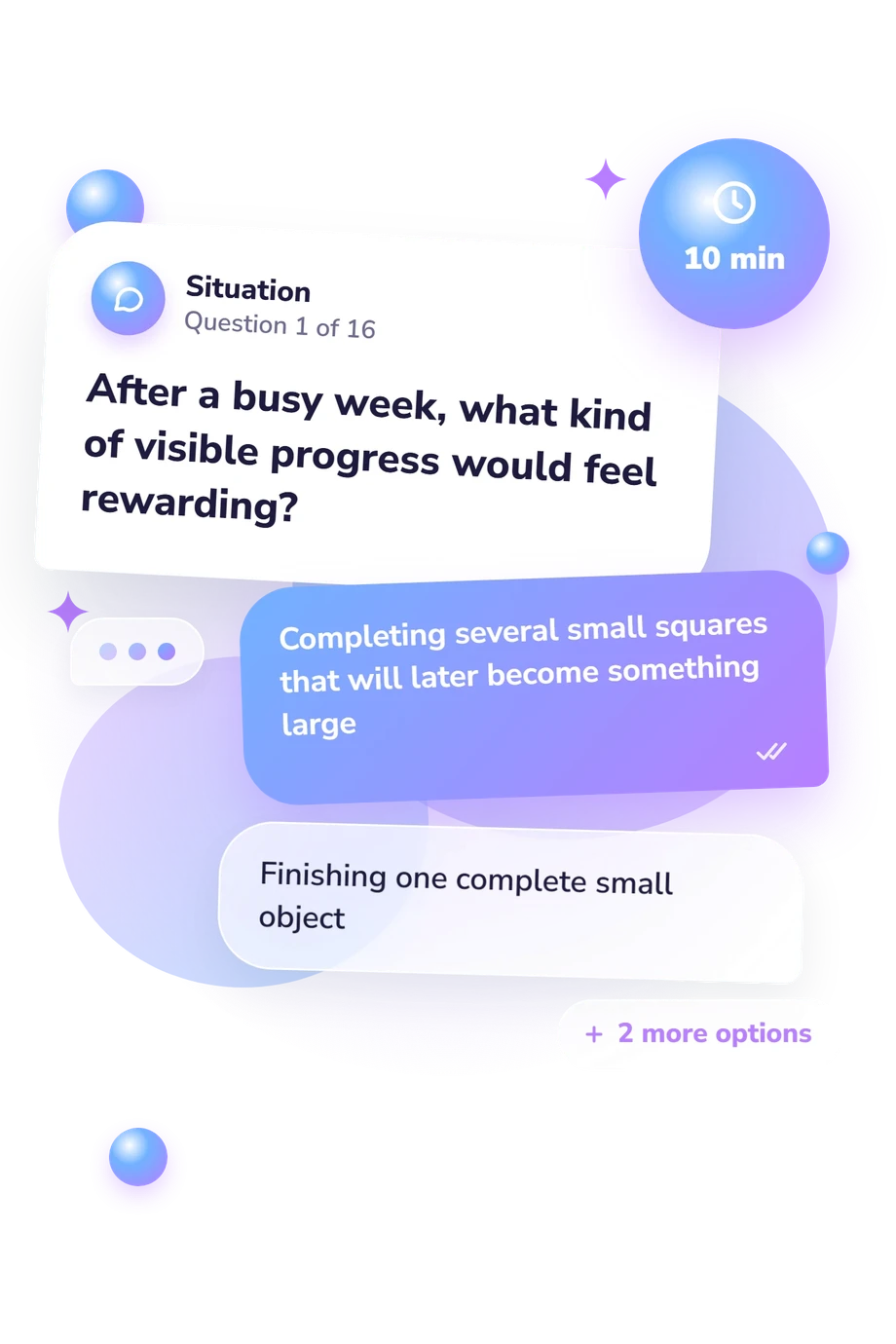
Example Questions From the Test
- Frequent shape changes and several pieces to join
- A stitch pattern that creates visible texture across the rows
- A mostly simple fabric with occasional decorative details
- Color changes that matter more than the surface texture
- A sturdy body and handles designed to carry everyday items
- A decorative shape that can sit on a shelf
- A soft item that is mainly comfortable to wear
- A useful piece that also includes a few ornamental sections
- I would rather make one uninterrupted piece of fabric
- I could enjoy it if most parts were quick and clearly labeled
- I like the idea of assembling pieces into a character
- I would tolerate a small amount of assembly for the right design
Crochet Quiz - Description and methodology of the test
People choosing a next project can use this assessment to match current patience, preferred pace, and enjoyment of construction with four crochet directions. The crochet quiz turns those preferences into a profile rather than a single right answer. When several possibilities seem equally appealing, the profile helps narrow the choice of crochet project by showing which direction fits best.
What This Assessment Explores
The questionnaire explores preferences for compact shaping, modular colour planning, practical construction, and a steady wearable rhythm. It suits crocheters comparing crochet project ideas; the result describes current project fit rather than technical ability.
The four profiles are:
- Amigurumi Pal (0-12) measures affinity for close counting and sculptural assembly: Different Direction 0-4, Possible Match 5-8, Strong Match 9-12.
- Granny-Square Blanket (0-12) measures affinity for modular progress and colour planning: Different Direction 0-4, Possible Match 5-8, Strong Match 9-12.
- Market Tote (0-12) measures affinity for durable, useful construction and handles: Different Direction 0-4, Possible Match 5-8, Strong Match 9-12.
- Textured Scarf (0-12) measures affinity for portable rows, tactile stitches, and wearable finishing: Different Direction 0-4, Possible Match 5-8, Strong Match 9-12.
Methodology and Evidence Base
Each item presents a project situation involving progress, yarn, construction, portability, counting, colour, or finishing, then asks which response feels most like you. There is no right answer; the format captures preferred kinds of effort, variety, repetition, and completion.
Responses are grouped into four comparable affinities. The highest total is the strongest current match, while totals within one point indicate a blended result. The profile provides a relative comparison of current project preferences.
Research by Burns and Van Der Meer connects crochet with creativity, relaxation, accomplishment, and connection, while Pöllänen describes materials, achievement, skill development, emotional control, and social meaning in craft well-being. These studies offer general context for the activities in the questions, not evidence for the four affinities or their comparative scoring.
Because it relies on self-report, the profile can change with current time, mood, projects, and self-perception; use it to compare the kinds of effort, materials, and finishes represented by the four directions when choosing a next crochet project, while checking practical factors such as available yarn, budget, skill level, and intended recipient yourself.
- Burns, Pippa, and Rosemary Van Der Meer. “Happy Hookers: Findings from an International Study Exploring the Effects of Crochet on Wellbeing.” Perspectives in Public Health 141, no. 3 (2021): 149-157. 10.1177/1757913920911961
- Pöllänen, Sinikka. “Elements of Crafts that Enhance Well-Being: Textile Craft Makers’ Descriptions of Their Leisure Activity.” Journal of Leisure Research 47, no. 1 (2015): 58-78. 10.1080/00222216.2015.11950351
Updated: