
Cocaine Addiction Quiz
How the Scales are Structured
Who Usually Takes This Test?
See How You Compare
Below is a preview of how scores are typically distributed across each scale.
Example Questions From the Test
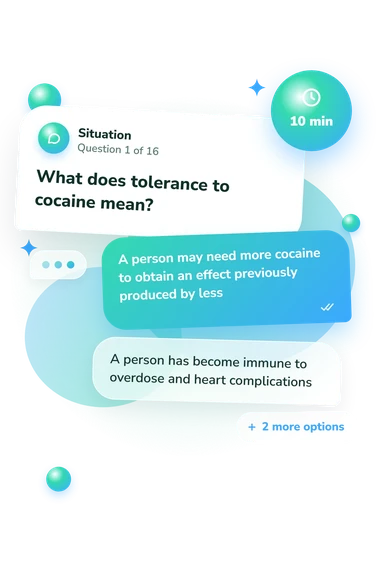
- A person may need more cocaine to obtain an effect previously produced by less
- A person has become immune to overdose and heart complications
- The body can now remove all contaminants from cocaine
- Stopping cocaine will no longer produce cravings or mood changes
- Relying on willpower without changing routines or seeking support
- Replacing cocaine with alcohol whenever cravings occur
- Waiting for a medication guaranteed to cure stimulant addiction
- Using structured behavioral care, such as contingency management or cognitive behavioral therapy
- A sedative-hypnotic
- An opioid
- A hallucinogen
- A stimulant
Cocaine Addiction Quiz - Description and methodology of the test
For people trying to understand cocaine-related risks, this cocaine addiction quiz offers a focused educational check rather than a history of personal use. As a cocaine knowledge test, it gives readers a structured way to review effects, tolerance, withdrawal, treatment, combinations, and emergencies. The result highlights areas of cocaine health knowledge that may need closer attention and can guide further learning about urgent responses and support.
What This Test Measures
Rather than estimating frequency of use, the questionnaire checks whether a respondent can recognise important facts about cocaine. It suits anyone seeking a structured review of risks and appropriate responses. Its themes include tolerance and reduced tolerance, routes of administration, alcohol or stimulant combinations, withdrawal, impaired control, treatment, and urgent responses to chest pain, collapse, slow breathing, severe paranoia, or possible fentanyl exposure.
The cocaine quiz reports one result: Cocaine Addiction Knowledge (0-16). It reflects the breadth of accurate information represented in the answers, not a personal-use history. The displayed bands are:
- Foundation to build (0-6) indicates that important concepts may be unfamiliar and need review.
- Developing knowledge (7-12) shows understanding of many key points while leaving gaps around risks, withdrawal, or treatment.
- Strong knowledge (13-16) reflects broad understanding of cocaine-related risks and appropriate responses.
Methodology and Evidence Base
Each item uses a multiple-choice format with four answer options. The result is presented as one educational total across the knowledge items; no separate clinical cutoff or diagnostic algorithm is stated.
Its evidence base is conceptually consistent with the Heidelberger Drogenbogen (HDB), a published instrument examining drug-specific knowledge in relation to illicit substance use. This online questionnaire is not presented as an adaptation of the HDB. Published HDB research reports reliability, validity, and cutoff findings for that instrument.
Guidance from the ASAM/AAAP guideline supports the treatment and emergency topics, including behavioural care, overdose response, cardiovascular danger, and urgent psychiatric symptoms. As a cocaine addiction knowledge test, it helps identify subjects to revisit before making decisions about support.
The HDB’s psychometric findings do not establish norms or validity for this online questionnaire, so the displayed bands are educational rather than norm-based. Attention, guessing, current context, and prior health information can affect test performance, so the result cannot establish whether someone has cocaine use disorder. Chest pain, collapse, breathing difficulty, seizures, or severe overheating require emergency services rather than waiting for a score.
- Aguilar-Raab, Corina, Moritz Heene, Dennis Grevenstein, and Jan Weinhold. “Assessing drug-specific knowledge as a protective factor in illicit substance use: The Heidelberger Drogenbogen (Heidelberg drug scales - HDB).” Journal of Substance Use, 20(6), 424-429, 2015. DOI 10.3109/14659891.2014.942400
- Aguilar-Raab, Corina, Moritz Heene, Dennis Grevenstein, and Jan Weinhold. “Assessing Drug Consumption Behavior With the Heidelberger Drogenbogen (Heidelberg Drug Scales): Reliabilities, Validities, and Cut-Off Criteria.” Substance Use & Misuse, 50(13), 1638-1649, 2015. DOI 10.3109/10826084.2015.1027926
- Clinical Guideline Committee (CGC) Members, ASAM Team, AAAP Team, and IRETA Team. “The ASAM/AAAP Clinical Practice Guideline on the Management of Stimulant Use Disorder.” Journal of Addiction Medicine, 18(1S Suppl 1), 1-56, 2024. DOI 10.1097/ADM.0000000000001299