
Checking Account Quiz
How the Scales are Structured
Who Usually Takes This Test?
See How You Compare
Below is a preview of how scores are typically distributed across each scale.
Example Questions From the Test
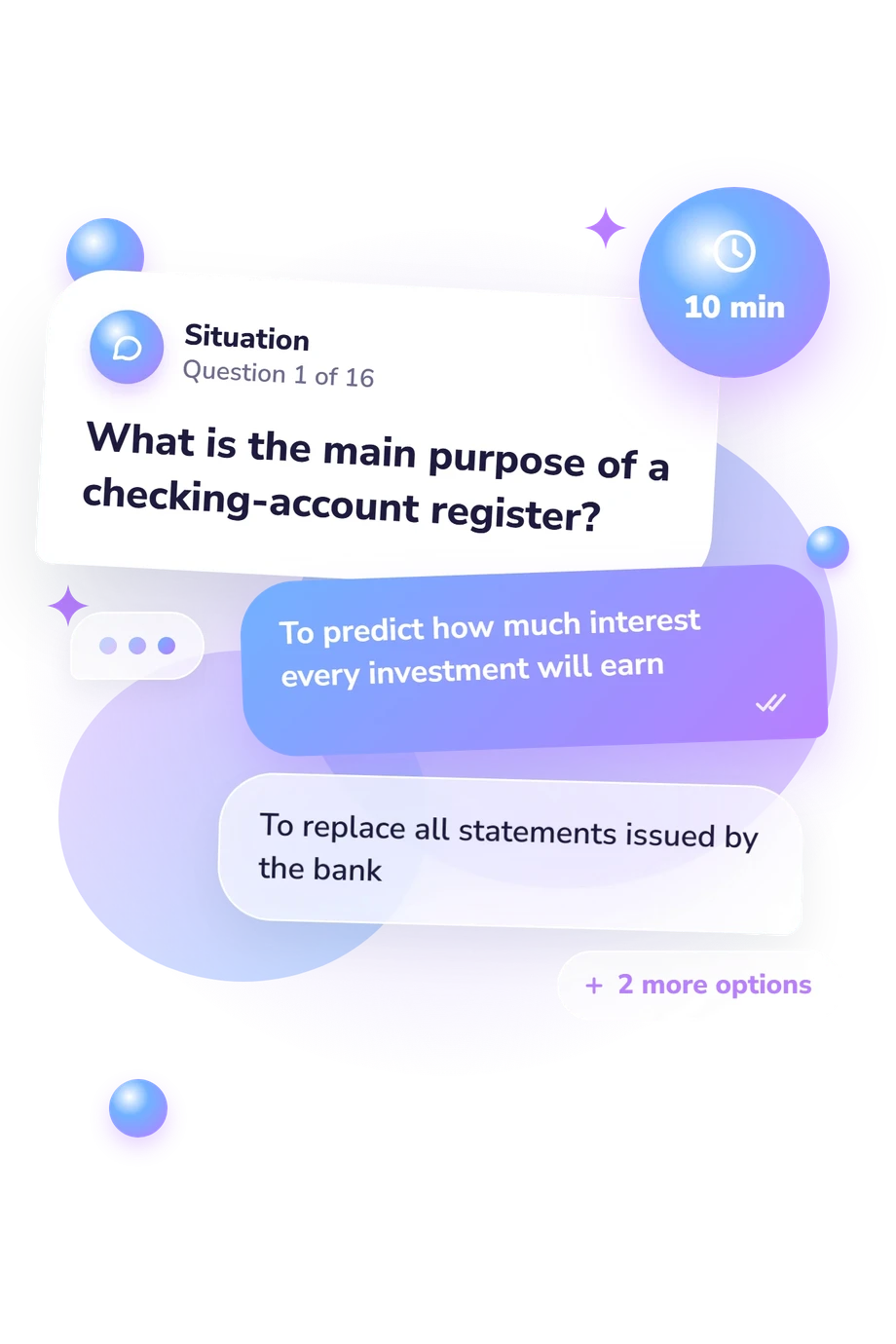
- To predict how much interest every investment will earn
- To replace all statements issued by the bank
- To track deposits, withdrawals, fees, and the running balance
- To record only checks that have already cleared
- A check the bank rejected and permanently canceled
- A check deposited into the account during the current month
- A written check that has not yet been deducted by the bank
- A check listed twice on a bank statement
- The payee decided not to deposit it
- The check was written correctly but remains outstanding
- The bank processed the check and deducted it from the account
- The check amount was added to the writer's account
Checking Account Quiz - Description and methodology of the test
People who want a clearer grasp of everyday checking-account activity can use this test as a focused learning check. The checking account quiz suits new account holders and anyone building practical confidence before relying on a register or statement. The result indicates your overall level of checking-account knowledge and suggests what account concepts may merit further review, helping readers decide what to review in routine account management.
What This Assessment Explores
Questions focus on how money enters, leaves, and moves through an account, including why a register, online activity, and statement can differ temporarily. The emphasis gives readers bank account reconciliation practice for everyday records.
The displayed scale is Checking Account Knowledge (0-16). Foundations to review (0-6) points to concepts needing review. Developing knowledge (7-12) reflects understanding with gaps around pending items or reconciliation; Strong knowledge (13-16) indicates a solid grasp of account activity, closing balances, and reconciliation. It is an educational score, and bank-specific policies may differ.
The question themes are:
- Register arithmetic shows how deposits, checks, purchases, withdrawals, and fees change a running balance.
- Transaction timing distinguishes pending, posted, outstanding, cleared, ACH, and direct-deposit activity.
- Reconciliation tasks test adjustments when statement and register figures do not match.
- Account terminology covers overdrafts, stop-payment requests, and other common checking-account terms.
Methodology and Scientific Basis
Each item presents a short account situation or definition with four answer choices. Respondents select a calculation, adjustment, transaction status, or term rather than rating feelings or reporting habits. The format therefore functions as a personal finance assessment of applied knowledge.
Results are presented as a single total and grouped into three result bands. The displayed result is an educational score; it summarizes performance on these items, covering balances, transaction timing, terminology, and reconciliation, rather than personal banking preferences or account suitability.
Conceptually, the content is consistent with Financial Fitness for Life (Walstad & Rebeck, 2005), which includes personal-finance knowledge assessment. Walstad, Rebeck, and MacDonald (2010) offer context for financial-knowledge assessment, not validation of this questionnaire. The 2021 national personal-finance standards organize related expectations for account management. These sources support the subject matter, not validation of this exact online questionnaire.
Performance can reflect prior instruction, vocabulary, arithmetic confidence, and familiarity with simplified scenarios. Posting times, fees, holds, and stop-payment rules vary by institution, so the result cannot determine which account or bank suits someone best.
- Walstad, William B., and Ken Rebeck. Financial Fitness for Life: High School Test Examiner's Manual (Grades 9-12). New York: National Council on Economic Education, 2005.
- Walstad, William B., Ken Rebeck, and Richard A. MacDonald. The Effects of Financial Education on the Financial Knowledge of High School Students. Journal of Consumer Affairs, vol. 44, no. 2, 2010, pp. 336-357. 10.1111/j.1745-6606.2010.01172.x
- Council for Economic Education and Jump$tart Coalition for Personal Financial Literacy. National Standards for Personal Financial Education. Council for Economic Education and Jump$tart Coalition for Personal Financial Literacy, 2021. ISBN 978-1-7348096-2-6
Updated: